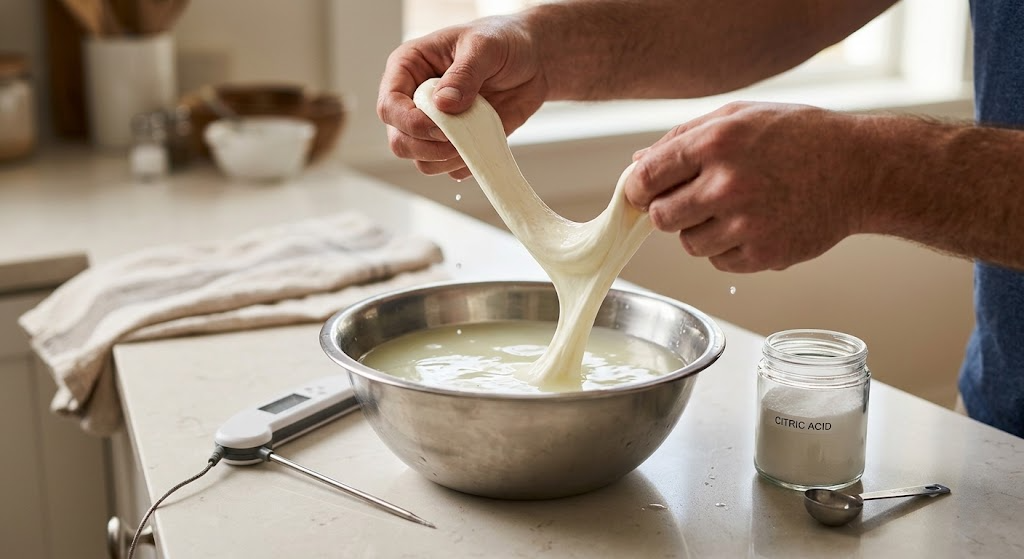
Fresh mozzarella is a forty-five minute project. That is the fact that surprises everyone: a gallon of milk, citric acid, a few drops of rennet, and less than an hour later you are stretching a warm, glossy ball of cheese that tastes better than anything in the supermarket case — because mozzarella’s whole personality is freshness, and yours is minutes old instead of weeks.
Some links in this post are affiliate links. If you buy through them we may earn a small commission at no extra cost to you — it never changes which products we recommend.
A beginner kit exists to solve the shopping problem, not the skill problem. The skill is easy; the ingredients are obscure. Rennet, citric acid, cheese salt and proper cultures are not in most supermarkets, and buying them separately in beginner quantities costs more than a kit that portions them for you. The good kits also include the thing beginners actually need most — instructions written by someone who has watched a first-timer overheat curds.
One ingredient warning before the list, because it ruins more first batches than everything else combined: ultra-pasteurised (UHT) milk does not make cheese. The high-heat treatment wrecks the proteins that form curds. Regular pasteurised milk is fine; the carton just must not say ultra-pasteurised. Check before you start, not after the rennet goes in.
Our Top 7 Picks for the Best Cheese Making Kit
Best Overall: The Big Cheese Mozzarella & Ricotta Making Kit

Mozzarella and ricotta are the correct first cheeses — fast, forgiving, and spectacular relative to effort — and this kit portions everything the pair needs: rennet, citric acid, cheese salt, cheesecloth, a thermometer-friendly method, and instructions that anticipate the classic beginner mistakes.
It makes many batches, not one; the consumables stretch across multiple gallons of milk, which makes the per-batch cost of homemade mozzarella almost embarrassing. The bonus nobody mentions: every batch leaves you whey, and a second-stage ricotta from that whey is the free encore.
Key Specifications
- Complete mozzarella and ricotta kit
- Rennet, citric acid, cheese salt and cloth included
- Supplies for multiple batches
- Beginner-focused instructions
Pros
- The right two cheeses to learn first
- Many batches per kit — low cost per cheese
- Anticipates beginner errors well
- 45-minute first success
Cons
- You supply the milk — and it must not be UHT
- Fresh cheeses only, no aged styles
- A thermometer helps and is not included
Best Variety: The Big Cheese Ultimate Kit — Makes 10 Cheeses

The upgrade question after mozzarella succeeds is always “what else?”, and this kit’s answer is ten fresh cheeses — mozzarella, ricotta, mascarpone, paneer, burrata-adjacent projects and more — from one box of supplies. The range matters pedagogically: paneer and mascarpone teach acid-set cheese, mozzarella teaches rennet and stretch, and together they cover the whole fresh-cheese toolbox.
For a curious cook, this is more instructive than buying three single-cheese kits, and it makes the definitive foodie gift.
Key Specifications
- Supplies and instructions for 10 fresh cheeses
- Covers acid-set and rennet-set styles
- Multiple batches of each
- Gift-ready presentation
Pros
- Widest range of any beginner kit
- Teaches every fresh-cheese technique
- Strong value across many batches
- Excellent gift
Cons
- Still fresh cheeses — aging needs more gear
- More components to organise
- UHT milk warning applies to everything
Best Vegan: The Big Vegan Cheese Making Kit — 6 Dairy-Free Cheeses

Vegan cheese is the category where homemade most embarrasses store-bought — commercial vegan cheeses are compromise products, while a fresh cashew mozzarella made this morning competes on its own terms. This kit covers six dairy-free styles built on nuts and plant milks, with the specialist setting agents portioned out.
If you already make your own plant milks — our nut milk bag guide is the companion piece — this is the natural next station on the same counter.
Key Specifications
- Six dairy-free cheese styles
- Plant-based setting agents included
- Works with nut and plant milks
- Multiple batches per kit
Pros
- Homemade vegan cheese beats store-bought decisively
- Covers stretchy, spreadable and firm styles
- Pairs with home plant-milk making
- Rare specialist ingredients pre-portioned
Cons
- Different technique family from dairy — expect a learning curve
- Nut costs add up per batch
- Textures are convincing, not identical
Best Classic Italian: Mozzarella & Ricotta Kit, Authentic Italian Style

A straightforward, well-established mozzarella-and-ricotta kit in the Italian tradition — the same core chemistry as our top pick, presented as a gift-friendly box with enough consumables for repeated batches.
Between near-identical kits, the tiebreakers are rennet form (liquid is easiest to measure precisely; tablets keep longer), whether cheese salt is included (table salt’s iodine can interfere with cultures), and instruction quality. This one covers all three competently.
Key Specifications
- Italian-style mozzarella and ricotta kit
- Multiple batches of supplies
- Gift-box presentation
- Includes salt and cloth
Pros
- Proven classic-format kit
- Good instruction quality
- Sensible gift for an Italian-food lover
- Repeat batches included
Cons
- Overlaps entirely with other mozzarella kits
- Fresh styles only
- Milk quality still decides the outcome
Best for Goat Cheese: Ricki’s Goat Cheese Kit

Ricki Carroll is the closest thing American home cheesemaking has to a founder — her New England Cheesemaking Supply company taught a generation — and this kit carries that pedigree into the easiest genuinely impressive cheese there is: fresh chèvre. Goat cheese sets overnight with almost no intervention; you drain it, salt it, roll it in herbs, and it looks like a farmers-market purchase.
If mozzarella’s hot-stretch step intimidates, chèvre is the gentler first cheese — harder to get wrong, and goat milk is increasingly easy to find in supermarkets.
Key Specifications
- Fresh chèvre kit from Ricki Carroll’s line
- Cultures and supplies for many batches
- Overnight set, minimal handling
- Works with store-bought goat milk
Pros
- Nearly foolproof first cheese
- The most credible pedigree in home cheesemaking
- Herb-rolled results look professional
- Many batches per kit
Cons
- Goat milk costs more than cow
- One style of cheese
- Overnight wait rather than same-day
Best Molds Upgrade: Easy Cheesemaking Set — 5 Italian Molds Plus Book

Once the chemistry works, presentation becomes the frontier, and molds are how a blob of fresh cheese becomes a disciplined little basket-ridged round. This Italian-made set of five molds with an included recipe book covers ricotta baskets, soft rounds and small forms — the shapes that make homemade cheese giftable.
Molds are also functional: proper drainage through the basket walls firms fresh cheese evenly, which changes texture, not just looks.
Key Specifications
- Five Italian-made cheese molds
- Included cheesemaking recipe book
- Basket and round formats
- Food-safe, reusable
Pros
- Turns fresh cheese into presentable rounds
- Drainage improves texture, not just shape
- Made-in-Italy quality
- Book adds recipes beyond the basics
Cons
- No ingredients — this is the hardware half
- Beginners need a starter kit alongside
- Hand wash to preserve the baskets
Best Beginner Mold Bundle: PetriStor 16-Piece Soft Cheese Making Kit

The volume answer to the same need: sixteen pieces of small soft-cheese molds at a budget price, for the cook who wants to drain and shape many small cheeses at once — a tray of individual chèvre rounds, ricotta baskets for gifts, paneer pressed neat.
What surprised me was how much the temperature matters and how little the clock does. I was fixated on timings and casual with the thermometer, and my first batch simply never came together — the curd stayed soft and grainy and I blamed the rennet. It was the heat. I had let the milk go past 40°C before adding it, and above that it does not set properly.
Watching the thermometer instead of the clock, the second attempt gave a clean curd in about ten minutes. The stretch is the enjoyable part and also the part people overdo: work it too long and you squeeze the moisture out and end up with something rubbery. Stop while it is still glossy and only just holding together.
Key Specifications
- 16-piece soft cheese mold set
- Small-format molds for individual cheeses
- Budget-friendly bundle
- Reusable food-safe plastic
Pros
- Many small cheeses draining at once
- Lowest cost per mold here
- Right scale for gifting rounds
- Simple to clean
Cons
- Plastic rather than Italian basketware
- Molds only — no ingredients
- Small formats only
The Ultimate Buying Guide for Cheese Making Kits
The Milk Rule That Decides Everything
Cheese is milk protein persuaded to set, and ultra-pasteurised milk has had that persuadability cooked out of it. UHT processing (often labelled “ultra-pasteurized”, common in organic and shelf-stable milk) denatures the proteins so rennet produces mush instead of curd. What works: ordinary pasteurised milk from the supermarket, low-temperature-pasteurised or cream-line milk where available. Whole milk, always — fat is flavour and texture. This single carton-label check prevents the most common first-batch failure in home cheesemaking.
What Is Actually in a Kit
- Rennet — the setting enzyme, liquid or tablet; vegetarian versions are standard in most kits
- Citric acid — the fast-acidification shortcut that makes 45-minute mozzarella possible
- Cultures (in some kits) — live bacteria for flavour development in chèvre and beyond
- Cheese salt — non-iodised; the iodine in table salt can hamper cultures
- Cheesecloth and sometimes molds — the draining hardware
A thermometer is the tool kits assume you own; curd temperatures matter within a few degrees, and guessing is how curds get squeaky. Our kitchen thermometer guide covers the options.
Fresh vs Aged: Where Kits Stop
Every kit above makes fresh cheese — mozzarella, ricotta, chèvre, paneer, mascarpone — eaten within days. That is the right ambition: same-day results, minimal gear, huge quality gap over store-bought. Aged cheeses (cheddar, gouda, brie) are a different hobby — presses, wax, months of temperature-and-humidity-controlled patience. Master fresh first; the aged path will still be there.
The Whey Bonus
Every batch leaves a pot of whey, and throwing it away is a rookie tax. Whey ricotta is the classic second act; beyond that, whey substitutes for water in bread dough magnificently, feeds smoothies, cooks rice and oats, and even waters tomato plants. One gallon of milk really becomes cheese and a useful litre or three of by-product.
Scaling Past the Kit
Kits are training wheels with an expiry date — eventually you will want rennet and cultures in bulk, which cost far less bought straight. The kit’s real product is the calibrated first experience: correct portions, correct sequence, written by someone who knows where beginners stall. Once you have stretched three successful batches, you are shopping ingredient catalogues like the rest of us.
Frequently Asked Questions About Cheese Making
Why did my mozzarella turn out rubbery?
Overworked or overheated, almost always. Stretching mozzarella too long or in water that is too hot squeezes out the fat and moisture that make it tender — stretch just until smooth and glossy, then stop. Squeaky, tough curd can also mean the milk was borderline UHT. Gentler heat, shorter stretch, better milk.
Why didn’t my milk form a curd?
In order of likelihood: ultra-pasteurised milk (the big one), rennet that is old or was dissolved in chlorinated water (chlorine kills it — use filtered water), wrong temperature, or acid out of proportion. Fix the milk first; it is the culprit in most no-curd stories.
Is homemade cheese cheaper than buying it?
For fresh mozzarella and ricotta, meaningfully: a gallon of ordinary milk yields about a pound of mozzarella plus whey ricotta, which beats deli-counter fresh mozzarella handily — and the freshness gap is bigger than the price gap. Chèvre lands near parity depending on goat milk prices. Nobody home-makes cheap sandwich slices competitively, but that was never the point.
How long does homemade fresh cheese keep?
Mozzarella is at its absolute best the day it is made and holds several days refrigerated, in its whey or lightly wrapped. Ricotta and chèvre keep about a week. There are no preservatives in any of it, which is the charm and the deadline in one.
Do I need raw milk to make good cheese?
No. Ordinary (non-UHT) pasteurised whole milk makes excellent fresh cheese, and every kit above assumes it. Raw milk carries genuine pathogen risks, is illegal to sell in some places, and is a choice experienced cheesemakers make with full information — not a beginner requirement.
Can I use the leftover whey?
Enthusiastically. Heat it promptly for whey ricotta, then use the rest in bread (swap it for the water), pancakes, smoothies, rice, soup stock, or the garden. Fresh whey keeps a few days in the fridge.
Final Thoughts
Start with the Big Cheese mozzarella and ricotta kit and a gallon of honestly-pasteurised whole milk — forty-five minutes later you will understand why people get evangelical about this. The Ultimate ten-cheese kit is the gift version and the curriculum version; Ricki’s chèvre is the gentlest on-ramp; and molds are the upgrade that makes your cheese look like it costs what it tastes like.
Check the carton, warm the milk gently, keep the whey. Serve the result with tomatoes from the garden and bread from the Dutch oven, and dinner is entirely homemade.
As an Amazon Associate we earn from qualifying purchases. Availability is accurate as of the date of publishing. We do not list prices because they change too often to quote honestly.

Rimi Sultana is a home cook from Bangladesh who has cooked for her family every day for the past five years and writes about it at Smart Cooks. Perpetually testing whether internet-famous recipes actually work in a regular home kitchen. Say hello on Facebook or through the contact page.