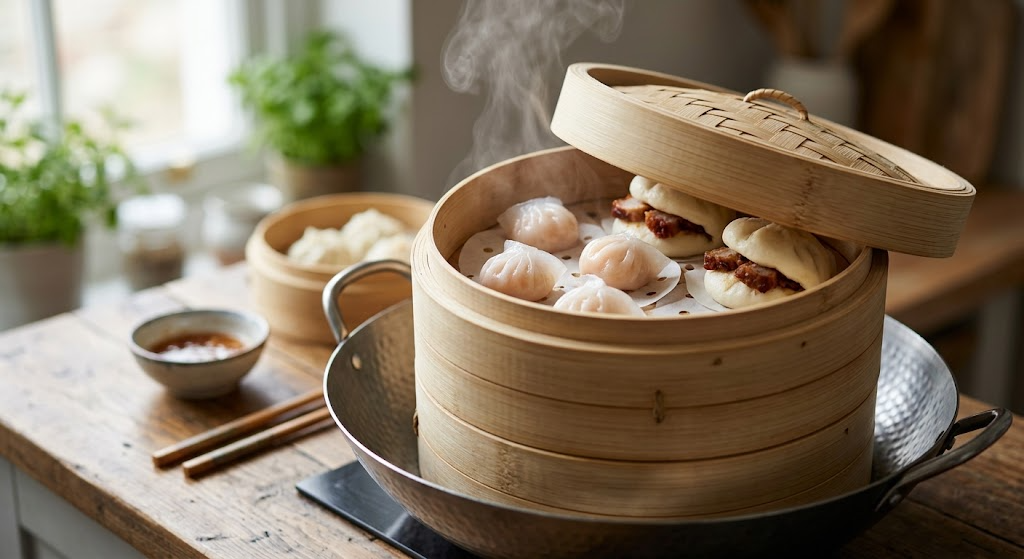
A metal steamer and a bamboo steamer do the same job with one crucial difference: the lid. Metal lids collect condensation and rain it back down onto your dumplings, turning wrappers soggy and bao tops dimpled. A woven bamboo lid absorbs and breathes the steam away, so everything under it comes out plump and dry-surfaced. That is the entire secret, and it is why a tool this cheap has never been improved on for this job.
Some links in this post are affiliate links. If you buy through them we may earn a small commission at no extra cost to you — it never changes which products we recommend.
The stacking is the other half of the argument. Two tiers over one wok of boiling water means dumplings and vegetables cooking simultaneously, then the tiers go straight to the table as serving dishes — dim sum restaurants are not being quaint, they are being efficient.
What separates a good bamboo steamer from a disappointing one is construction: how the rings are bound, how flat the slats sit, and whether it fits your actual cookware. Below are seven worth buying, and the sizing rule that stops the classic mistake. If yours will sit in a wok, our carbon steel wok guide is the natural companion.
Our Top 7 Picks for the Best Bamboo Steamer
Best Overall: Joyce Chen 2-Tier 10-Inch Bamboo Steamer

Joyce Chen is the name that introduced half of America to wok cooking, and this 10-inch two-tier steamer is the category benchmark: tightly woven lid, properly bound rings that stay round through years of steam cycles, and slats set flat and level so dumplings do not lean into each other.
Ten inches is the correct default size — big enough for a real batch across two tiers, small enough to sit securely in a standard 14-inch wok. It is the steamer to buy when you want to buy this exactly once.
Key Specifications
- 10-inch diameter, two tiers plus lid
- Traditional woven bamboo lid
- Bound-ring construction
- Fits a standard 14-inch wok
Pros
- Benchmark build quality in the category
- Correct default size for home woks
- Lid weave manages condensation properly
- Decades-proven brand
Cons
- Costs more than commodity steamers
- Needs a wok or ring to sit over a pot
- Bamboo requires drying after use like any wood
Best Deep Tiers: HAPPI STUDIO 10-Inch Bamboo Steamer Set

The HAPPI STUDIO’s pitch is depth: taller tiers that clear fat bao buns and whole fish plates, which standard tiers scrape. If your steaming ambitions run past dumplings — buns that rise, a plate of fish with aromatics, sticky rice in lotus leaf — the extra headroom is the difference between a lid that seats and a lid that squashes.
It ships as a set with liners and usually chopsticks, aimed at the cook building a steaming habit from scratch.
Key Specifications
- 10-inch set with extra-deep tiers
- Includes reusable liners
- Clears tall bao and plated dishes
- Set format with accessories
Pros
- Headroom for buns and whole-plate steaming
- Liners included from day one
- Good starter bundle
- Solid weave quality
Cons
- Taller stack needs more lid clearance under a hood
- Set extras vary by batch
- Slightly bulkier storage
Best With Steel Rim: KITCHENCRUST 2-Tier 10-Inch Reinforced Steamer

The way bamboo steamers eventually die is at the rim — rings loosen, bindings fray, tiers ovalise. This design wraps the rims in stainless steel bands, which is a genuine engineering fix rather than a gimmick: the bamboo still breathes and absorbs steam through the lid and slats, while the steel holds the geometry forever.
The trade is aesthetic — it looks less like Sunday dim sum and more like equipment — and the steel rim gets hotter to the touch than bare bamboo.
Key Specifications
- Stainless-banded bamboo rims
- Two 10-inch tiers plus lid
- Traditional bamboo lid and slats
- Reinforced for heavy rotation
Pros
- Rim reinforcement fixes how steamers die
- Keeps bamboo’s condensation advantage
- Stays round under heavy use
- Good for daily-steaming households
Cons
- Steel rim runs hot — use towels
- Less traditional look on the table
- A little heavier
Best With Pot Adapter: 10-Inch Steamer with Handle and Ring Adapter

The honest obstacle to bamboo steaming in many kitchens is not owning a wok. This set solves it with a stainless ring adapter that seats the steamer securely over an ordinary saucepan or stockpot — the adapter bridges the gap between pot rim and basket base so steam feeds in without the basket ever touching the water.
Add the side handle for lifting hot tiers and this is the no-wok kitchen’s bamboo steamer, full stop.
Key Specifications
- 10-inch two-tier bamboo steamer
- Stainless ring adapter for pots
- Side handle for hot lifting
- Liners included
Pros
- Works over ordinary saucepans — no wok needed
- Adapter prevents scorched basket bottoms
- Handle spares your knuckles
- Complete kit for non-wok kitchens
Cons
- Adapter is one more thing to store
- Fit depends on your pot diameter — measure
- Handle adds width in the cupboard
Best Value: Classic 10-Inch 2-Tier Bamboo Steamer with Liners

The straightforward commodity version of the classic design: two 10-inch tiers, woven lid, liners in the box, at the price that makes trying bamboo steaming a no-stakes decision. The weave is a touch coarser than Joyce Chen’s and the bindings simpler — differences you notice in year three, not week one.
If steamed dumplings are an experiment rather than a lifestyle yet, start here; the upgrade path will announce itself.
Key Specifications
- Two 10-inch tiers with lid
- Reusable liners included
- Standard woven bamboo build
- Entry price point
Pros
- Cheapest sensible entry to the category
- Liners included
- Standard size fits woks and adapters
- Does the actual job identically at first
Cons
- Coarser weave and simpler bindings
- Shorter working life under heavy use
- Quality varies between units
Best for Bao: Deep 2-Tier 10-Inch Dumpling and Bao Steamer

Bao are the stress test of a steamer: they double in size as they cook, they touch nothing or they scar, and they demand steady generous steam. This deep-tier design is built around them, with the height and flat slats that let a batch of buns rise untouched.
It earns its keep on everything else oversized too — tamale-style parcels, halved winter squash, a whole trout on a plate with ginger and scallions.
Key Specifications
- Deep tiers sized for rising buns
- 10-inch two-tier format
- Flat, even slat floors
- Woven bamboo lid
Pros
- Buns rise without touching the lid
- Handles plated and oversized items
- Even steam across the floor
- Classic construction
Cons
- Deep tiers steal cupboard height
- Small dumplings rattle around in it
- Needs a big pot of water beneath for long steams
Best Two-Pack Set: HAPPI STUDIO Steamer Set with Accessories

The full-accessories version of the HAPPI STUDIO steamer — tiers, lid, a generous liner supply and serving extras — assembled for the cook who intends to put dim sum on the table this weekend, not eventually.
I tested this with the most unforgiving thing I could think of — plain steamed rice cakes, nothing on top to hide behind. In the metal pan under a metal lid the tops came out pitted and wet, because every drop of condensation that forms on that lid falls straight back down onto the food. The same batter in the bamboo basket came out matte and dry to the touch. The difference is not subtle and it is not marketing; you can see it across the tray.
One thing to know before your first use: soak a new basket for twenty minutes and line it with cabbage leaves or perforated paper. I skipped that and lost a whole tray of dumplings welded to the slats.
Key Specifications
- Steamer tiers with full accessory bundle
- Multiple liners included
- Serving-ready presentation
- 10-inch standard diameter
Pros
- Most complete box of the group
- Liner supply lasts months
- Goes stove-to-table well
- Good gift format
Cons
- Paying for extras you may duplicate
- Bundle contents shift between listings
- Same care rules as all bamboo
The Ultimate Buying Guide for Bamboo Steamers
Why Bamboo Beats Metal at This One Job
Steam rises, hits the lid, condenses. On metal, that condensate has nowhere to go but back down — onto wrappers that turn gluey and bao that come out pockmarked. Bamboo’s woven lid absorbs moisture and lets excess steam breathe through, so the atmosphere inside stays saturated but nothing drips. Add that bamboo tiers barely conduct heat (so you can lift them barehanded at the rim) and stack infinitely over one heat source, and the five-hundred-year-old design turns out to be simply correct.
Size: Measure Your Wok Before You Order
- 10 inches is the home default — sits properly in a 14-inch wok, feeds a family across two tiers
- 8 inches suits small households and small woks; single-serving dim sum scale
- 12 inches is party scale, and needs a big wok or wide pot to sit safely
The rule: the steamer must rest on the wok’s sloping sides above the waterline, never floating or wedged at the bottom. In a wok, that means the steamer diameter should be a few inches less than the wok’s. No wok? Buy a set with a ring adapter, or bridge a pot with the steamer resting fully on the rim.
What to Look For in the Weave
- Bound rings (bamboo strips or metal banding) rather than glue and staples alone — steam dissolves shortcuts
- Flat, level slat floors so dumplings stand straight and steam reaches underneath
- A tight lid weave — the lid is the whole condensation mechanism; gappy weaves leak the advantage
- Smooth interior finish with no splinters or machine-oil smell out of the box
Liners: Always Something Under the Food
Bare slats grab dumpling skins and tear them at the worst moment. Line each tier with perforated parchment, a reusable silicone mat, cabbage or lettuce leaves (the traditional and delicious option), or oiled paper — anything porous enough for steam, slick enough for release. Cloth liners work for buns and sticky rice. This one habit prevents nearly all bamboo-steamer heartbreak.
Care: The Five Rules
- Rinse, do not soak. Hot water and a soft brush immediately after use; soaking swells and warps the weave.
- Skip the soap except for real grease — bamboo absorbs flavours, including detergent’s.
- Air-dry completely, tiers separated, before stacking away — trapped damp is how mildew starts.
- Never the dishwasher. It is a wooden basket; the dishwasher is a wood chipper with extra steps.
- A pale steam-darkened patina is normal and means the steamer is being used correctly.
The First-Use Ritual
New steamers can smell faintly of raw bamboo. Steam it empty over plain water for twenty minutes — some cooks add a splash of rice vinegar to the water — and the smell leaves with the first steam. This also seasons the weave and shows you how your particular lid vents before food is at stake.
Frequently Asked Questions About Bamboo Steamers
Can I use a bamboo steamer without a wok?
Yes, three ways: a ring adapter that seats it over a saucepan, resting it fully across the rim of a pot of matching diameter, or standing it in a deep skillet with an inch of water — provided the water stays below the slats. The requirement is only ever steady steam from below and no direct flame licking the bamboo.
Why do my dumplings stick to the steamer?
Bare slats. Always line the tier — perforated parchment, a silicone mat, or cabbage leaves — and give wrappers a light touch of oil for insurance. A stuck dumpling is a liner problem, not a steamer problem.
How long do things take in a bamboo steamer?
Over properly boiling water: fresh dumplings about 8 to 10 minutes, frozen 12 to 15, filled bao 10 to 12, vegetables 5 to 10 depending on cut, fish fillets about 8 to 10. Resist lifting the lid to peek — every peek costs steam and minutes.
Is mold on a bamboo steamer dangerous?
A mildewed steamer should be retired — mould roots into bamboo’s pores beyond what surface scrubbing reaches. Prevention is the actual answer: rinse promptly, dry completely and separately, store with airflow. A steamer that goes away bone-dry does not mildew.
Can bamboo steamers go stove-to-table?
That is half their charm. The tiers barely hold heat at the rim, look right on a table, and keep food warm under the breathing lid without sogging it. Put a plate underneath and serve straight from the basket like every dim sum house on earth.
Metal steamer inserts are cheaper — am I missing much?
For vegetables, no. For anything wrapped in dough — dumplings, bao, rice rolls — yes: the metal lid’s condensation drip is precisely what ruins wrappers, and it is the thing bamboo exists to prevent. Buy for what you actually steam.
Final Thoughts
The Joyce Chen 10-inch is the buy-once answer and the correct default. No wok? The ring-adapter set removes the excuse. Steaming daily? The steel-rimmed KITCHENCRUST fixes the way bamboo steamers die. And if bao are the dream, buy deep tiers from the start.
Line the slats, keep the water below them, dry it like you mean it — and put the tiers on the table. Pair it with the carbon steel wok underneath and you have the two-piece foundation of a whole cuisine.
As an Amazon Associate we earn from qualifying purchases. Availability is accurate as of the date of publishing. We do not list prices because they change too often to quote honestly.

Rimi Sultana is a home cook from Bangladesh who has cooked for her family every day for the past five years and writes about it at Smart Cooks. Perpetually testing whether internet-famous recipes actually work in a regular home kitchen. Say hello on Facebook or through the contact page.