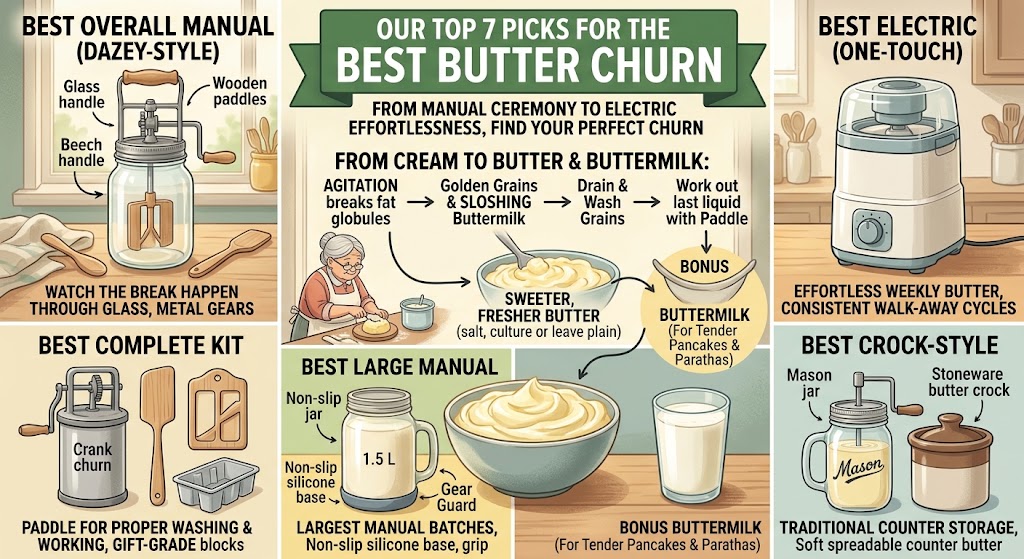
Butter is cream that has been agitated past whipped and out the other side — the fat globules crash together, clump, and abruptly divorce the buttermilk. That is the entire process, it takes ten to fifteen minutes by hand crank, and the result is unlike supermarket butter in ways that surprise people: sweeter (it is fresher by weeks), yours to salt or culture or leave alone, and it arrives with a bonus — real buttermilk, the tangy-adjacent liquid that makes the tenderest parathas and pancakes of your life.
Some links in this post are affiliate links. If you buy through them we may earn a small commission at no extra cost to you — it never changes which products we recommend.
A churn is a jar with a geared paddle, and the buying questions are correspondingly honest: hand-crank or electric (crank is charming and ten minutes of arm; electric is a button), jar size against your actual cream supply, and gear quality — because the moment cream thickens toward butter, cheap plastic gears meet their moment of truth.
Worth saying at the top: the churn is optional equipment for a non-optional pleasure. A stand mixer or even a shaken mason jar makes butter too. The churn’s case is control, capacity and ceremony — and the ceremony is genuinely half of it, as anyone whose grandmother made makhon will recognise. Seven worth buying below.
Our Top 7 Picks for the Best Butter Churn
Best Overall Manual: Dazey-Style Hand-Crank Churn with Beech Handle

The Dazey pattern is the classic American kitchen churn — a glass jar, a geared crank in the lid, wooden paddles below — and this modern version keeps the pattern honest: beechwood handle, metal gearing, and a jar sized for a quart of cream, which becomes roughly a pound of butter plus its buttermilk.
Glass is the right vessel because you can watch the stages — whipped, grainy, broken — and stop exactly when the butter gathers. Ten to fifteen minutes of moderate cranking, a cold-water wash, and breakfast changes.
Key Specifications
- Glass jar with geared hand crank
- Beechwood handle, wooden paddles
- ~1 quart cream capacity
- Classic Dazey pattern
Pros
- Watch the break happen through glass
- Metal gears take real cream loads
- The heritage experience, working
- About a pound of butter per churn
Cons
- Ten-plus minutes of honest cranking
- Hand wash the wood and gears
- Glass jar demands respect
Best Electric: One-Touch Electric Butter Churn, 34 oz

The button version: pour in cream, press once, and the motor does the ten arm-minutes in five to fifteen machine-minutes while you warm the toast. At 34 ounces it handles a full quart of cream, and the one-touch cycle means butter becomes a weekly staple instead of a weekend event.
Electric churns are the right answer for anyone making cultured butter regularly — ferment the cream a day first, then let the machine do the churning it does not care is tangier.
Key Specifications
- One-touch electric churning
- 34 oz capacity
- 5 to 15 minute cycles
- Motorised paddle drive
Pros
- Effortless weekly butter
- Handles cultured cream identically
- Full-quart batches
- Consistent, walk-away cycles
Cons
- A motor to store and eventually replace
- Less romance, same butter
- Needs an outlet, unlike a crank
Best 2-in-1: Electric Butter Maker & Food Processor

The counter-space argument: a machine that churns butter and moonlights as a small food processor, for kitchens that cannot justify a single-purpose appliance. The butter cycle is the same motorised agitation; the processor bowl earns the shelf between churns.
Compound butters are where this shines — churn, then blitz in garlic and herbs or honey in the same vessel.
Key Specifications
- 2-in-1 churn and processor
- Electric drive
- Compound-butter friendly
- Multi-use bowl
Pros
- One appliance, two jobs
- Compound butters in one vessel
- Space-efficient
- Good gift versatility
Cons
- Master of neither job alone
- More parts than a simple churn
Best Large Manual: 1.5 L Churner with Silicone Base and Guard
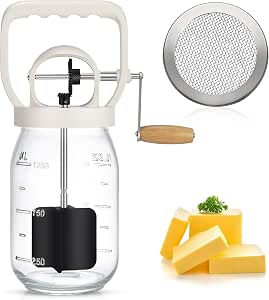
The bigger-batch crank: 1.5 litres of jar means half again more cream per churn, with a silicone base that grips the counter — the underrated feature, since churning is a two-handed job and a walking jar is the classic frustration — and a guard over the gears.
For households where fresh butter disappears as fast as it is made, the extra capacity is the difference between churning weekly and churning constantly.
Key Specifications
- 1.5 L glass jar
- Non-slip silicone base
- Gear guard
- Hand-crank drive
Pros
- Largest manual batches here
- Base grip solves the walking jar
- Guarded gears around children
- Solid crank feel
Cons
- More cream per batch to source
- Bigger jar to wash and store
Best Complete Kit: Hand-Crank Churn with Paddle and Molds

The gift-grade kit: crank churn plus the finishing tools most listings forget — a wooden butter paddle for working out the last buttermilk (the step that decides shelf life) and molds that press the finished butter into presentable blocks.
Washing and working the butter matters more than beginners expect: residual buttermilk is what turns butter sour in a week. The paddle is not decoration; it is preservation.
Key Specifications
- Crank churn with paddle and molds
- Retro kit presentation
- Glass jar
- Finishing tools included
Pros
- Paddle enables proper washing and working
- Molds make giftable blocks
- Complete cream-to-block workflow
- Strong gift format
Cons
- More wooden pieces to dry and keep
- Kit quality varies piece to piece
Best Crock Style: Mason Jar Crank Churn with Stoneware Crock

The farmhouse-aesthetic build: mason-jar churning up top, a stoneware crock in the kit for storing the finished butter the traditional way. Butter crocks are not just pretty — a water-sealed butter bell keeps soft, spreadable butter fresh on the counter for a week-plus without refrigerator carpentry.
For the kitchen that has followed our fermentation crocks and clay pots this far, the material language will feel like home.
Key Specifications
- Mason jar churn with crank
- Stoneware storage crock included
- Counter-storage workflow
- Farmhouse kit
Pros
- Churn and traditional storage in one
- Soft spreadable counter butter
- Handsome on a shelf
- Mason parts are replaceable everywhere
Cons
- Crock adds cost over bare churns
- Two vessels to wash
Best Budget: 32 oz Glass Jar Hand Churner

The lowest-cost real churn: 32-ounce glass jar, geared crank, ten-minute butter. It is the try-the-hobby purchase — and because the hobby is ten minutes and one ingredient, most people know by the second batch whether the churn earns permanence.
Growing up, butter wasn’t something we just bought from a store; it was the weekly reward of patiently saving the thick malai (cream) from our daily boiled cow’s milk until we had enough to churn into fresh, pale makhon that would melt instantly over warm, puffed ruti.
Key Specifications
- 32 oz glass jar
- Geared hand crank
- ~10 minute churn time
- Entry price
Pros
- Cheapest real churn
- Pound-scale batches
- Simple, watchable process
- Low-stakes trial of the hobby
Cons
- Lighter gearing than premium cranks
- No finishing tools included
The Ultimate Buying Guide for Butter Churns
How Cream Becomes Butter (In One Paragraph)
Agitation whips air into cream, then keeps going: the membrane around each fat globule wears through, bare fat clumps to bare fat, and somewhere around minute ten the whipped mass suddenly “breaks” — solid golden grains in sloshing buttermilk. Drain, wash the grains in cold water until it runs clear, work the last buttermilk out with a paddle, salt if you like. The washing is the step that decides whether your butter lasts two days or two weeks.
Crank vs Electric vs Improvised
- Hand-crank churns: ten to fifteen minutes of moderate effort, full visual control, no outlet, maximum ceremony. The right first churn.
- Electric churns: five to fifteen unattended minutes; the answer for weekly and cultured-butter habits.
- Improvised: a stand mixer with a splash guard makes excellent butter (it will splatter at the break), and a half-filled shaken mason jar is the children’s-science version. The churn’s case is batch size, gearing built for the job, and the crock-and-paddle tradition around it.
Cream Decides Everything
Heavy cream, the higher-fat the better, and not ultra-pasteurised if you can find it — UHT cream churns reluctantly and yields less, the same processing problem our cheese kit guide fights. Let cream ripen at cool room temperature for a few hours first (about 60°F is the classic churning temperature); too cold and the break takes forever, too warm and the butter arrives greasy. For cultured butter — the tangy European style — stir a spoonful of live yogurt (see our homemade yogurt recipe) or cultured buttermilk into the cream and let it ferment a day before churning; the churn neither knows nor cares.
The Buttermilk Is Not a Byproduct
What drains off is true buttermilk — thinner and subtler than the cultured supermarket kind, and the traditional liquid for the tenderest pancakes, parathas, biscuits and soda breads. A pound of butter yields roughly two cups. Plan a batter for churn day; it is half the harvest.
Frequently Asked Questions About Butter Churns
How much butter does a quart of cream make?
Roughly a pound of butter and about two cups of buttermilk, varying with the cream’s fat content. The arithmetic rarely beats supermarket butter on price alone — freshness, control and buttermilk are the actual dividends.
Why is my cream stuck at whipped and never breaking?
Almost always temperature or processing: cream straight from the fridge churns glacially (let it stand toward 60°F), and ultra-pasteurised cream resists breaking on principle. Keep cranking — the whipped stage always feels eternal at minute eight — and the break, when it comes, comes in seconds.
How long does homemade butter keep?
Well-washed and worked: a couple of weeks refrigerated, months frozen (butter freezes perfectly). Poorly washed: days, then sour. Salt extends life and a water-sealed butter crock keeps counter butter spreadable and fresh for a week-plus. When in doubt, wash one more round than feels necessary.
Can I make butter from store-bought cream?
Yes — ordinary pasteurised heavy cream is exactly what most home churns run on. Seek out non-UHT cartons for easier churning and better yield, and local or high-fat cream when the point is tasting the difference.
What is cultured butter, and can a churn make it?
Butter churned from fermented cream — ripened overnight with live cultures — giving the complex, faintly cheesy tang of good European butter. Any churn makes it; only the cream preparation changes. It is the single easiest upgrade in home dairying, and the buttermilk it leaves behind is even better.
Final Thoughts
The Dazey-style crank is the right first churn — watchable, geared properly, a pound at a time. Weekly-butter households should let the electric one-touch earn the plug, and the kit with paddle and molds is the version that gifts best and preserves best, because the paddle is what makes butter keep.
Ripen the cream, crank past the eternal whipped stage, wash like you mean it — and make pancakes with the evidence. Ten minutes, one ingredient, two harvests.
As an Amazon Associate we earn from qualifying purchases. Availability is accurate as of the date of publishing. We do not list prices because they change too often to quote honestly.

Rimi Sultana is a home cook from Bangladesh who has cooked for her family every day for the past five years and writes about it at Smart Cooks. Perpetually testing whether internet-famous recipes actually work in a regular home kitchen. Say hello on Facebook or through the contact page.