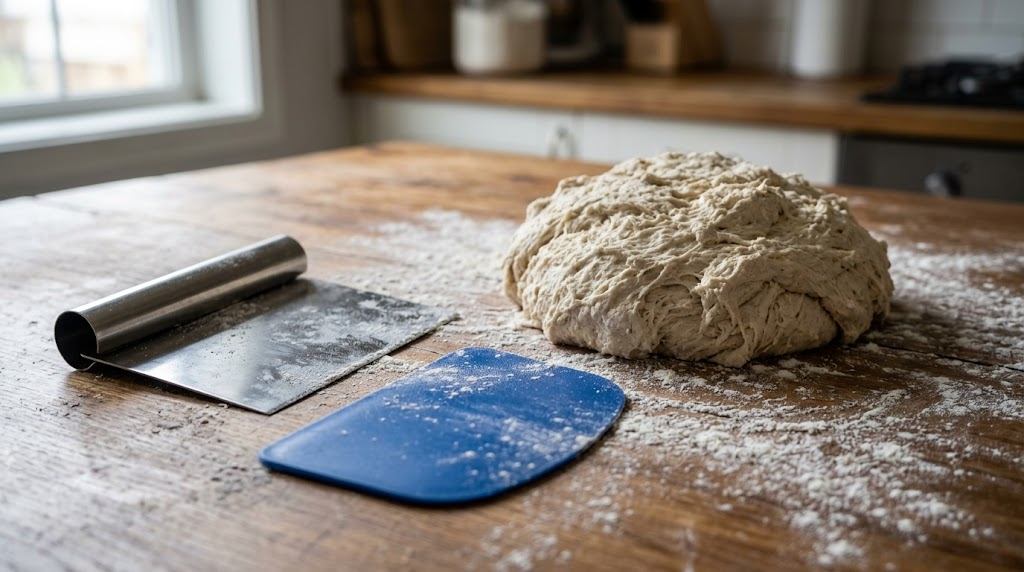
Bench scraper and dough cutter are often used interchangeably online, which causes confusion when you’re actually shopping, because the tools sold under each name aren’t always identical. Here’s what actually distinguishes them and which one solves which problem.
Some links in this post are affiliate links. If you buy through them we may earn a small commission at no extra cost to you — it never changes which products we recommend.
What Actually Matters
Rigid Metal vs Flexible Plastic
A classic bench scraper is a flat, rigid rectangle of metal with a straight edge, used for cutting dough portions, scraping sticky dough off a work surface, and transferring chopped ingredients. Flexible plastic ‘dough cutters’ or bowl scrapers bend to follow the curve of a mixing bowl, which a rigid metal scraper can’t do.
Edge Sharpness for Dividing Dough
For actually cutting bread or pizza dough into even portions, a scraper with a genuinely sharp, straight edge matters — a dull or slightly curved edge tears dough instead of cutting it cleanly, which can affect gluten structure at the cut.
Measurement Markings
Some metal bench scrapers have measurement markings along the top edge, which is a small but genuinely useful feature for dividing dough into equal weights or sizes without pulling out a scale every time.
From My Kitchen
I only owned a flexible plastic bowl scraper for a long time and assumed it was doing the job of a bench scraper too — it wasn’t. The first time I tried dividing sourdough into loaf portions with it, the flexible edge just squished and dragged instead of making a clean cut, and switching to a rigid metal scraper fixed that immediately.
Worth Considering
For actual dough dividing and clean surface scraping, the OXO Good Grips Multi-Purpose Scraper & Chopper is a sturdy rigid option that also doubles for chopped vegetables. For bowl-scraping and folding batters, the BOORIKA Dough Scraper & Bench Scraper set gives you both a rigid and flexible option together.
The Real Split Is Rigid Metal Versus Flexible Plastic
The names are used interchangeably and confusingly — bench scraper, dough cutter, bench knife, chopper — and most of the time they refer to the same thing. The distinction that actually matters when you are buying one is material. A rigid metal blade with a handle cuts dough, divides portions, scrapes a work surface clean and transfers chopped vegetables to a pan. A flexible plastic scraper, usually curved on one edge, does something different: it follows the inside curve of a bowl to get every bit of wet dough out, and folds high-hydration dough without tearing it.
Put another way, the metal one is for the counter and the plastic one is for the bowl. Bakers working with slack, sticky doughs end up owning both and reaching for them at different moments. Someone who mostly makes biscuits, pastry and cookie dough needs the metal one and will rarely miss the other.
Quick Comparison
| Metal bench scraper | Plastic bowl scraper | |
|---|---|---|
| Cutting dough into portions | Excellent, clean single cut | Poor, tears rather than cuts |
| Clearing a floured counter | Excellent | Adequate |
| Getting dough out of a bowl | Awkward, rigid edge | Excellent, follows the curve |
| Folding wet dough | Too stiff | Excellent |
| Moving chopped vegetables | Excellent, wide flat blade | Poor |
| Marked measurements | Often included on the blade | No |
The Uses Nobody Mentions When You Buy One
A metal bench scraper stops being a baking tool within about a week of owning one. It is the fastest way to move a board of chopped onion into a pan without shedding half of it, it cuts butter into flour when you have no pastry blender, it squares off the edges of focaccia or brownies in the tin, it portions dough into even pieces using the ruler stamped on the blade, and it lifts and turns sticky dough without adding more flour. The counter-cleaning job it is named for is genuinely the least of it.
The ruler markings are worth looking for specifically. Dividing dough into even portions by eye is surprisingly hard, and uneven portions bake unevenly — the small roll is dry by the time the large one is cooked. A blade with centimetre or inch marks turns that into a measurement rather than a guess, which matters for anything baked in a batch.
Two Worth Considering
Best single tool: OXO Good Grips Multi-Purpose Scraper and Chopper
Stainless blade, comfortable handle, and measurement markings along the edge. If you are buying one scraper and want it to handle dough, prep transfer and counter cleanup equally well, this is the version of the tool that gets used daily rather than living in a drawer.
Pros
- Rigid stainless blade cuts cleanly
- Measurement markings for even portioning
- Comfortable grip, good for prep transfer too
Cons
- Too stiff for scraping out a bowl
- Blade edge can mark soft wooden boards
Best pair for bread bakers: BOORIKA Dough Scraper and Bench Scraper Set
Getting both the rigid and the flexible scraper together is the sensible move if you bake bread, since wet dough needs the curved plastic one to come out of the bowl cleanly and the metal one to divide and shape on the counter.
Pros
- Covers both the bowl and the counter jobs
- Flexible scraper handles high-hydration dough well
- Inexpensive for two tools
Cons
- Plastic scraper wears at the edge over time
- Two items to store rather than one
Frequently Asked Questions
Can one tool replace both a bench scraper and a bowl scraper?
Not well — the rigidity that makes a bench scraper good at clean cuts is exactly what makes it bad at following a curved bowl, so most serious bakers eventually own one of each.
Is a bench scraper worth it if I don’t bake bread?
Yes — it’s genuinely useful for transferring chopped vegetables, scraping down a floury counter, and portioning dough for anything from pie crust to biscuits, not just bread.
Will a metal bench scraper damage my worktop?
On stainless steel, wood or laminate, used at a low angle, it is fine — that is what it is designed for. On a polished stone or quartz counter, use a light touch and keep the blade flat; the risk is not usually scratching the stone but chipping the blade’s edge on a hard aggregate, which then leaves the scraper less effective. On glass, do not use it at all.
If I only buy one, which should it be?
The metal one, by a clear margin. It does the plastic scraper’s job badly but it does five other jobs that plastic cannot do at all, and those jobs come up in everyday cooking rather than only when you are baking. Add the flexible plastic scraper later if you start working with wetter doughs, where its advantage becomes obvious the first time you try to get a sticky ciabatta dough out of a bowl.

Rimi Sultana is a home cook from Bangladesh who has cooked for her family every day for the past five years and writes about it at Smart Cooks. Perpetually testing whether internet-famous recipes actually work in a regular home kitchen. Say hello on Facebook or through the contact page.