As an Amazon Associate, Smart Cooks earns from qualifying purchases. Product prices and availability are shown on Amazon and may change.
“Fiber-maxxing” has become one of 2026’s more persistent food trends — people deliberately building more fiber into everyday meals, not through supplements but through actual food. I’ll be upfront that I’m not a nutritionist and this isn’t medical advice; if you have specific digestive or health concerns, that’s a conversation for a doctor or dietitian, not a food blog. What I can talk about, as someone who cooks every day, is which pantry staples make it genuinely easy to add fiber to meals you’re already making, without turning dinner into a health-food project.
Some links in this post are affiliate links. If you buy through them we may earn a small commission at no extra cost to you — it never changes which products we recommend.
What Actually Matters
Why Whole-Food Fiber Sources Beat Fortified Products
A lot of “high fiber” packaged foods add isolated fiber (inulin, chicory root) to products that weren’t naturally high in it, which can work but often comes with a trade-off in digestive comfort if you increase intake too quickly, and it doesn’t bring along the other nutrients whole foods carry with their fiber. Beans, lentils, whole grains, and seeds bring fiber packaged together with protein, minerals, and the kind of texture that actually holds up in cooking, which is the more sustainable way to build it into a Bengali-adjacent kitchen where lentils are already doing a lot of the work.
The Pantry Staples Worth Actually Stocking
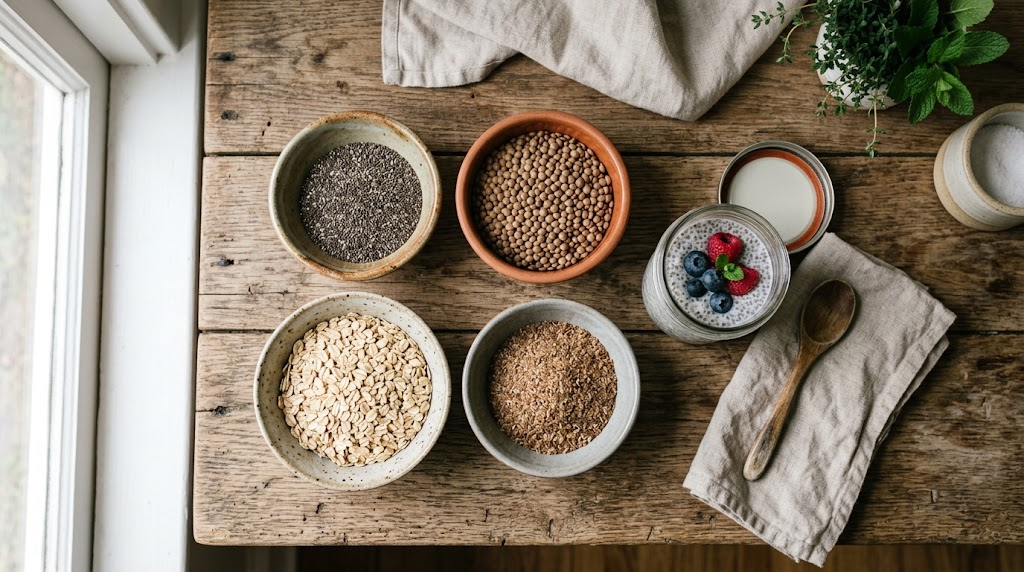
- Chia seeds — nearly flavorless, work in both sweet (pudding, smoothies) and savory (stirred into raita or yogurt) applications, and thicken liquids on their own within minutes.
- Whole masoor and chana dal — already a kitchen staple in most Bengali households, and a genuinely fiber-dense one compared to more refined grains.
- Oats — not just for breakfast; ground oats work as a binder in cutlets and koftas in place of some of the breadcrumbs.
- Flaxseed, ground fresh — whole flaxseed largely passes through undigested, so grinding it just before use actually matters here, unlike chia.
- Popcorn — an underrated one; air-popped, it’s a genuinely high-fiber whole grain snack, not just empty carbs.
How Much Actually Changes by Adding These
This is where I want to be careful not to oversell it. Swapping white rice for a lentil-forward meal a few times a week, or adding a tablespoon of chia to your morning routine, is a small, additive change — not a transformation. The realistic value is consistency: small amounts added regularly across a week add up more than one dramatic “fiber-maxxed” meal followed by nothing for the rest of the week.
Building It Into Meals You Already Cook
The realistic way this works long-term isn’t a separate “fiber meal” — it’s small substitutions inside food you’re already making. Stir a tablespoon of ground flaxseed into dal after cooking instead of before (it thickens slightly and you won’t taste it). Use whole wheat atta for luchi or paratha at least some of the time instead of exclusively maida. Add a handful of soaked chana to a salad or bhorta you’d normally make without it. None of these changes the dish enough that anyone would notice at the table, which is exactly why they’re the ones that actually stick, unlike a dramatic one-time “high fiber day” that’s hard to repeat.
What I Don’t Bother With
Fiber supplements and fortified snack bars marketed hard around this trend haven’t made it into my regular rotation, mostly because whole-food sources already cover it in a way that also does more for the actual meal — a bowl of masoor dal is doing several jobs at once (protein, fiber, flavor), while a fiber-fortified granola bar is doing exactly one job and often has more added sugar than the label’s health claims suggest at first glance.
From My Kitchen
I started keeping a jar of chia seeds on the counter, not in the pantry, specifically because out of sight meant out of use for me. My first attempt at chia pudding was a genuine failure — I used the same ratio I’d seen online (roughly 3 tablespoons chia to a cup of milk) but didn’t stir it again after the first minute, and it set into an uneven mix of thick clumps and watery milk at the bottom instead of a uniform pudding. The fix, which took me embarrassingly long to figure out, is stirring it again at the five-minute mark, after the chia has started swelling but before it’s set — that second stir is what breaks up the clumps. Now it’s a genuinely reliable breakfast I make the night before, and the only pantry change I’ve actually kept up for more than a month, which says something given how many food trends I’ve tried and abandoned.
Worth Considering
For chia seeds specifically, quality and freshness vary more than you’d expect, and stale chia seeds lose the swelling ability that makes them useful. Spectrum Organic Chia Seed is a reliably fresh, widely available option in a size that won’t go stale before you finish it. If you go through chia seeds quickly or want a larger stock, Garden of Life Raw Organics Chia Seeds is a solid bulk option worth having on hand.
Spectrum Organic Chia Seed — reliably fresh in a size you will finish before it goes stale.
Garden of Life Raw Organics Chia Seeds — a solid bulk option if you go through chia quickly.
Frequently Asked Questions
Can adding fiber too quickly cause digestive discomfort?
Yes, this is a genuinely common experience, and it’s worth taking seriously rather than pushing through. Increasing fiber intake gradually, over a couple of weeks, and drinking enough water alongside it, is the standard, sensible way to avoid bloating or discomfort. If you have an existing digestive condition, check with a doctor before making a significant change either way.
Do chia seeds and flaxseed provide fiber in the same way?
Not quite. Chia seeds absorb liquid and form a gel while staying mostly intact, which is why they thicken puddings and smoothies. Whole flaxseed has a hard outer shell that often passes through digestion largely intact, meaning you get less benefit from it whole than ground — grinding it right before use (a small coffee grinder works fine) is the one step that actually matters for flaxseed specifically.
Is fiber-maxxing the same thing as a high-protein diet trend?
They overlap in practice more than in intent — a lot of the same whole foods (lentils, oats, chia) show up in both trends, but fiber-maxxing is specifically about digestive and metabolic health through fiber intake, while high-protein trends focus on satiety and muscle. You don’t need to choose between them; a dal-and-whole-grain-forward diet genuinely supports both goals at once, which is part of why lentil-based cooking has aged well as a foundation regardless of which trend is more prominent in a given year.

Rimi Sultana is a home cook from Bangladesh who has cooked for her family every day for the past five years and writes about it at Smart Cooks. Perpetually testing whether internet-famous recipes actually work in a regular home kitchen. Say hello on Facebook or through the contact page.