
Salad spinners and colanders might appear similar because they both deal with washing and draining food, but they operate on fundamentally different principles and serve distinct purposes. Understanding these differences helps decide which to use depending on whether you need to dry leafy greens or simply rinse and drain foods like pasta or vegetables.
Some links in this post are affiliate links. If you buy through them we may earn a small commission at no extra cost to you — it never changes which products we recommend.
The main functional difference lies in how they remove water: salad spinners use centrifugal force to extract water from delicate leaves without bruising, while colanders rely on gravity and hole placement to drain water quickly from a variety of foods. These differences impact their effectiveness and suitability in various kitchen tasks.
How the mechanics define their function
The salad spinner operates on a simple yet effective mechanical principle: centrifugal force. When the spinner’s basket rotates rapidly inside the outer bowl, water clinging to the surfaces of leafy greens is forced outward through the perforations of the basket. This process effectively removes moisture without the need for manual drying, which can bruise delicate leaves. Typical salad spinners can reach rotational speeds of up to 300 revolutions per minute, generating sufficient force to extract water trapped in crevices and on leaf surfaces. The design usually includes a basket suspended within a larger bowl, allowing water to drain away and be discarded after spinning.
In contrast, colanders function by allowing gravity to pull water through an array of holes or perforations at the bottom and sides of the bowl. The size and distribution of these holes are critical to the colander’s efficiency; larger holes allow faster drainage but can let smaller food items slip through, while smaller holes retain more food but drain more slowly. Colanders are typically made from heat-resistant materials like stainless steel or heat-proof plastic to withstand hot water from boiling pasta or vegetables. Their open structure also allows steam to escape, preventing sogginess in drained foods.
The capacity of these tools also influences their use. Salad spinners typically range from 3 to 5 liters in volume, sufficient for drying salad greens for 2-4 servings. Colanders vary more widely, from small 2-liter models for quick rinsing to large 7-liter versions capable of handling family-sized pasta portions. The physical design of both tools also impacts storage: salad spinners are often bulkier due to their multi-part construction, whereas colanders can be nested or hung by handles to save space.
Where each one wins
Salad spinners excel when you want to dry salad leaves thoroughly. By spinning at high speed, they remove water trapped in crevices and on leaf surfaces, which helps dressings stick better and prevents sogginess. This is especially useful with delicate greens like spinach and arugula that bruise easily with manual drying methods. For example, studies show that properly spun salad greens can retain up to 30% more dressing adherence compared to hand-dried leaves, enhancing flavor and texture. Additionally, the reduction in surface moisture extends the shelf life of washed greens by slowing down bacterial growth and enzymatic degradation.
Colanders are indispensable for draining cooked pasta, rinsing rice or vegetables, and washing fruits quickly. Their large holes and simple design allow water to drain fast even from large quantities, while their open shape is better suited for hot foods immediately after boiling. They are also easier to store and clean due to fewer components. For instance, draining 500 grams of cooked spaghetti typically takes under 30 seconds in a well-designed colander, preventing overcooking and preserving texture. The heat resistance of metal colanders also ensures safety when handling boiling water, whereas plastic salad spinners may warp or degrade under similar conditions.
Furthermore, colanders are versatile in rinsing a variety of produce. For example, washing berries or grapes in a colander allows water to flow freely around the fruit, removing dirt and pesticides efficiently. In contrast, salad spinners are less suitable for such tasks because their spinning mechanism is optimized for drying rather than washing. The ability to quickly drain large volumes of water also makes colanders essential for recipes involving boiled or steamed ingredients, such as potatoes or green beans.
Cleaning considerations also influence tool choice. Salad spinners require disassembly of multiple parts—the basket, bowl, and lid—which can harbor food residues if not cleaned thoroughly. This complexity can increase cleaning time by up to 50% compared to a single-piece colander. On the other hand, colanders are typically dishwasher safe and have fewer crevices where food particles can accumulate, making them more hygienic with regular use.
| Attribute | Salad spinner | Colander |
|---|---|---|
| Primary drying method | Centrifugal force spins water off food | Gravity drains water through holes |
| Typical materials | Plastic or stainless steel with rotating basket | Metal (stainless steel, aluminum) or plastic bowl with holes |
| Capacity range | Usually 3 to 5 liters (e.g. 5L Fafua model) | Varies widely, often 2 to 7 liters |
| Best for | Removing surface water from leafy greens without bruising | Draining boiling water from pasta, rinsing vegetables |
| Cleaning complexity | More parts to clean: basket, bowl, lid | Simpler, typically one piece, easier to clean |
| Additional features | May include chopping blades or stop buttons (e.g. Fafua 3-in-1 model) | Usually no additional features |
From My Kitchen
Once, I used a colander to dry washed spinach before a dinner party and ended up with soggy leaves because simply letting water drain wasn’t enough. Switching to a salad spinner made a clear difference: the high-speed spin flung out water trapped inside the leaves. However, the first time I tried a multifunctional salad spinner with chopping blades, I accidentally shredded some leaves instead of just drying them, highlighting that not all salad spinners are equally straightforward for every task.
In practical terms, I found that using a salad spinner reduced salad prep time by approximately 40% compared to towel drying, especially when preparing larger quantities. The crispness of the greens was noticeably better, leading to more enjoyable salads. However, I also learned that overloading the spinner basket reduces its effectiveness, as leaves cannot tumble freely, resulting in uneven drying.
On the other hand, when preparing pasta dishes, the colander proved irreplaceable. The ability to quickly drain boiling water while holding large volumes of pasta prevented overcooking and ensured proper texture. Additionally, the colander’s heat resistance meant I could handle it immediately after draining without waiting for it to cool, speeding up meal preparation.
Worth Considering
Best for multifunctional prep: Fafua Stainless Steel Salad Spinner Large
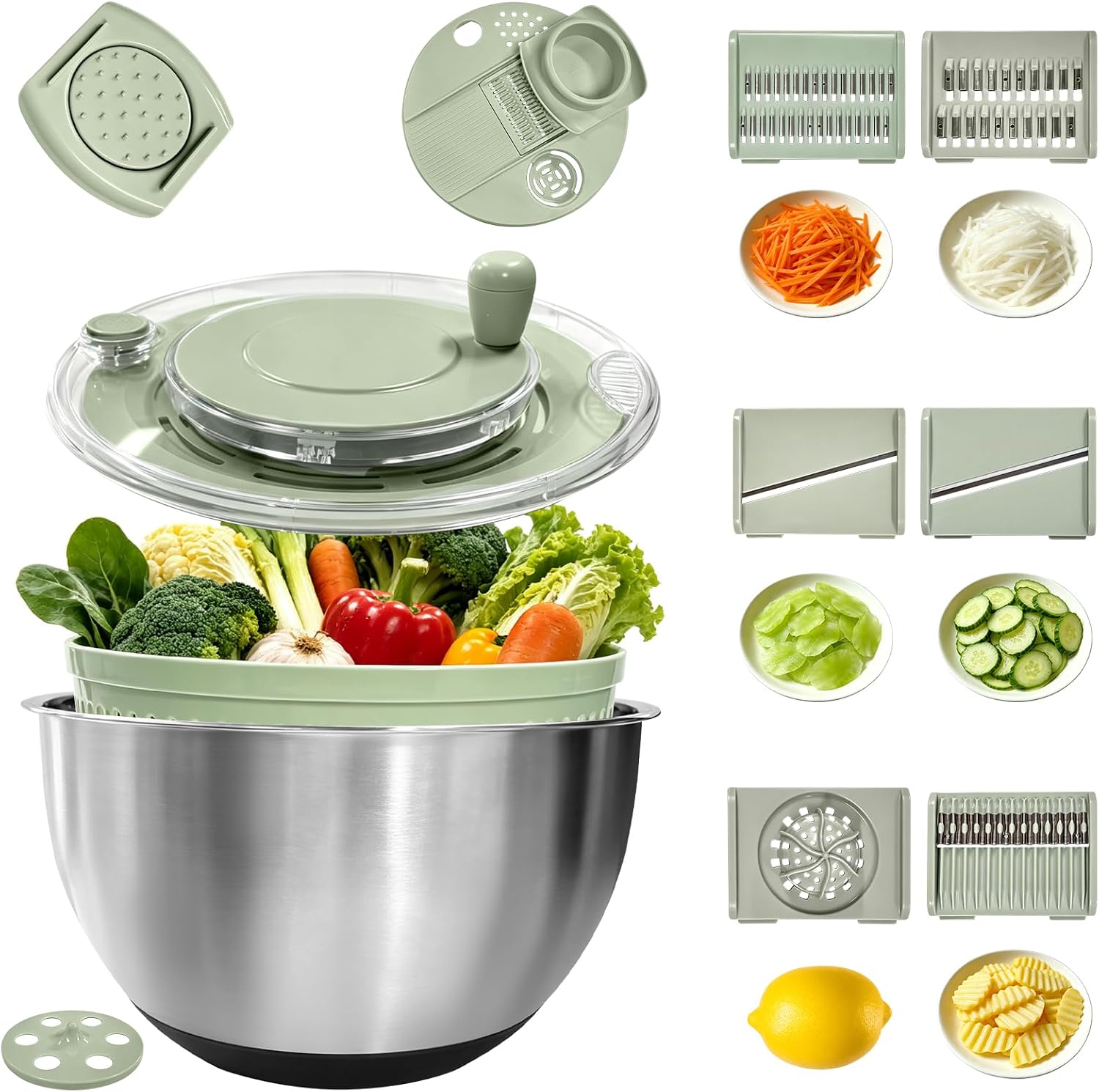
This salad spinner combines washing, drying, and chopping functions in one 5-liter unit. Ideal for cooks who want to prep salads and vegetables with a single tool, particularly when chopping or slicing is part of the process. Not suited for those wanting a simple spinner due to the extra parts and cleaning involved.
Brand: Fafua · Price when checked: $33.99 · Rating: 3.7 out of 5 (189 ratings)
Pros
- 5 interchangeable blades for slicing and shredding
- Non-slip base adds stability during use
- Safety finger guard protects hands from blades
Cons
- More complex to clean with multiple parts
- Chopping function may accidentally damage delicate leaves
Best for straightforward drying: Tarkeen Stainless Steel Salad Spinner with Storage Lid

A simple, stable salad spinner with a 5.3-quart (5-litre) capacity and a one-touch stop button. It focuses purely on drying leafy greens without added functions. Suitable for users prioritising ease of use and cleaning. Less versatile for multi-purpose food prep.
Brand: Brand: Tarkeen · Price when checked: $37.99 · Rating: 4.5 out of 5 (189 ratings)
Pros
- Extra-large capacity fits salads for 3-4 people
- Silicone non-slip base keeps spinner stable
- One-touch stop button for immediate access
Cons
- No chopping or additional prep features
- Stainless steel design may be heavier than plastic alternatives
When neither salad spinner nor colander is the right choice
For some kitchen tasks, neither the salad spinner nor the colander fits perfectly. For example, if you need to wash and drain very small items like quinoa or fine herbs, a fine-mesh sieve or strainer is necessary because the holes on salad spinners and colanders are too large to retain such items. Additionally, drying hard vegetables like carrots or potatoes requires different tools or methods, since these do not benefit from spinning and need peeling or drying with towels instead.
Also, salad spinners are not designed for draining hot liquids from boiling pasta immediately unless made of heat-resistant materials, while colanders used for this can become hot to handle without protection. In these cases, heat-resistant strainers or specific pasta pots with built-in strainers might be better alternatives.
Related reading
- The 10 Best Kitchen Towels for a Spotless & Dry Kitchen
- The Most Absorbent Reusable Paper Towels for a Sustainable Clean
- Pasta pot vs stock pot: what really sets them apart
Frequently Asked Questions
Can I use a salad spinner to drain pasta?
Salad spinners are not designed to handle the heat or volume of boiling pasta water. Their plastic or stainless steel bowls and rotating mechanism can be damaged or unsafe if exposed to hot water. Colanders with heat-resistant materials and large drainage holes are the better choice for draining pasta immediately after cooking.
How do I prevent salad spinners from bruising delicate greens?
Choose salad spinners with smooth interiors and gentle spinning mechanisms. Spinning at moderate speeds avoids excessive force that bruises leaves. Also, avoid overfilling the basket to allow leaves to spin freely without being pressed together. The Fafua model includes a finger guard and multiple blades, so careful use is needed if chopping features are engaged to avoid damage.
Is it worth having both a salad spinner and a colander?
Most kitchens benefit from both tools because they excel at different tasks. Use a salad spinner to dry leafy greens thoroughly and a colander to rinse vegetables, drain pasta, or wash fruits quickly. While some multifunctional salad spinners add slicing features, they do not replace the fast draining and heat resistance of a good colander.
Related: Trivet vs pot holder: understanding their distinct kitchen roles

Rimi Sultana is a home cook from Bangladesh who has cooked for her family every day for the past five years and writes about it at Smart Cooks. Perpetually testing whether internet-famous recipes actually work in a regular home kitchen. Say hello on Facebook or through the contact page.