Selecting a suitable whetstone for Japanese knives hinges on matching the stone’s grit and composition to the knife’s steel and edge geometry. Japanese knives often have harder, thinner blades that demand precise grit progression to maintain their sharpness without damaging the edge.
Some links in this post are affiliate links. If you buy through them we may earn a small commission at no extra cost to you — it never changes which products we recommend.
The decisive property in a whetstone is how it abrades the blade metal — the stone’s grit size controls the abrasiveness, while the stone’s material and water retention affect how evenly the blade sharpens and how quickly metal is removed. A poor whetstone can cause uneven sharpening, edge chipping, or prolonged sharpening times.
What actually matters
Understanding the technical differences between whetstones can help you choose the right stone for your Japanese knives and sharpening goals.
The grit size of a whetstone is fundamental because it determines how much metal is removed from the blade during sharpening. For example, a 400 grit stone can remove metal at a rate of approximately 0.1 mm per minute under moderate pressure, making it ideal for repairing chips or reshaping edges. In contrast, a 10000 grit stone removes metal at a rate closer to 0.001 mm per minute, focusing on polishing rather than reshaping.
The progression of grits is critical to maintaining the blade’s integrity. Starting with too fine a grit on a dull or damaged edge can lead to prolonged sharpening sessions without meaningful improvement, while skipping coarse grits when repairing chips can cause uneven edges and reduced blade life. For Japanese knives, a typical progression might be 1000 grit for edge repair, 3000 or 6000 grit for sharpening, and 8000 grit or higher for finishing polish. This sequence balances efficient metal removal with delicate edge refinement.
Stone material and water retention play a vital role in sharpening effectiveness. Natural stones, such as the famed Japanese ‘Toishi’, have variable grit distributions and water absorption rates, which can lead to unique sharpening characteristics but inconsistent results. Synthetic stones are engineered for uniform grit size and consistent cut rates; for example, synthetic aluminum oxide stones typically cut at a rate of 0.05 mm per minute at 1000 grit. Water retention affects slurry formation, which lubricates the blade and carries away metal particles. Stones that hold water well create a rich slurry that smooths the sharpening process and prevents heat buildup, which can temper the blade steel and reduce hardness.
The size and thickness of the whetstone also influence sharpening performance and maintenance. Larger stones, such as those measuring 210 mm by 70 mm by 20 mm, provide greater surface area for consistent edge sharpening and reduce the frequency of flattening. Thicker stones last longer but require more time and effort to flatten when they become concave. Accessories like angle guides help maintain the precise sharpening angle—typically 15 degrees per side for Japanese knives—ensuring optimal edge geometry. Non-slip bases enhance safety by preventing stone movement during sharpening, and flattening stones are essential tools to restore a flat surface, as even slight concavity can lead to uneven edge sharpening and premature blade wear.
Grit size and progression
Grit size, expressed as a number, indicates the coarseness of the stone. Lower grits like 400-1000 remove metal quickly and are used to repair chips or re-profile edges. Medium grits (1000-3000) sharpen a dull edge, while high grits (6000-10000) polish and refine the blade for a razor finish. For Japanese knives, a typical progression might start at 1000 grit, move to 3000 or 6000 grit, then finish at 8000 grit or above to preserve the blade’s delicate edge.
For example, a 1000 grit stone can remove approximately 0.02 mm of metal per sharpening pass, sufficient to reshape the edge without excessive wear. Moving to 3000 grit reduces metal removal to about 0.005 mm per pass, refining the edge and smoothing out micro-serrations. Finally, an 8000 grit stone polishes the edge, reducing surface roughness to less than 1 micron, which enhances cutting performance and edge retention.
Stone material and water retention
Japanese whetstones are traditionally made of natural materials or synthetic bonded abrasives. Synthetic stones tend to have consistent grit and cut rates. Water retention affects how the stone interacts with the blade; stones that hold water well create a slurry that aids sharpening and prevents overheating. Stones that dry out too quickly or don’t produce enough slurry can scratch or unevenly abrade the blade.
For instance, synthetic stones made from aluminum oxide or silicon carbide retain water differently. Aluminum oxide stones absorb water and produce a thick slurry that enhances cutting efficiency, whereas silicon carbide stones may require more frequent wetting to maintain lubrication. Natural stones, while prized for their unique sharpening characteristics, often require longer soaking times (up to 30 minutes) and careful maintenance to avoid uneven wear.
Size, thickness, and accessories
The stone’s dimensions impact stability and how much sharpening surface you have. Thicker stones last longer but take more time to flatten. Accessories like angle guides help maintain consistent sharpening angles, while non-slip bases improve safety. Some stones include flattening stones to restore a flat surface, essential for effective sharpening.
For example, a stone with dimensions of 210 mm x 70 mm x 20 mm provides ample surface area for sharpening larger blades such as a gyuto or santoku, reducing the risk of uneven edges caused by limited contact. Thinner stones (around 10 mm thick) may wear out after several sharpening sessions, necessitating frequent flattening or replacement. Angle guides calibrated to 15 degrees per side help maintain the acute edge angles favored in Japanese knives, which contribute to their superior cutting performance but require precise technique to avoid edge damage.
Choosing the right whetstone for your needs
If you have a typical Japanese kitchen knife, starting with a 1000 grit stone for sharpening and a 3000 to 6000 grit for polishing covers most needs. For occasional edge chipping, a coarser 400 grit stone helps. Finishing stones above 8000 grit are only necessary if you want a mirror polish or own very high-end knives.
Beginners should consider kits with angle guides and non-slip bases to maintain consistent sharpening technique. Those on a budget can start with dual grit stones like MITSUMOTO SAKARI or Wucgea sets, keeping in mind these will wear faster and may need flattening sooner.
Professional users or enthusiasts with multiple knives and sharpening demands benefit from full sets like the Yoshihiro Toishi series, which offer consistency and longevity but come at higher cost. If you do not regularly sharpen your knives or prefer electric sharpeners, whetstones may not be necessary.
The consequences of choosing an inappropriate whetstone can be significant. Using too coarse a stone on a delicate Japanese knife blade can cause edge chipping and reduce blade lifespan. Conversely, using only fine stones on a dull or damaged blade leads to prolonged sharpening sessions and inadequate edge restoration, resulting in poor cutting performance. Additionally, neglecting proper grit progression can cause micro-serrations to build up, which impair slicing ability and increase the risk of blade corrosion.
Moreover, the maintenance of the whetstone itself affects sharpening outcomes. Stones that become concave or uneven due to wear can produce inconsistent edge angles, ultimately compromising the knife’s sharpness and durability. Regular flattening with a diamond or silicon carbide flattening stone is recommended every 5 to 10 sharpening sessions, depending on usage frequency.
In terms of numbers, a well-maintained 1000 grit synthetic stone can last for several years with weekly use, while natural stones may require more frequent replacement or resurfacing. The cost-benefit analysis favors investing in higher quality stones for long-term sharpening efficiency and blade preservation.
| Pick | Best for | Grit range | Watch out for |
|---|---|---|---|
| MITSUMOTO SAKARI | Reliable dual grit set | 1000/3000 | No base included, requires soaking |
| Intelitopia | Complete kit with accessories | 400/1000 and 3000/8000 | Bulky set may be overkill for some |
| Yoshihiro Toishi Set | Professional-grade full set | 1000/3000/6000 | High price, specialized use |
| KING Starter Set | Beginner friendly with angle guide | 1000/6000 | Plastic base can be unstable |
| wucgea | Budget-friendly multi-grit set | 400/1000 and 3000/8000 | Lower durability compared to premium stones |
| Yoshihiro 10000 | Finishing stone for polish | 10000 | Not suitable alone for edge repair |
| Kota Japan | Mid-range finishing stone | 3000/8000 | Limited grit range for full sharpening |
From My kitchen
One time I used a too-fine grit stone alone to sharpen a seriously dull Japanese gyuto blade. The edge didn’t improve much because the stone removed metal too slowly to reset the edge angle. Switching to a 1000 grit coarser stone first made all the difference, quickly restoring the edge shape before moving to finer grits for polishing. That experience underscored the importance of grit progression and knowing when to use each whetstone.
This practical experience aligns with sharpening science: coarser stones remove metal faster, reshaping the blade geometry, while finer stones polish and refine. Neglecting coarse grit stages can result in inefficient sharpening and poor edge performance.
Worth Considering
Best for reliable dual grit sharpening: MITSUMOTO SAKARI 1000/3000 Grit Japanese Whetstone Knife Sharpening Stone

This dual grit stone offers a traditional 1000 grit side for edge repair and a 3000 grit side for refining. It’s straightforward and efficient but requires soaking before use and lacks extra accessories like a base or angle guide.
Brand: MITSUMOTO SAKARI · Price when checked: $30.59 · Rating: 4.5 out of 5 (2166 ratings)
Pros
- Dual grit for versatile sharpening
- Compact size for easy handling
- Consistent synthetic abrasive
Cons
- No included base or angle guide
- Needs soaking before use
Best for complete sharpening kit: Intelitopia Complete Knife Sharpening Stone Set

This set covers a wide grit range from 400 to 8000 and includes leather strop, flattening stone, and angle guide. It’s ideal for someone wanting all sharpening stages in one package, but its many components may be excessive for casual users.
Brand: Brand: Intelitopia · Price when checked: $29.99 · Rating: 4.5 out of 5 (25,673 ratings)
Pros
- Wide grit range from 400 to 8000
- Includes angle guide and flattening stone
- Non-slip bases for stability
Cons
- Large set takes space
- May overwhelm beginners
Best for professional-grade full set: Yoshihiro Professional Grade Toishi Japanese Whetstone Knife Sharpener Water Stones (SET)

This premium set includes 1000, 3000, and 6000 grit stones with enough thickness for years of use. The stones are made in Japan with a wider surface area for accuracy, suitable for serious cooks or chefs but pricey and not beginner friendly.
Brand: Yoshihiro · Price when checked: $289.99 · Rating: 4.8 out of 5 (429 ratings)
Pros
- High quality Japanese craftsmanship
- Large surface area for precise sharpening
- Long-lasting thickness
Cons
- Expensive
- No included base or guides
Best for beginners with angle guide: KING Whetstone Starter Set Include 1000/6000 Grit Combination Whetstone

KING’s set provides a reliable 1000/6000 grit combination with a plastic base and angle holder, making it easier for beginners to maintain consistent angles. The base, however, can feel unstable and the plastic less durable than wood or bamboo.
Brand: Brand: KING · Price when checked: $52.50 · Rating: 4.5 out of 5 (1491 ratings)
Pros
- Angle guide included
- Original wiping cloth aids cleanup
- Trusted Japanese brand
Cons
- Plastic base less stable
- Combination stone less forgiving for precise grit transitions
Best budget multi-grit set: Wucgea Knife Sharpening Stone Kit

Wucgea offers a 400/1000 and 3000/8000 grit set with non-slip base and angle guide at a low price point. It’s a good entry-level option but its abrasive material wears faster than premium stones and may require more frequent flattening.
Brand: wucgea · Price when checked: $21.99 · Rating: 4.5 out of 5 (2166 ratings)
Pros
- Affordable price
- Includes angle guide and flattening stone
- Non-slip base
Cons
- Less durable abrasive
- May wear unevenly over time
Best for ultra-fine finishing: Yoshihiro Professional Grade Toishi Japanese Whetstone Knife Sharpener Water Stones (#10000 grit)
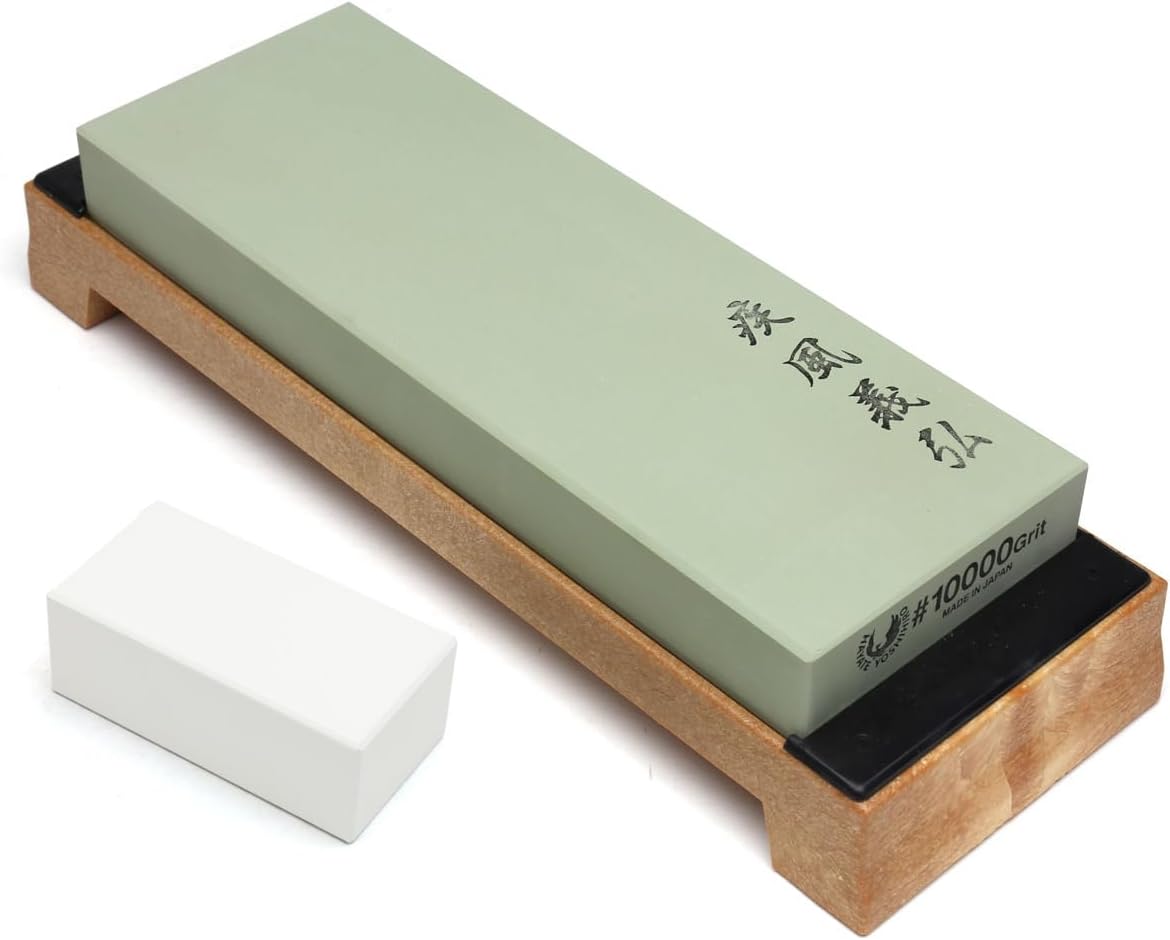
This 10000 grit stone is excellent for polishing and refining already sharp edges, especially on high-end Japanese knives. It’s not suitable alone for edge repair and should be used after coarser stones.
Brand: Yoshihiro · Price when checked: $109.99 · Rating: 4.7 out of 5 (1491 ratings)
Pros
- Extremely fine grit for razor polish
- Ample size for stable sharpening
- Includes Nagura conditioning stone
Cons
- Not for rebuilding edges
- High cost for a single-purpose stone
Best for mid-range finishing: Kota Japan 3000-8000 Grit Whetstone Knife Sharpening Stone

Kota’s 3000-8000 grit stone covers medium to fine sharpening stages, suitable for users who already have a coarse stone and want to refine edges. It does not cover coarser grit needs and is therefore a niche pick rather than an all-in-one solution.
Brand: Kota · Rating: 4.4 out of 5
Pros
- Smooth transition grit range
- Good for polishing and edge refinement
- Solid build quality
Cons
- No coarse grit side
- Limited versatility for full sharpening process
Choosing the right whetstone for your needs
If you have a typical Japanese kitchen knife, starting with a 1000 grit stone for sharpening and a 3000 to 6000 grit for polishing covers most needs. For occasional edge chipping, a coarser 400 grit stone helps. Finishing stones above 8000 grit are only necessary if you want a mirror polish or own very high-end knives.
Beginners should consider kits with angle guides and non-slip bases to maintain consistent sharpening technique. Those on a budget can start with dual grit stones like MITSUMOTO SAKARI or Wucgea sets, keeping in mind these will wear faster and may need flattening sooner.
Professional users or enthusiasts with multiple knives and sharpening demands benefit from full sets like the Yoshihiro Toishi series, which offer consistency and longevity but come at higher cost. If you do not regularly sharpen your knives or prefer electric sharpeners, whetstones may not be necessary.
Related reading
- Knife Sharpener: Manual vs Electric
- Better Than The Original: Taco Bell Mexican Pizza Recipe
- Best Kitchen Knife Sharpeners: Top Picks for a Razor Edge
Frequently Asked Questions
Do I need multiple whetstones for Japanese knives?
Yes. Japanese knives typically require a progression of grits to maintain the edge properly. Coarser stones (400-1000 grit) reshape and repair edges, medium stones (1000-3000 grit) sharpen dull knives, and finer stones (6000-10000 grit) polish and refine the edge. Using only one grit can either remove too much metal or fail to restore a sharp edge effectively.
How long should I soak my whetstone before sharpening?
Most synthetic Japanese whetstones need soaking for 10 to 15 minutes in water before use. Soaking saturates the stone, helping it release abrasive particles and produce a slurry that lubricates the blade for smoother sharpening. Some stones are splash-and-go and require less soaking, but always check the manufacturer’s instructions.
Can I use the same whetstone for Western and Japanese knives?
Generally yes, but Japanese knives often have harder steel and thinner edges requiring finer grit progression and gentler sharpening angles (around 15 degrees per side). Western knives can tolerate coarser stones and more aggressive sharpening angles (20 degrees or more). Choosing stones with appropriate grit ranges and maintaining correct angles is more important than the stone type itself.

Rimi Sultana is a home cook from Bangladesh who has cooked for her family every day for the past five years and writes about it at Smart Cooks. Perpetually testing whether internet-famous recipes actually work in a regular home kitchen. Say hello on Facebook or through the contact page.