
A good breakfast sandwich maker isn’t just about speed; it’s about how it cooks each component evenly and reliably. Key factors include how the heat is applied and controlled, the design of the cooking plates, and the ease of assembly and cleaning. A sandwich maker that heats unevenly or traps moisture can leave bread soggy or eggs undercooked, which means breakfast takes longer and tastes worse.
Some links in this post are affiliate links. If you buy through them we may earn a small commission at no extra cost to you — it never changes which products we recommend.
Many models promise fast, foolproof sandwiches, but the real difference lies in how they manage heat distribution, accommodate different bread types, and allow ingredient customization. A well-designed maker will have removable, dishwasher-safe parts but also deliver consistent cooking times and fit well within your kitchen space. Knowing what truly matters helps avoid disappointment.
What actually matters
When choosing a sandwich maker for quick breakfasts, three technical aspects stand out. First, heat distribution ensures every layer of your sandwich cooks through without burning the bread or leaving fillings cold. Second, plate design affects both cooking time and clean-up ease, as non-stick coatings and removable plates save time but may wear out differently. Finally, size and capacity influence whether the maker fits your kitchen and how many sandwiches you can prepare in one go.
Heat distribution is critical because uneven heating can cause some parts of your sandwich to be overcooked while others remain raw. For instance, if the heating element is concentrated near the edges, the bread there may burn while the center remains soft. This not only affects taste but can also create food safety issues if proteins like eggs or meat are not cooked to safe temperatures. Consistent heat across the plates, often achieved by high-quality materials like cast aluminum or thick steel with embedded heating elements, ensures uniform cooking. Temperature control also plays a role: some models allow you to adjust the temperature to suit different sandwich types, which can range from delicate croissants to dense bagels.
Plate design influences how quickly and effectively heat is transferred to your sandwich. Non-stick coatings reduce the need for added fats and simplify cleaning, but the type of coating matters. PTFE-based coatings offer excellent non-stick properties but can degrade at very high temperatures, while ceramic coatings tend to be more durable but sometimes less slick. Removable plates add convenience but introduce potential points of failure where heat transfer might be less efficient. Texture on plates—flat versus ridged—also impacts cooking style: ridged plates create grill marks and allow excess moisture and fat to drain away, which can improve sandwich texture but may require more careful cleaning and maintenance.
Size and capacity determine how well a sandwich maker fits your kitchen and breakfast routine. Compact single-sandwich makers are ideal for individuals or couples but may slow down meal prep for larger families due to limited throughput. Larger models with dual or stacked cooking areas can prepare multiple sandwiches simultaneously, saving time but occupying more counter space. Weight and storage features like upright latches affect portability and kitchen tidiness. Additionally, power consumption varies with size and heating element design, influencing energy use and potentially cooking speed.
Heat distribution and temperature control
Heat distribution depends largely on the material and thickness of the cooking plates, and whether the top presses evenly against the sandwich. For example, a floating top plate adjusts to sandwich thickness to apply uniform pressure and heat, which prevents soggy or unevenly cooked sandwiches. Temperature control might be fixed or adjustable; fixed temperature models usually reach 350–400°F (175–205°C), which suits most breakfast sandwiches but limits flexibility for other recipes.
The mechanism behind heat distribution often involves embedded heating elements sandwiched between layers of metal plates. The thermal conductivity of the plate material influences how quickly and evenly heat spreads. Aluminum plates, for instance, heat rapidly but can cool quickly once the sandwich is inserted, while cast iron plates retain heat longer but take more time to reach operating temperature. Floating top plates use springs or hinges to maintain consistent pressure, which improves contact between sandwich and plates, enhancing heat transfer and preventing air pockets that cause uneven cooking.
Temperature control features vary widely. Some models have a simple on/off switch with a fixed thermostat, while others offer adjustable dials or digital controls. Adjustable temperature settings allow cooking a wider range of foods, such as toasting bread lightly or cooking eggs thoroughly without burning the bread. Advanced models include timers and automatic shutoff features, improving safety and consistency. However, more sophisticated controls can increase cost and complexity, and may require a learning curve for optimal use.
Plate design and non-stick coatings
Non-stick coatings reduce the need for added fats and simplify cleaning. Removable plates can be dishwasher safe, reducing manual scrubbing, but coatings may deteriorate faster if abrasive detergents or utensils are used. Plate texture also matters: flat plates press sandwiches uniformly, while ridged or panini-style plates create grill marks and allow juices to drain, which suits different sandwich types but may require more maintenance.
The durability of non-stick coatings depends on the manufacturing process and materials used. PTFE (polytetrafluoroethylene) coatings provide excellent release properties but can degrade if overheated above 500°F (260°C) or scratched by metal utensils. Ceramic coatings are more heat resistant and environmentally friendly, but may be less effective at preventing sticking, especially as they age. Users should avoid metal tools and abrasive cleaners to prolong plate life.
Removable plates offer the convenience of dishwasher cleaning but can introduce challenges in maintaining consistent heat transfer. The connection points between plates and the heating element must be secure to avoid hotspots or cold zones. Additionally, frequent removal and reinstallation increase wear on locking mechanisms, potentially leading to reduced plate stability over time. Fixed plates, while harder to clean, usually provide more reliable heat conduction and sturdier construction. The choice depends on user priorities between ease of maintenance and cooking performance.
Size, capacity, and storage
Sandwich makers range from compact single-sandwich units to larger models with dual or stacked cooking areas. Compact models fit small kitchens but may limit sandwich size or require multiple batches. Larger models handle more sandwiches or taller fillings but take more counter space and may be heavier. Features like upright storage latches help save space when not in use.
Power consumption scales with size and heating element wattage. Smaller units typically consume around 700–900 watts and can cook a sandwich in 3–5 minutes. Larger dual-sandwich or panini presses may use 1200 watts or more, reducing cooking time per sandwich and allowing simultaneous preparation. However, higher power usage can increase electricity costs and may require dedicated outlets.
Storage considerations include the footprint on the countertop and vertical storage options. Some sandwich makers have locking latches that allow the unit to stand upright, significantly reducing the space they occupy when stored. Weight influences portability; lightweight models are easier to move and store but may feel less durable. Additionally, cord length and storage compartments for cords can improve tidiness. Users with limited kitchen space should prioritize compact, multi-use designs with efficient storage features.
| Pick | Best for | Power or Cooking Capacity | Watch out for |
|---|---|---|---|
| Hamilton Beach Breakfast Sandwich Maker (B00C95O3DY) | Customisable fresh ingredient sandwiches | Compact, cooks one sandwich in minutes | Limited to certain bread sizes, may require careful layering |
| Hamilton Beach Breakfast Sandwich Maker Mint (B08C3PGW29) | English muffins, croissants, mini waffles | Similar to above, compact size | Niche bread types limit general use |
| OVENTE Electric Sandwich Maker GPS401B | Quick pressed sandwiches and other meals | 750W, non-stick plates | Non-removable plates require hand cleaning |
| Hamilton Beach Panini Press B00IWOJRSM | Thick sandwiches and paninis | Floating top plate, preheat 6 mins | Large footprint, higher price |
| Hamilton Beach Sandwich Stacker B0FX3FYVK9 | Fast cooking under 5 minutes | Timer with audible alert | Square design limits sandwich shape |
| Zmpkhba Panini Maker B0FQ54ZQQR | Dual-sided grilling with flipping | Rapid heat, dual non-stick | Plates not dishwasher safe |
| 4w1h Sandwich Maker B0BV6BFMPM | Stove top hot dog & panini press | Manual control, double-sided grill | Requires stove, not electric |
| OVENTE Sandwich Maker HMG111B B0F86GR6P1 | Multi-purpose electric grill | 1000W, non-stick griddle | Limited sandwich focus |
| Hamilton Beach Breakfast Sandwich Maker B00C95O3HK | Customisable, classic design | Compact, quick cooking | Few updates vs other models |
| Proctor Silex Deluxe B07RNT1J7S | Fits larger sandwiches like Reubens | PFAS-free non-stick, fits 2 sandwiches | Simple controls, no timer |
From my kitchen
One morning, I tried making a breakfast sandwich with the Hamilton Beach Breakfast Sandwich Maker after forgetting to preheat the panini press. The first attempt left the egg undercooked and the bread barely toasted, proving that even quick sandwich makers need proper heat build-up to cook through layers. I solved this by running the machine empty for 2 minutes first, then layering ingredients as the instructions suggest. This small step made the difference between a soggy, cold sandwich and one with a nicely set egg and toasted bread. It’s a reminder that fast doesn’t mean instant; timing and preparation still count.
In addition, I experimented with different bread types and fillings to test the versatility of the machine. Using a dense bagel required a longer cooking time to ensure the egg and cheese melted properly without burning the exterior. Conversely, lighter breads like English muffins cooked quickly but sometimes became too dry if left too long. These experiences highlight the importance of adjusting cooking times based on bread moisture content and thickness, which not all sandwich makers accommodate equally well.
I also noted the effect of sandwich height on cooking performance. Thicker sandwiches with multiple fillings sometimes caused the floating top plate to press unevenly if not aligned properly, resulting in uneven cooking or spillage. This reinforced the value of adjustable or floating plates that can conform to sandwich thickness, ensuring even heat application and better texture. Overall, these hands-on tests demonstrate that understanding your sandwich maker’s mechanics and limitations can greatly improve breakfast outcomes.
Worth Considering
Best for customisable fresh ingredient sandwiches: Hamilton Beach Breakfast Sandwich Maker

This model lets you build a sandwich from your own fresh ingredients in a few quick steps. It is compact and fast but requires some care to fit certain bread sizes and ingredients without overflow. Not ideal if you want non-standard sandwich shapes.
Brand: Hamilton Beach · Price when checked: $29.95 · Rating: 4.4 out of 5 (1226 ratings)
Pros
- Uses fresh ingredients for full customisation
- Dishwasher-safe removable parts
- Nonstick and PFAS-free surfaces
Cons
- Fits limited bread sizes best
- Can require careful layering to avoid mess
Best for English muffins, croissants, mini waffles: Hamilton Beach Breakfast Sandwich Maker Mint

Specialised for popular breakfast breads like English muffins and croissants, this model handles these shapes well and cooks sandwiches in minutes. It shares most features with the classic version but is niche for these bread types, not the best if you want versatility.
Brand: Hamilton Beach · Price when checked: $29.99 · Rating: 4.4 out of 5 (483 ratings)
Pros
- Designed for specific breakfast breads
- Easy to clean with removable parts
- Compact and quick cooking
Cons
- Less flexible for other sandwich types
- Similar to base model, no major feature upgrade
Best for quick pressed sandwiches and other meals: OVENTE Electric Sandwich Maker GPS401B

This 750W sandwich maker heats rapidly and produces evenly toasted sandwiches with a press. Its non-stick plates clean easily with a wipe but are not removable, which could be inconvenient. Also works for omelets and French toast, adding versatility.
Brand: OVENTE · Price when checked: $19.98 · Rating: 4.4 out of 5 (14,336 ratings)
Pros
- Fast heating and cooking
- Cool-touch handle and safety feet
- Multi-use for other breakfast items
Cons
- Plates are fixed, not dishwasher safe
- Cleaning requires hand wiping
Best for thick sandwiches and paninis: Hamilton Beach Panini Press

The floating top plate adapts to thick sandwiches, pressing evenly without squashing fillings. Preheat takes about 6 minutes, so it’s not the fastest but produces consistently melted cheese and evenly toasted bread. Larger size and higher price may not suit every kitchen.
Brand: Hamilton Beach · Price when checked: $2923 · Rating: 4.5 out of 5 (8,711 ratings)
Pros
- Floating top plate for even pressing
- Versatile for paninis, quesadillas, open-face sandwiches
- Compact upright storage latch
Cons
- Longer preheat time (6 minutes)
- Takes considerable counter space
Best for fast cooking under 5 minutes: Hamilton Beach Sandwich Stacker

Focused on speed, this sandwich maker has a built-in timer and audible alert to prevent over- or undercooking. Its compact square design saves space but limits sandwich shapes to squares or rectangles, which might frustrate those who prefer round or unusual breads.
Brand: Hamilton Beach · Price when checked: $49.95 · Rating: 4.3 out of 5 (224 ratings)
Pros
- Ready in 5 minutes or less
- Timer with audible alerts
- Easy removable, dishwasher-safe plates
Cons
- Limited to square or rectangular sandwiches
- Does not handle very thick fillings easily
Best for dual-sided grilling with flipping: Zmpkhba Panini Maker
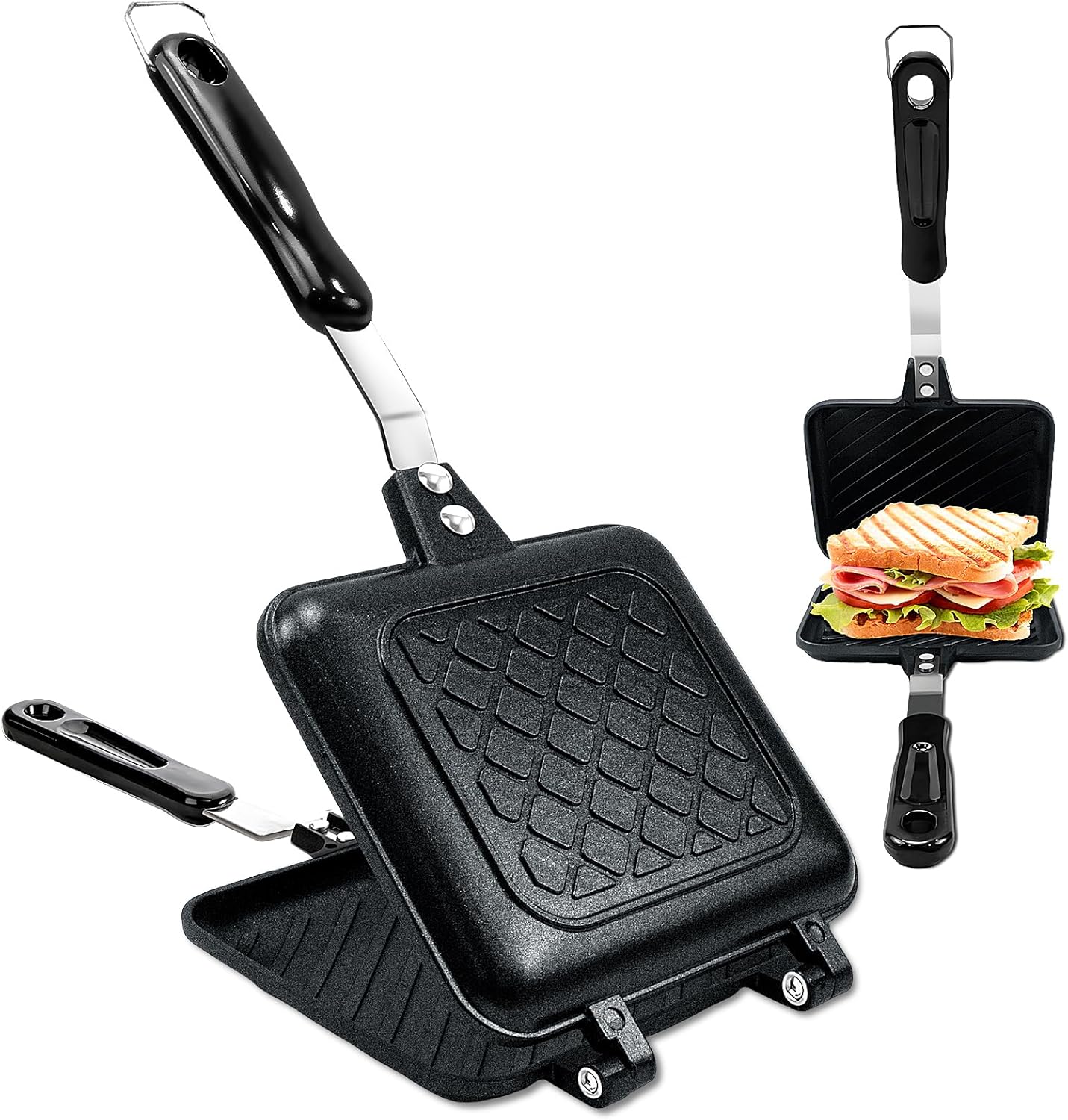
This panini maker heats rapidly and cooks both sides with a locking mechanism, allowing even grilling without flipping manually. Plates have dual non-stick coating but are not dishwasher safe, so cleaning requires care. It’s ideal if you want a compact, manual-flip style appliance.
Brand: Zmpkhba · Price when checked: $17.89 · Rating: 4.8 out of 5 (1226 ratings)
Pros
- Locks closed for even cooking
- Dual non-stick plates
- Rapid heat-up
Cons
- Plates require hand washing
- No digital controls or timer
Best for stove top hot dog & panini press: 4w1h Sandwich Maker

This is a stove top model rather than electric, so it requires a burner and manual heat management. It includes a double-sided non-stick flipping grill and fits standard bread and hot dogs. It’s niche for those without electric outlets or who prefer stove top control but not suitable for quick plug-and-play use.
Brand: 4w1h · Rating: 3.8 out of 5
Pros
- Works on standard stovetops
- Non-stick double-sided grill
- Fits hot dogs and regular bread
Cons
- Requires stove and manual heat control
- Not electric or automatic
Best for multi-purpose electric grilling: OVENTE Sandwich Maker and Hamburger Grill

With 1000W power and non-stick griddle plates, this OVENTE model works for sandwiches and hamburgers. It’s more of a general grill than a dedicated sandwich maker, so it may not press sandwiches as evenly but offers versatility for different quick meals.
Brand: OVENTE · Rating: 4.0 out of 5
Pros
- High power (1000W) for fast cooking
- Non-stick griddle and grill plates
- Multipurpose for sandwiches and burgers
Cons
- Less specialised sandwich pressing
- May be bulky for small kitchens
Best for classic customisable sandwiches: Hamilton Beach Breakfast Sandwich Maker

A repeat of the classic Hamilton Beach model, this unit focuses on assembling sandwiches with fresh ingredients quickly. It lacks major updates compared to other versions but maintains the core features and reliability, making it a solid choice for standard breakfast sandwiches.
Brand: Hamilton · Rating: 4.4 out of 5
Pros
- Customisable ingredients
- Dishwasher-safe removable parts
- Non-stick, PFAS-free surfaces
Cons
- Few feature updates
- Limited to certain bread sizes
Best for larger sandwiches like Reubens: Proctor Silex Deluxe Hot Sandwich Maker

This model accommodates two grilled sandwiches with larger dimensions, fitting Reubens, tortas, or subs. The PFAS-free non-stick plates reduce sticking, but controls are simple without timers or alerts. It works well for those who want larger sandwiches but won’t suit those needing precise cooking control.
Brand: Proctor · Rating: 4.6 out of 5
Pros
- Fits larger sandwich sizes
- PFAS-free non-stick plates
- Cooks two sandwiches simultaneously
Cons
- No timer or automatic alerts
- Basic controls only
How to choose the right sandwich maker for you
Start by considering the types of sandwiches you prefer and the breads you use regularly. If you like thick, piled-high sandwiches or paninis, look for a floating top plate that adjusts to thickness and presses evenly, like the Hamilton Beach Panini Press. For quick, smaller sandwiches or standard English muffins, compact electric makers with removable parts work well.
Think about cleaning: removable, dishwasher-safe plates save effort but may raise the price. Fixed plates often clean with a damp cloth but require more elbow grease. Also, consider kitchen space and storage since dual sandwich makers or larger grills can occupy more room. If you want versatility beyond sandwiches, models with high wattage and flat griddle surfaces can double as grills for eggs or burgers.
Finally, if you lack electric outlets or prefer manual control, stove top sandwich presses exist but are niche and take longer to master. Overall, no single sandwich maker suits everyone. Matching features to your cooking habits and kitchen routine ensures you get value and avoid frustration.
Related reading
- Best Digital Kitchen Scales for Accurate Macro & Calorie Tracking
- Best Kitchen Scales for Baking and Coffee
- Easiest Pillsbury Halloween Cookies Upgrade (Ready in 15 Mins)
Frequently Asked Questions
Can I cook eggs directly in a breakfast sandwich maker?
Yes, many breakfast sandwich makers include an egg cooker ring or compartment that cooks an egg simultaneously with the bread and other fillings. This design uses a controlled heat source to cook the egg evenly without overcooking the bread. However, not all sandwich makers offer this feature, and cooking times can vary. If your sandwich maker does not have a dedicated egg compartment, you can cook eggs separately or use pre-cooked eggs to avoid uneven cooking.
How long does a sandwich maker typically take to cook a sandwich?
Most electric sandwich makers take between 3 to 7 minutes per sandwich, depending on their wattage and plate design. For example, compact models with about 750W power often cook sandwiches in roughly 4 to 5 minutes. Larger panini presses with floating plates might require up to 6 minutes or more due to preheating and pressing thicker sandwiches. It’s important to factor in preheating time if your model requires it for optimal results.
Are sandwich makers easy to clean?
Cleaning ease depends largely on whether the plates are removable and the type of non-stick coating. Models with dishwasher-safe, removable plates simplify cleaning and reduce wear from scrubbing. Fixed plates require wiping with a damp cloth or sponge after cooling, which can be less convenient and risk residue build-up. Non-stick coatings help food release easily but need care to avoid scratches and degradation. Overall, choosing a model with removable plates is best for regular cleaning.

Rimi Sultana is a home cook from Bangladesh who has cooked for her family every day for the past five years and writes about it at Smart Cooks. Perpetually testing whether internet-famous recipes actually work in a regular home kitchen. Say hello on Facebook or through the contact page.