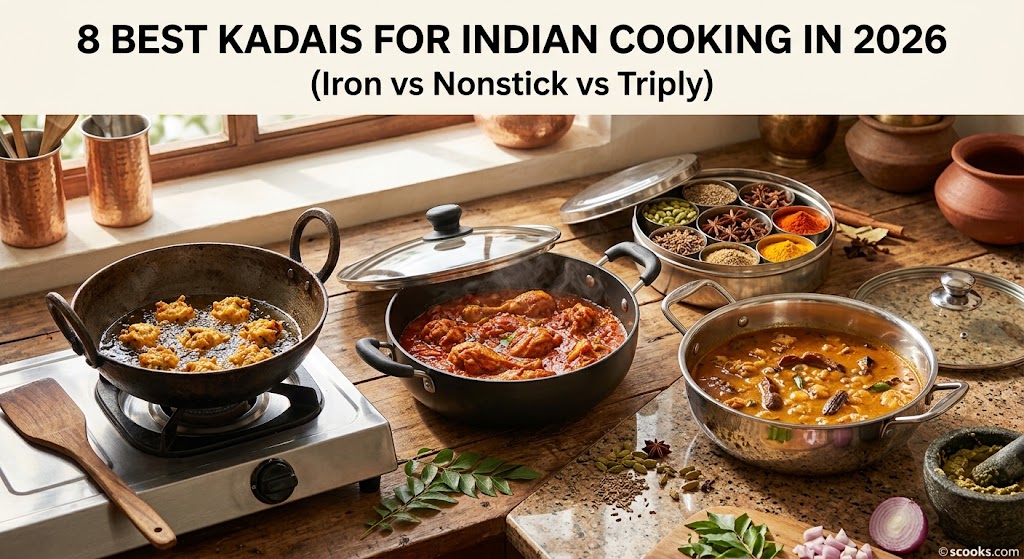
A kadai looks like a wok and is not one. The walls are steeper, the bowl deeper, the base rounder — because it was engineered for different physics. A wok is built to keep food moving fast over huge heat; a kadai is built to hold things still in hot fat and reducing masala: deep-frying puris in a modest pool of oil, bhuna-ing onions until they collapse, simmering a curry down until the oil separates. The depth is the feature — less oil to fry, less splatter to clean, more masala contact per stir.
Some links in this post are affiliate links. If you buy through them we may earn a small commission at no extra cost to you — it never changes which products we recommend.
Choosing one is really choosing a material, because kadais come in everything: bare iron that seasons like an heirloom, hard-anodized and nonstick for weeknight convenience, triply stainless for the acid-heavy tomato gravies, and brass for tradition. Each is genuinely right for a different kitchen, and the guide below is honest about which.
A kadai also completes a set this site has been building: spices staged in a masala dabba, ground fresh with the tools from our molcajete guide, and finished in the pan built for them.
Our Top 8 Picks for the Best Kadai
Best Overall: Hawkins Futura Nonstick Kadhai, 2.5 L with Stainless Lid

Hawkins Futura is the kadai millions of Indian kitchens actually run, and the reasons transfer perfectly: a thick 3.25 mm hard-anodized body that spreads heat evenly under a durable nonstick surface, the correct deep-bowl geometry, and a fitted stainless lid for the simmer-down phase every curry ends with.
At 2.5 litres it is the everyday family size — dal for four, a chicken curry, Sunday puris in surprisingly little oil. If one pan has to do all of Indian home cooking, this is the sensible one.
Key Specifications
- 2.5 L, 26 cm hard-anodized body
- 3.25 mm thickness, nonstick interior
- Stainless steel lid included
- Classic deep kadai geometry
Pros
- The proven subcontinent standard
- Thick base — no scorching masala hotspots
- Nonstick eases the daily-cook cleanup
- Lid included for simmering
Cons
- Nonstick means moderate heat and no metal tools
- Check the variant for induction compatibility
- Nonstick is a consumable surface long-term
Best Stainless: LOLYKITCH Tri-Ply Stainless Kadai, 4 Qt with Lid

Tomato, tamarind, yogurt, lime — Indian gravies are acid engines, and acid is what quietly eats seasoning off iron and shortens nonstick. Tri-ply stainless is immune: an aluminium core for even heat, sealed in steel that does not care what simmers in it, ever.
Four quarts and twelve inches makes this the big-batch and dinner-party kadai, and it is dishwasher-and-metal-spoon proof in a way no other material here is. The skill cost: stainless demands proper preheating and enough fat, or paneer will stick to teach you.
Key Specifications
- 4-quart, 12-inch tri-ply stainless
- Aluminium core, steel skin
- Induction compatible
- Lid included
Pros
- Utterly immune to acidic gravies
- Metal utensils and dishwasher fine
- Even heat from the tri-ply core
- Lifetime-grade construction
Cons
- Sticks if preheating is rushed
- Heavier than anodized aluminium
- Shows masala staining unless scrubbed
Best Traditional Iron: Handmade Iron Kadai (Lokhandi)

The bare iron kadai is the subcontinent’s cast-iron skillet: cheap, indestructible, and better every year as seasoning builds. Iron takes the ferocious heat that bhuna cooking actually wants, sears onions to the deep brown that anodized pans approximate, and generations of cooks swear by what it does to a dry sabzi.
It asks for cast-iron manners — dry after washing, film of oil, no long tomato simmers until seasoning matures — and repays them for decades. This is the heirloom option.
Key Specifications
- Handmade traditional iron kadai
- Seasons with use like cast iron
- Takes maximum heat
- Lokhandi-style construction
Pros
- Highest heat tolerance of the group
- Flavour and sear that coatings imitate
- Effectively immortal with care
- Usually the cheapest real kadai
Cons
- Needs seasoning and drying discipline
- Acidic dishes strip young seasoning
- Rusts if neglected
Best Ceramic Nonstick: Hawkins 3.5 L Ceramic Kadhai with Glass Lid

The larger, PTFE-free branch of the Hawkins family: a ceramic nonstick surface over a 3.5-litre induction-ready body, with a glass lid for watching a biryani’s dum without lifting. Ceramic coatings run hotter than classic nonstick and skip the chemistry some cooks avoid, trading a somewhat shorter coating lifespan.
The 3.5 litre size suits bigger families and the cook-once-eat-twice rhythm.
Key Specifications
- 3.5 L ceramic nonstick
- Induction compatible
- Glass lid included
- Deep-fry and curry geometry
Pros
- PTFE-free release surface
- Watchable glass lid
- Family-plus capacity
- Induction-ready out of the box
Cons
- Ceramic coatings age faster than anodized nonstick
- Still no metal utensils
- Bulkier to store
Best Hard Anodized: Vinod Black Pearl Deep Kadhai, 3.1 L with Glass Lid

Vinod’s hard-anodized kadai is the uncoated middle path: anodizing hardens the aluminium surface into something far tougher than nonstick without adding a coating that can wear off. It browns better than nonstick, weighs less than iron or triply, and shrugs off the daily tadka-bhuna-simmer cycle.
3.1 litres with a glass lid lands it squarely in family-size territory, from the same Vinod whose masala dabba topped our spice-box guide.
Key Specifications
- 3.1 L hard anodized aluminium
- No coating to wear off
- Glass lid included
- Deep family-size bowl
Pros
- Tougher surface than any nonstick
- Browns masala properly
- Light for its capacity
- Trusted Indian brand
Cons
- Not nonstick — expect some sticking early
- Anodized surfaces dislike dishwashers
- Confirm induction per variant
Best Budget Nonstick: Induction-Base Deep Kadai with Glass Lid, 240 mm

The functional minimum done right: a 240 mm nonstick kadai with an induction base and a glass lid, at student-kitchen money. It will not outlive the decade like iron or triply, but it will cook every weeknight curry of it perfectly acceptably.
For a first kitchen, a rental, or a backup pan for the second burner, this is the honest budget answer.
Key Specifications
- 240 mm nonstick with induction base
- Glass lid included
- Lightweight build
- Entry price
Pros
- Cheapest complete kadai-with-lid here
- Induction works from day one
- Light and easy handling
- Fine daily performer while it lasts
Cons
- Thinner body — hotspots on max flame
- Nonstick lifespan matches the price
- Not a buy-it-for-life pan
Best Triply Value: Stainless Triply Kadai with Steel Lid

The everyday-size triply: same sandwich construction as the LOLYKITCH in a smaller, lighter format with a steel lid, priced for the kitchen that wants stainless permanence without the party capacity.
For couples and small families cooking acid-forward gravies daily, this is the pan that simply never becomes a problem.
Key Specifications
- Tri-ply stainless construction
- Steel lid included
- Everyday compact size
- Induction compatible
Pros
- Triply benefits at a friendlier price
- Right size for daily two-to-four cooking
- Immune to acids and metal spoons
- Light enough for one-handed pouring
Cons
- Small for festival cooking
- Same preheat discipline as all stainless
- Thin lid rattles at a hard boil
Best Traditional Brass: Pure Brass Hammered Kadhai (Pital)

The brass kadai is the ceremonial branch of the family — the hammered pital pan of wedding kitchens and sweet-makers, prized for the gentle, even heat that halwa and khoya demand and for looking magnificent doing it. Traditional brass cooking vessels are tin-lined (kalai) because bare brass reacts with acidic food; confirm the lining, and re-tin when it wears.
Buy it for sweets, special occasions and the shelf it will decorate between them — not as the daily curry pan.
The iron one lives on my stove and the others live in the cupboard, which tells you most of what you need to know. It does bhaja, any dry sabzi, and anything that wants real heat under it.
After a year it looks nothing like the photo on the listing: matte black, slightly uneven, noticeably darker around the base where the flame sits, and it has finally stopped rusting between uses because the seasoning took. That took about four months of regular cooking, and during those four months it was genuinely annoying — it rusted if I left it wet and things stuck to it. Nobody warns you about that stretch. I still keep the nonstick one for anything with tomato and tamarind, because acid strips seasoning and I would rather not fight that particular battle every week.
Key Specifications
- Hand-hammered pure brass
- Traditional pital construction
- Gentle, even sweet-making heat
- Heirloom and ceremonial grade
Pros
- Unmatched for halwa and milk sweets
- Genuinely beautiful object
- Traditional craft construction
- Even, gentle heat
Cons
- Needs tin lining (kalai) for acidic food
- High maintenance polish and re-tinning
- Expensive per litre
- Not the everyday pan
The Ultimate Buying Guide for Kadais
Kadai vs Wok: Different Tools
Both are bowls of metal over flame; the resemblance ends there. A wok’s wide flare is built for tossing — food constantly moving over maximum heat. A kadai’s deeper, steeper bowl is built for containment: shallow-pool deep frying, long bhuna where onions and masala reduce against the walls, gravies simmering down. Deep-fry in a wok and you need double the oil; stir-fry in a kadai and there is nowhere to toss. Own both if you cook both cuisines — our carbon steel wok guide covers the other half.
Choosing Material by What You Actually Cook
- Nonstick / hard-anodized (Hawkins, Vinod) — the daily driver for most home cooks: easy release, easy cleanup, moderate heat. Replace the surface every several years and accept no metal spoons.
- Tri-ply stainless — the acid answer: tomato-tamarind-yogurt gravies forever, metal tools, dishwasher. Learn the preheat.
- Bare iron — the heat answer: hardest sear, best dry sabzis, heirloom lifespan, cast-iron care rules.
- Brass (tin-lined) — the sweets and ceremony answer, not the Tuesday answer.
Size Sense
- 2 to 2.5 L (24-26 cm) — couples and small families; the default
- 3 to 3.5 L — four-plus households, batch cooking
- 4 L / 12-inch — parties, big fries, festival days
The Induction Question
Traditional iron works on induction (it is iron); brass and plain aluminium do not; stainless triply almost always does; nonstick and anodized pans vary by whether an induction plate is bonded to the base — the same model often exists in both versions, so check the specific listing, not the brand.
Kadai Technique, Briefly
- Tadka wants stable heat: whole spices bloom in oil in seconds — the kadai’s depth contains the sputter.
- Bhuna is the flavour step: keep the masala moving against hot walls until oil separates; thin pans scorch here, which is why thickness matters more than coating.
- Deep-frying advantage: the narrow base means 2-3 cm of oil behaves like a fryer — monitor with a thermometer.
- Iron and anodized both hate the dishwasher; stainless alone forgives everything.
Frequently Asked Questions About Kadais
Can I use a kadai instead of a wok?
For curries, frying and braising — the kadai’s home ground — absolutely. For high-heat toss stir-frying, only grudgingly: the steep walls block the tossing motion and the deep bowl steams what should sear. The two pans overlap perhaps sixty percent; the remaining forty is why both exist.
Which kadai is best for deep frying?
Iron or hard-anodized, sized 2.5 to 3.5 litres: iron takes sustained oil temperatures indefinitely, and the narrow deep bowl means proper frying depth from remarkably little oil. Avoid deep-frying as a habit in classic nonstick — prolonged high oil heat is exactly what ages the coating.
Is an iron kadai healthy to cook in?
It is the same story as cast iron: trace iron does migrate into food, particularly acidic food, which is generally harmless and sometimes cited as a modest benefit. The practical concerns are care ones — rust and stripped seasoning — not health ones. People medically advised to limit iron intake are the exception and should prefer stainless.
Why does my stainless kadai stick?
Preheat, then fat, then food — in that order, with patience. Steel needs to reach the temperature where its surface effectively seals (a water drop should bead and skate) before oil goes in. Cold-pan paneer is welded paneer; properly preheated, stainless releases nearly as well as coatings.
How do I season an iron kadai?
Scrub off the factory coating, dry on the flame, wipe with a thin film of high-smoke-point oil, heat until it just smokes, cool, repeat two or three times. Then cook fatty, non-acidic things for the first weeks — frying builds seasoning fastest — and keep tomatoes away until the surface turns properly black.
Kadai and karahi — same thing?
Same pan, different romanisations (kadai, kadhai, karahi, cheenachatti by region). Menus use “karahi” for dishes finished in one — chicken karahi — but the vessel is the vessel across South Asia.
Final Thoughts
For most kitchens the Hawkins Futura 2.5 L is the honest answer — the pan half a continent already standardised on. Cook acid-heavy gravies daily and the LOLYKITCH triply removes every long-term worry; want the heirloom and the hardest sear, season the iron kadai and let it outlive us all.
Whichever you choose, keep the masala dabba within reach of it — the pan and the spice box are one system, and together they run the kitchen.
As an Amazon Associate we earn from qualifying purchases. Availability is accurate as of the date of publishing. We do not list prices because they change too often to quote honestly.
Rimi Sultana is a home cook from Bangladesh who has cooked for her family every day for the past five years and writes about it at Smart Cooks. Perpetually testing whether internet-famous recipes actually work in a regular home kitchen. Say hello on Facebook or through the contact page.