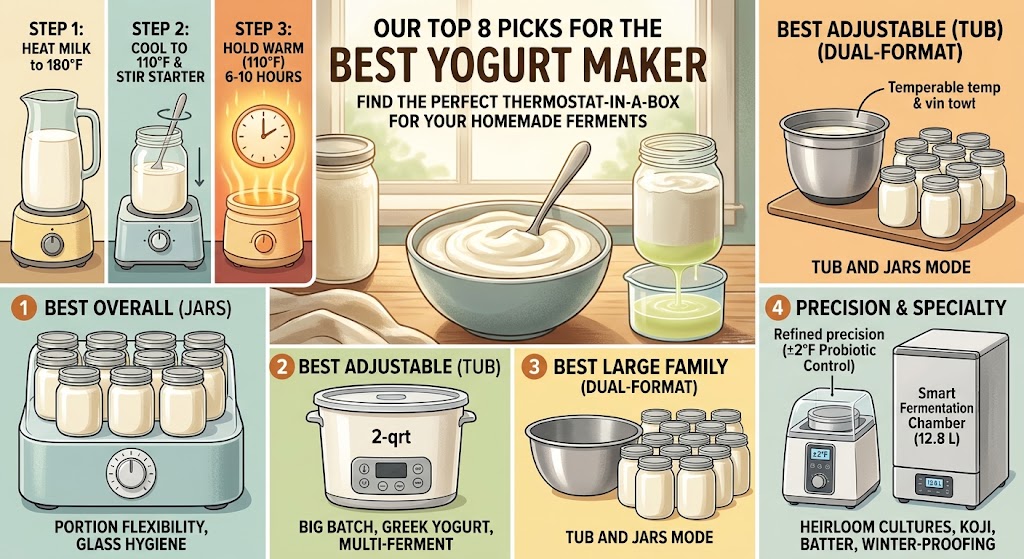
Yogurt is the least mysterious ferment in the kitchen: heat milk, cool it to warm, stir in a spoonful of live yogurt, and hold it warm and undisturbed for six to ten hours. That last clause is the entire product category. A yogurt maker is a thermostat in a box — nothing more — and the reason to own one is that “hold at 110°F for eight hours” is exactly what ovens, counters and radiators are bad at and a cheap dedicated appliance is perfect at.
Some links in this post are affiliate links. If you buy through them we may earn a small commission at no extra cost to you — it never changes which products we recommend.
The buying decisions are honest ones: jars versus one big tub (portioning convenience versus batch flexibility), fixed temperature versus adjustable (adjustable unlocks other ferments and heirloom cultures), and whether you want a timer that simply stops instead of waking you at 3 a.m. We already publish a homemade yogurt recipe — this is the equipment column to go with it.
One upstream truth before the list, familiar from our cheese kit guide: milk quality decides texture. Whole milk sets thicker than skim, and a live-culture starter (or proper freeze-dried culture) decides everything else. The machine just keeps the promise warm.
Our Top 8 Picks for the Best Yogurt Maker
Best Overall: Euro Cuisine YM80 Yogurt Maker with 7 Glass Jars

The YM80 has been the default American yogurt maker for a generation, and its formula is hard to argue with: seven six-ounce glass jars, a gentle fixed warmth in the correct culturing range, a timer dial on the front, and a price that undercuts a month of premium yogurt cups.
Jars are the underrated format for families — each is a grab-and-go portion, flavours can differ jar to jar (vanilla for the kids, plain for the dal-side raita), and glass washes honestly. Simple machine, decades of it working.
Key Specifications
- Seven 6 oz glass jars
- Fixed culturing temperature
- Front timer dial
- The long-standing category standard
Pros
- Portioned jars ready for lunchboxes
- Per-jar flavour flexibility
- Glass, not plastic, against the food
- Cheap and proven
Cons
- No temperature adjustment
- No auto-shutoff on the base model
- Jars cap batch size at ~42 oz
Best Adjustable: Euro Cuisine YM260 with Time & Temperature Control, 2 Qt

The YM260 is the serious-fermenter’s Euro Cuisine: a two-quart single vessel with genuinely adjustable time and temperature — which quietly turns a yogurt maker into a general mesophilic-and-thermophilic culturing chamber. Different cultures want different holds; a dial honours them.
Two quarts in one tub also suits the strained-yogurt households: make a big batch, strain half for Greek-style or labneh, and the machine has paid for itself in a fortnight.
Key Specifications
- 2-quart single vessel
- Adjustable time and temperature
- Auto shutoff
- Culture-flexible range
Pros
- Temperature control unlocks other ferments
- Big single batch for straining
- Shuts itself off
- Trusted brand lineage
Cons
- No portion jars
- Bigger footprint than jar models
Best Digital Jars: GDOR Yogurt Maker with 8 Jars, 48-Hour Timer

The modernised jar machine: eight six-ounce jars under a digital panel with adjustable temperature and a timer that runs to 48 hours — which matters because long, cool ferments are how you brew genuinely tart, probiotic-dense yogurt, and 24-hour-plus specialty protocols (popular in some dietary approaches) need a machine that will actually go the distance.
Set, walk away, and the shutoff handles the 3 a.m. problem.
Key Specifications
- Eight 6 oz jars
- Adjustable temperature
- 48-hour digital timer with shutoff
- Digital control panel
Pros
- Long-timer support for extended ferments
- Jar portioning plus real controls
- Auto shutoff
- Eight jars beats seven
Cons
- More electronics to eventually fail
- Jar lids are the losable part
Best Large Family: 1.7-Quart Maker with Stainless Bowl and 9 Jars
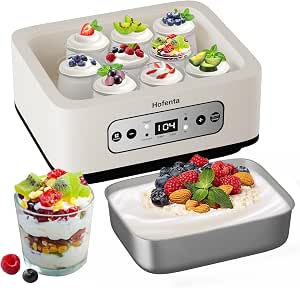
The both-formats machine: a 1.7-quart stainless inner bowl for big batches and nine glass jars for portion weeks, swapping on the same warming base. Stainless is the right tub material — it pours, chills fast, and never stains turmeric-gold the way plastic tubs do after the first shrikhand experiment.
For a household that alternates between family-tub and lunchbox modes, this is the one machine that does both without compromise.
Key Specifications
- 1.7-qt stainless bowl plus 9 jars
- Digital timer and temp control
- Dual-format warming base
- Glass and steel food contact
Pros
- Tub and jar modes in one machine
- Stainless bowl cleans and cools well
- Nine-jar capacity
- Full digital control
Cons
- Most parts to store of any pick
- Bowl and jars cannot run together
Best Precision: 6-Jar Maker with ±2°F Probiotic Control

Culture nerdery, rewarded: this six-jar machine holds temperature within a couple of degrees, which is precisely what finicky cultures care about — heirloom strains, Bulgarian starters and specific probiotic blends all have narrow happy zones, and a ±2°F hold keeps them in it batch after batch.
If your starter came from a culture library rather than a supermarket cup, this is the machine that respects the lineage.
Key Specifications
- Six jars with precision hold
- ±2°F class temperature stability
- Timer control
- Probiotic-focused design
Pros
- Stable holds for fussy heirloom cultures
- Repeatable results batch to batch
- Compact six-jar format
- Set-and-forget controls
Cons
- Six jars is the smaller batch
- Precision is wasted on supermarket starters
Best Multi-Ferment: 12.8 L Smart Fermentation Chamber

This is not a yogurt maker so much as a countertop fermentation chamber that also makes yogurt: 12.8 litres of controlled warm space that will hold whatever temperature your project wants — yogurt today, natto or tempeh next week, a kombucha jar through a cold snap, dosa-idli batter overnight in a winter kitchen.
For readers who followed our fermentation and kombucha guides into the hobby, this is the infrastructure purchase that serves every culture in the house.
Key Specifications
- 12.8 L fermentation chamber
- Wide temperature range
- Fits jars, tubs and trays
- Multi-ferment design
Pros
- One chamber for every warm ferment
- Winter-proofs batter and kombucha
- Huge capacity
- True temperature flexibility
Cons
- Counter-hostile size
- Overkill for yogurt alone
- More to clean
Best Premium: TANICA YOGURTiA Fermentation Machine

TANICA is the Japanese fermentation-appliance specialist, and the YOGURTiA is its export: precise temperature control in a refined, compact chamber trusted for everything from yogurt to amazake and koji work — ferments where a degree or two genuinely changes the result.
It is the most machine anyone needs for cultured dairy, and the right machine if Japanese ferments are on your horizon.
Key Specifications
- Precision Japanese fermentation machine
- Wide, accurate temperature range
- Yogurt, amazake, koji capable
- Compact chamber format
Pros
- Best-in-class temperature fidelity
- Multi-ferment credibility
- Quality Japanese build
- Compact for its abilities
Cons
- Premium price
- Imported availability fluctuates
- Manual leans on translated instructions
Best Budget Digital: 6-Jar Maker with Glass Jars and Temp Control

The lowest-cost route to a digital machine with glass jars and adjustable control — the spec sheet of machines twice its price, built to its price. For a first yogurt maker, or a second base for the other end of the counter, it makes the same yogurt the expensive ones do, because the biology never checks the receipt.
When I make doi at home, the secret to getting a set thick enough to hold a spoon upright isn’t the machine itself—it’s patiently boiling full-fat cow’s milk until it reduces by about twenty percent, letting it cool just until it is comfortably warm to the touch, and whisking in a generous spoonful of a previous batch’s thick homemade yogurt as the starter.
Key Specifications
- Six glass jars
- Digital temperature and timer
- Auto shutoff
- Entry price
Pros
- Cheapest adjustable digital option
- Glass jars at budget money
- Timer with shutoff included
- Same biology, smaller bill
Cons
- Lighter build and lid fit
- Fewer jars than the GDOR
- Longevity matches the price tier
The Ultimate Buying Guide for Yogurt Makers
Jars vs Tub
Jar machines portion as they ferment — lunchbox-ready, per-jar flavours, glass hygiene — at the cost of batch ceiling and lid-juggling. Tub machines make the big undivided batch that straining households need: Greek yogurt, labneh, shrikhand and raita all start from quantity. The dual-format machines exist because most families are honestly both.
Fixed vs Adjustable Temperature
Standard yogurt cultures are content around 105-115°F, which is all a fixed machine offers — and for supermarket-starter yogurt, all you need. Adjustability earns its money the day you meet anything else: heirloom and Bulgarian strains with preferences, long-ferment protocols, and the whole world of warm ferments beyond dairy — batter, natto, tempeh, koji — that a controllable chamber quietly unlocks.
The Process the Machine Cannot Do for You
- Heat milk to ~180°F first — this reshapes the proteins for a thicker set — then cool to ~110°F before culturing; hot milk kills the starter
- Starter: a spoonful per quart of live-culture yogurt, or a packet of freeze-dried culture; more starter is not thicker, it is crowded
- Do not jostle the machine mid-set — disturbed yogurt sets grainy and weepy
- Ferment 6-10 hours to taste: longer is tarter; chill before judging thickness, cold finishes the set
- Whole milk, or add milk powder, for spoon-standing thickness; skim sets thin by nature
Straining and the Whey Bonus
Greek yogurt is just yogurt minus whey: strain through cloth in the fridge for two to four hours (longer makes labneh). The whey that drains is the same useful liquid our cheese guide defends — bread, smoothies, rice, plants. A two-quart tub becomes a quart of Greek and a quart of whey; nothing is lost but water weight.
Frequently Asked Questions About Yogurt Makers
Why is my homemade yogurt thin or slimy?
Thin: milk not pre-heated to 180°F, skim milk, too-short ferment, or a tired starter — fix in that order. Slimy or ropey usually means culture trouble: an old starter or contamination; start fresh with new culture and scalded equipment. And always chill fully before judging — warm yogurt is honestly loose.
Can I keep using my own yogurt as the next starter?
For several generations, yes — then vigour fades as wild strains crowd in, typically after 4-8 batches. When sets slow down or thin out, refresh from a new live-culture cup or a fresh culture packet. Heirloom cultures, properly kept, re-culture indefinitely — that is their entire point.
Do I really need a machine? My oven light works.
Every warm corner trick works sometimes — oven light, cooler of warm water, wrapped Instant Pot. The machine’s only claim is working every time, unattended, at a held temperature, for the price of a few supermarket tubs. If your improvised method never fails you, keep it; most people buy the thermostat after the second soupy batch.
How long does homemade yogurt keep?
About two weeks refrigerated, growing gently tarter as it goes — and save a spoonful as the next batch’s starter before the two weeks run out. Strained yogurt keeps similarly; the drier labneh end lasts longest, especially rolled and oiled.
Can yogurt makers use non-dairy milk?
Yes, with adjusted expectations: soy sets most readily; coconut and oat need added thickeners or specialised vegan cultures to move past drinkable. Use cultures marketed for plant milks, and treat the first batches as experiments. The machines neither know nor care what the milk came from.
Final Thoughts
The Euro Cuisine YM80 remains the sensible default — cheap, proven, portioned. Strainers and tinkerers should reach for the YM260 or the stainless dual-format machine; culture collectors, the precision six-jar; and anyone whose counter already ferments in three languages will recognise the 12.8 L chamber as infrastructure, not appliance.
Whole milk, 180 then 110, a spoonful of live starter, eight undisturbed hours — and our homemade yogurt recipe for the walkthrough. The machine keeps the temperature; the culture keeps the tradition.
As an Amazon Associate we earn from qualifying purchases. Availability is accurate as of the date of publishing. We do not list prices because they change too often to quote honestly.

Rimi Sultana is a home cook from Bangladesh who has cooked for her family every day for the past five years and writes about it at Smart Cooks. Perpetually testing whether internet-famous recipes actually work in a regular home kitchen. Say hello on Facebook or through the contact page.