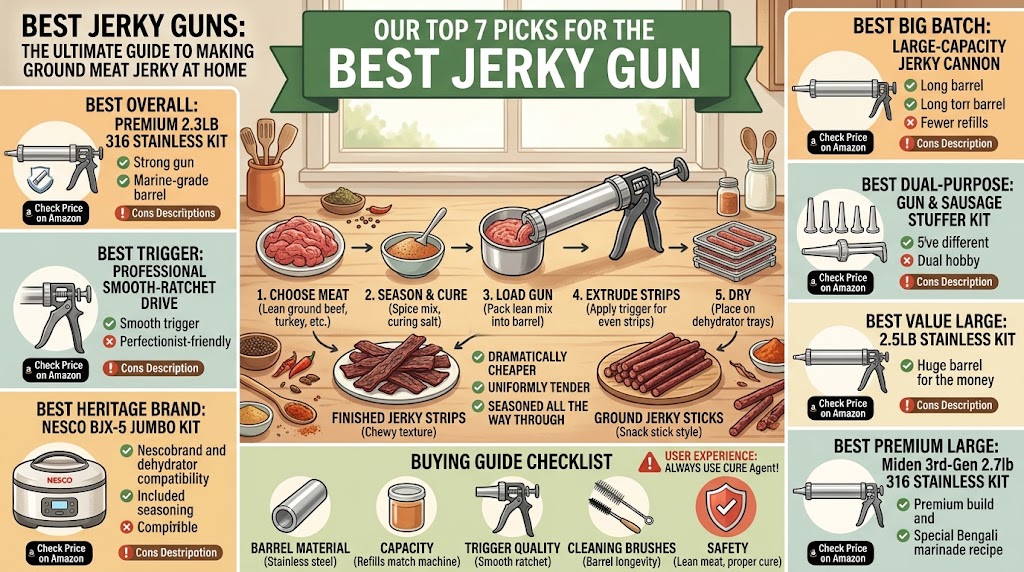
There are two kinds of homemade jerky. Whole-muscle jerky is sliced from a roast, marinated, and dried — chewy, traditional, and hostage to your knife skills and the grain of the meat. Ground jerky is seasoned ground meat extruded into flat strips or sticks and dried — uniformly tender, seasoned all the way through instead of surface-deep, and dramatically cheaper because ground meat costs less than whole rounds. The jerky gun exists for the second kind, and the second kind is why people who own dehydrators end up owning guns.
Some links in this post are affiliate links. If you buy through them we may earn a small commission at no extra cost to you — it never changes which products we recommend.
A jerky gun is a caulking gun for meat: barrel, plunger or ratchet trigger, and nozzles — flat for strips, round for sticks. The buying variables are barrel capacity (refills are the tedium), material (stainless barrels and metal ratchets outlive plastic ones by years), and trigger quality, because a gritty ratchet under a pound of cold seasoned beef is where cheap guns die.
The gun’s natural partner is already reviewed on this site — our best dehydrator for beef jerky guide covers the drying half. Here are seven guns for the loading half.
Our Top 7 Picks for the Best Jerky Gun
Best Overall: Premium 2.3 lb 316 Stainless Jerky Gun Kit

The spec that matters most in a jerky gun is the barrel, and this kit’s is upgraded 316 stainless — the marine-grade alloy that shrugs off salty, acidic marinade-laden meat where aluminium pits and plastic stains. At 2.3 pounds per load it runs a full dehydrator tray-set from roughly two fills.
Metal ratchet, flat and round nozzles, and cleaning brushes in the box. This is the kit for someone who makes jerky monthly rather than annually.
Key Specifications
- 2.3 lb capacity 316 stainless barrel
- Metal ratchet trigger
- Flat and round nozzles
- Cleaning brushes included
Pros
- Marine-grade barrel survives salty meat
- Big loads mean fewer refills
- Smooth ratchet under full load
- Complete kit with brushes
Cons
- Heavier in hand when loaded
- Costs more than aluminium rivals
Best Big Batch: Large-Capacity Stainless Jerky Cannon

The cannon format — a longer, fatter barrel — exists because refilling is the worst part of jerky day. More meat per load means a full dehydrator’s worth of strips extruded in one continuous session, trigger-squeezing in rhythm instead of stopping to repack.
If your dehydrator runs nine trays, match it with a cannon rather than a pistol.
Key Specifications
- Extra-large stainless barrel
- Cannon-length format
- Strip and stick nozzles
- High-volume design
Pros
- Fewest refills per dehydrator load
- Consistent strips over long runs
- Solid stainless contact surfaces
- Right scale for nine-tray dehydrators
Cons
- Long barrel is harder to wash and store
- Unwieldy for small batches
Best Heritage Brand: NESCO BJX-5 Jumbo Jerky Works Kit

NESCO is the dehydrator company — the machines in our dehydrator guide wear the same badge — and the Jerky Works kit is their matching press, sized and shaped to lay strips that fit NESCO trays exactly. Included seasoning-and-cure packets get a first batch made the day the box arrives.
The press body is working plastic rather than stainless; the brand ecosystem, spare parts and cure-packet supply are the argument.
Key Specifications
- NESCO jumbo press kit
- Seasoning and cure packets included
- Strip and stick attachments
- Matched to NESCO dehydrator trays
Pros
- First batch possible out of the box
- Cure packets remove guesswork
- Spares ecosystem of a real brand
- Strips sized to the matching trays
Cons
- Plastic body wears faster than steel
- Modest capacity per load
Best Dual-Purpose: Stainless Jerky Gun and Sausage Stuffer Kit

Five nozzles turn one barrel into two hobbies: flat jerky strips and round meat sticks one weekend, small-casing sausage stuffing the next. The geometry is genuinely shared — a jerky gun is a small sausage stuffer with different exits — and this kit leans into it honestly.
For a household curious about snack sticks in casings, this is the cheapest respectable way to find out before committing to a crank stuffer.
Key Specifications
- Stainless barrel, 5 nozzles
- Jerky strips, sticks and casing stuffing
- Trigger-driven
- Dual-purpose kit
Pros
- Two meat hobbies, one tool
- Casing nozzles included
- Stainless where it matters
- Good value breadth
Cons
- Casing work is slower than a crank stuffer
- More nozzles to clean and track
Best Trigger: 2 lb Professional Gun with Smooth-Ratchet Drive

Trigger feel is the ergonomic heart of a jerky gun: cold seasoned ground beef is stiff, and a coarse ratchet under that load means surging strips — thick, thin, thick — that dry unevenly. This two-pounder’s finer ratchet advances the plunger in small, smooth increments, which is exactly what even strips require.
The pick for anyone whose hands tire quickly, and for perfectionists about strip uniformity.
Key Specifications
- 2 lb stainless barrel
- Fine-pitch smooth ratchet
- Strip and stick nozzles
- Professional-grade drive
Pros
- Smoothest extrusion control here
- Even strips dry evenly
- Kind to tired hands
- Solid build
Cons
- Fine ratchets mean more squeezes per strip
- Mid-pack capacity
Best Value Large: 2.5 lb Stainless Jerky Gun Kit

The volume-per-dollar pick: a 2.5-pound stainless barrel — the largest standard-format load on this list — at mid-range money. One fill lays most of a dehydrator; two fills does jerky for a hunting camp.
Fit and finish sit a notch below the 316 premium kit; the working capacity does not.
Key Specifications
- 2.5 lb capacity barrel
- Stainless construction
- Multiple nozzles
- Volume-value positioning
Pros
- Biggest standard loads for the money
- Fewer refill interruptions
- Stainless contact surfaces
- Camp-batch friendly
Cons
- Finish below premium kits
- Heavy at full load
Best Premium Large: Miden 3rd-Gen 2.7 lb 316 Stainless Kit
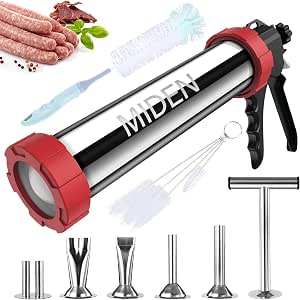
The maxed-out spec sheet: 2.7 pounds of capacity in a 316 stainless barrel with a third-generation drive — the kit for the jerky maker who has already worn out a plastic gun and wants the last one they buy.
The last time I prepped a large batch of ground beef for a homemade shutki-style dry, I ditched the standard western sauces and marinated the meat overnight with roasted cumin powder, garlic paste, a splash of mustard oil, and a tiny scrape of Naga chili; pushing that dense, spice-heavy mixture through the gun yielded an intense, deeply flavorful jerky with a perfectly authentic kick.
Key Specifications
- 2.7 lb capacity, 316 stainless
- Third-generation ratchet drive
- Full nozzle and brush kit
- Premium build
Pros
- Largest premium-grade capacity
- Marine-grade barrel longevity
- Refined drive under load
- Buy-once positioning
Cons
- Top-of-category price
- More gun than an annual batch needs
The Ultimate Buying Guide for Jerky Guns
Why Ground Jerky at All?
Three honest reasons: cost (lean ground beef undercuts whole rounds), texture (ground jerky is tender where whole-muscle is a jaw workout — kinder to kids and dental work), and seasoning depth (mixed through the meat, not marinated onto its surface). Whole-muscle purists are not wrong about tradition; they are just answering a different question. Most jerky households end up making both.
The Specs That Matter
- Barrel material: 316 stainless > standard stainless > aluminium > plastic. Salty cured meat is corrosive and staining; the barrel lives in it.
- Capacity: 1 lb guns refill constantly; 2 to 2.7 lb loads match dehydrator trays. Match the gun to the machine.
- Trigger: fine metal ratchets extrude smooth, even strips; coarse plastic ones surge and eventually strip their teeth.
- Nozzles: flat for classic strips, round for snack sticks; casing nozzles turn the gun into a small sausage stuffer.
- Brushes included — a barrel you cannot clean properly is a barrel you will retire early.
Meat, Cure and Safety — the Part That Is Not Optional
Ground meat carries surface bacteria all the way through, which is why food-safety guidance for ground jerky is firm: use lean meat (90/10 or leaner — fat goes rancid, not dry), use a proper curing agent per its packet directions for shelf-stable results, and ensure the meat reaches a safe internal temperature — USDA guidance favours heating to 160°F, either by pre-heating or by finishing dried strips in the oven — rather than trusting drying alone. Follow tested recipes; jerky is preserved meat, and preserved meat rewards precision.
Technique for Even Strips
- Chill the seasoned meat an hour before loading — cold mix extrudes cleaner and tastes better cured
- Pack the barrel in small handfuls, punching out air pockets; trapped air spits gaps into strips
- Extrude in one continuous motion per strip, directly onto the tray, cutting at the nozzle
- Uniform thickness beats uniform length — thickness is what dries evenly
- Wash the barrel immediately; dried seasoned meat in a tube is a chisel job
Frequently Asked Questions About Jerky Guns
What meat works besides beef?
Lean ground turkey and chicken (cure and 165°F handling non-negotiable), venison (the classic gun meat — hunters invented this workflow), and lamb or goat for spiced styles. The constant is leanness: whatever the animal, fat is the enemy of shelf life.
Do I really need curing salt?
For refrigerated, eaten-this-week jerky, tested recipes exist without it. For shelf-stable jerky, room-temperature storage, or any batch where botulism-adjacent risk matters — use cure per its directions, full stop. It is a teaspoon-scale ingredient with a century of safety behind it; this is not the corner to improvise.
How long does ground jerky take to dry?
Typically four to eight hours at jerky settings (about 160°F) depending on strip thickness and machine — our dehydrator guide covers the hardware. Done right, a strip cracks when bent but does not snap, with no moist centre line.
Can I use a jerky gun without a dehydrator?
Yes — an oven at its lowest setting with the door cracked, strips on racks over sheet pans, works and always has. It is less energy-efficient and needs more attention than a dehydrator, but the gun neither knows nor cares what dries its output.
How do I clean the gun properly?
Disassemble fully, wash barrel, plunger and nozzles in hot soapy water with the included brushes immediately after use, and dry completely before reassembly — trapped moisture in a capped barrel is the other way guns retire early. Stainless components generally tolerate the dishwasher; ratchet handles prefer the sink.
Final Thoughts
The 2.3 lb 316 stainless kit is the right gun for a real jerky habit; the cannon if your dehydrator runs deep; the NESCO kit if its dehydrator already lives on your counter and you want cure packets included with your training wheels.
Lean meat, real cure, cold mix, even strips — then let the dehydrator do the patient half. Homemade jerky costs half the store price and answers to your spice cupboard; the gun is just the honest middleman.
As an Amazon Associate we earn from qualifying purchases. Availability is accurate as of the date of publishing. We do not list prices because they change too often to quote honestly.

Rimi Sultana is a home cook from Bangladesh who has cooked for her family every day for the past five years and writes about it at Smart Cooks. Perpetually testing whether internet-famous recipes actually work in a regular home kitchen. Say hello on Facebook or through the contact page.