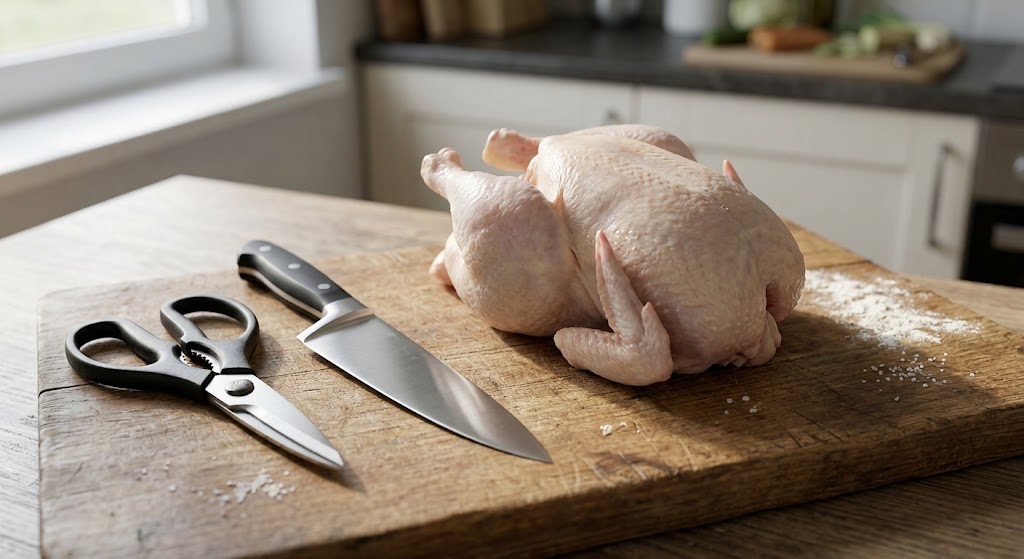
When you’re breaking down a whole chicken, the tool you reach for changes everything about how the job goes. A chef’s knife feels like the “proper” choice, but kitchen shears often get the job done faster and safer. The honest answer is that you probably want both, but if you’re only going to buy one right now, here’s how to decide.
Some links in this post are affiliate links. If you buy through them we may earn a small commission at no extra cost to you — it never changes which products we recommend.
What Each Tool Is Actually Good At
Kitchen shears: speed and control on bone and cartilage
Shears excel at cutting through joints, cartilage, and thin bones — the connective tissue between a thigh and a drumstick, the backbone of a whole chicken for spatchcocking, the rib cage of a rack. Because you’re squeezing rather than pressing down with your body weight, you get more control with less risk of the blade slipping, which matters when the bird is wet and the cutting board is slick.
A chef’s knife: precision on flesh and portioning
A knife is better at everything shears are bad at: clean slices through muscle, portioning breast meat into even pieces, trimming fat, and any cut where you need a straight, precise line rather than a crushing or shearing action. Trying to cut through meat (not bone) with shears tends to tear and compress it rather than slice cleanly.
From My Kitchen
I used to break down whole chickens with just a chef’s knife because that’s what every recipe video shows, and I’d fight the backbone every single time — knife slipping, board sliding, way more force than felt safe. The first time I used shears just for that one cut (removing the backbone) and switched to the knife for the rest, the whole process went from a wrestling match to maybe two minutes of actual work. I still use the knife for portioning and trimming; the shears just replaced the one part that never worked well with a blade.
Worth Considering
For general kitchen use — trimming herbs, cutting open packaging, breaking down poultry — the KitchenAid All Purpose Kitchen Shears are sturdy, dishwasher safe, and come apart for cleaning. If poultry prep is a regular thing in your kitchen, dedicated poultry shears with a built-in bone notch make backbone and joint cuts even easier, and often include a nutcracker-style base for tougher bones.
Where Each Tool Wins on a Bird
Shears win wherever you are cutting through or around bone. Spatchcocking a chicken means removing the backbone, and a pair of shears goes through those ribs in four or five deliberate cuts with the force coming from your whole hand. Doing the same with a chef’s knife means either finding the joint precisely or hammering the blade through bone, which is how knives chip and how people slip.
The knife wins on everything that is a slice rather than a cut. Separating a thigh from a drumstick at the joint, removing a breast from the carcass, trimming skin, portioning cooked meat — these all want a long blade that follows a line cleanly. Shears crush as much as they cut on soft flesh, and the result looks ragged.
Quick Comparison
| Task | Shears | Chef’s knife |
|---|---|---|
| Removing the backbone | Excellent | Difficult and risky |
| Cutting through rib bones | Excellent | Poor |
| Separating joints | Good | Excellent |
| Removing breast meat | Poor | Excellent |
| Trimming skin and fat | Good for small trims | Excellent |
| Portioning a cooked bird | Good, no board needed | Excellent |
What Makes Poultry Shears Different
Kitchen shears and poultry shears are not the same tool. Poultry shears usually have a curved blade, a bone notch near the pivot for gripping and snapping small bones, and a spring that reopens them so you are only supplying the closing force. That spring matters more than it sounds — working through a whole chicken with unsprung shears is genuinely tiring.
The other feature worth insisting on is that the blades come apart. Poultry shears get raw chicken deep into the pivot, and a pair that cannot be separated cannot be cleaned properly. Take-apart shears go in the dishwasher as two pieces and dry completely, which is the difference between a hygienic tool and one that develops a smell.
Two Options Worth Considering
Best all-purpose: KitchenAid All Purpose Kitchen Shears
Sensible if you want one pair that handles poultry occasionally alongside herbs, packaging and general kitchen work. Not as specialised as dedicated poultry shears, but far more likely to be within reach when you need scissors.
Pros
- Useful for everyday kitchen tasks too
- Come apart for proper cleaning
- Comfortable grips
Cons
- No bone notch or spring for heavy poultry work
- Less leverage on thick bone
Best for whole birds: Poultry Shears With Built-in Bone Notch
The bone notch and spring return are what make working through a whole chicken quick rather than a fight. Worth owning specifically if you buy whole birds and spatchcock or portion them yourself.
Pros
- Bone notch grips and snaps small bones
- Spring return reduces hand fatigue
- Curved blades follow a carcass well
Cons
- Too specialised for everyday scissor jobs
- Bulkier to store than standard shears
Frequently Asked Questions
Can shears fully replace a knife for chicken prep?
No — they handle bone and joint cuts well but do a poor job on clean meat slices. Most home cooks get the best results using shears for backbone and joint separation, then a knife for portioning.
Are kitchen shears safe to put in the dishwasher?
Most all-purpose kitchen shears are dishwasher safe, but check the specific product — some with wood or riveted handles are hand-wash only to avoid loosening the joint.
Can I put kitchen shears in the dishwasher?
Only if they come apart, and then they should. Shears that do not separate trap raw poultry residue in the pivot where no brush reaches and no dishwasher jet gets to, and that is where the smell and the bacteria live. If yours do not separate, wash them immediately by hand with the blades open, working a brush into the pivot, and dry them fully before closing.
Is it safe to cut through chicken bones with a chef’s knife?
Through rib bones, yes with care, but it is not what the knife is for — and the technique people improvise, hitting the spine of the blade with their palm, is how chips and slips happen. Leg and thigh bones should never be cut with a chef’s knife; find the joint and cut through the cartilage instead, which takes almost no force. A cleaver is the right tool if you genuinely need to go through heavy bone.

Rimi Sultana is a home cook from Bangladesh who has cooked for her family every day for the past five years and writes about it at Smart Cooks. Perpetually testing whether internet-famous recipes actually work in a regular home kitchen. Say hello on Facebook or through the contact page.