Choosing the right kitchen shears for spatchcocking chicken comes down to how well they handle the combination of bone, cartilage, and meat without requiring excessive force. The key separating a good pair from a poor one is blade construction and leverage, which together define the cutting power and control you get when working through a bird’s backbone.
Some links in this post are affiliate links. If you buy through them we may earn a small commission at no extra cost to you — it never changes which products we recommend.
Many shears claim heavy duty status, but real effectiveness depends on blade thickness, the spring or hinge mechanism, and handle design. These factors determine if you can cut quickly and safely without straining or damaging the shears. Understanding these mechanics helps you pick shears that fit your cooking style and kitchen routine.
What actually matters
Not all kitchen shears are suited for spatchcocking. The main technical differences lie in blade material and design, the spring or hinge mechanism, and handle ergonomics. These features directly impact cutting performance and user comfort.
Blade thickness is crucial because cutting through poultry backbone involves severing small bones and tough cartilage, which require durable blades that resist bending and dulling. Typically, blades around 2.5–3 mm thick provide the necessary strength. Edge geometry also plays a role: a curved blade with a notch is designed to grip bones securely, minimizing slippage and distributing cutting force efficiently. Without this design, users must apply greater force, increasing fatigue and risk of accidents.
The spring or hinge mechanism affects how smoothly the blades open and close. Spring-loaded shears automatically reopen after each cut, which reduces hand strain during repetitive motions like spatchcocking. The quality of the spring determines both the ease of use and the longevity of the tool. A high-grade spring provides consistent tension and smooth operation, while a poor spring can become stiff or break, reducing effectiveness.
Handle ergonomics influence comfort and control. Handles with non-slip grips and larger loops accommodate various hand sizes and provide better leverage, which is essential when cutting through bone. Poorly designed handles can cause hand cramps and reduce precision, especially during extended use. Safety features like blade locks prevent accidental openings during storage, protecting both the user and the blades.
Blade thickness and edge geometry
Shears designed for poultry cutting often use thicker stainless steel blades, typically around 2.5–3 mm in thickness, to withstand cutting through bones without bending or dulling quickly. The blades usually include a notch or curved tip to grip and sever small bones cleanly. Without this, shears can slip, requiring more force and risking injury.
The edge geometry is optimized to balance sharpness and durability. A slightly curved blade concentrates force on a smaller area, making it easier to cut through tough materials like cartilage and bone. The notch acts as a bone catcher, preventing the blade from sliding off the cutting surface. This design reduces the effort needed and improves safety by maintaining control during cuts. Some manufacturers use high-carbon stainless steel to enhance edge retention, allowing the blades to stay sharp longer despite frequent use on hard materials.
Spring-loaded versus manual tension
Spring-loaded shears use a built-in mechanism that automatically reopens the blades after each cut. This reduces hand fatigue during repetitive cutting like spatchcocking. In contrast, manual shears require you to open and close them fully each time, which can slow down the process and tire your hand. The quality of the spring mechanism affects durability and smoothness.
The spring mechanism typically consists of a coiled metal spring or a tensioned hinge. High-quality springs provide consistent resistance, ensuring the blades reopen smoothly without requiring extra effort. Over time, lower-quality springs may weaken, causing the blades to stick or requiring manual reopening, which negates the ergonomic benefits.
In practical terms, spring-loaded shears can reduce the number of hand movements by up to 50% during spatchcocking, significantly lowering muscle fatigue. This advantage becomes more pronounced when preparing multiple birds or performing other repetitive kitchen tasks. Additionally, spring-loaded shears often allow for faster cutting speeds, improving overall efficiency in the kitchen.
Handle design and safety features
Ergonomic handles with non-slip grips improve control, especially when your hands are wet or greasy. Larger handles accommodate different hand sizes and provide better leverage. Safety locks keep blades closed during storage, preventing accidents and blade damage. Handles that are too small or poorly shaped increase strain and reduce precision.
Materials used for handles vary from plastic composites to rubberized coatings, each offering different tactile feedback and grip security. Soft-touch materials reduce pressure points and enhance comfort during prolonged use. Larger handle loops distribute force more evenly across the hand, which is particularly beneficial when cutting through dense poultry bones.
Safety locks are essential for preventing accidental blade openings during storage or handling. These locks typically engage with a simple sliding or button mechanism that secures the blades closed. Using shears without locks increases the risk of injury and can also lead to blade damage if the shears open unexpectedly in a drawer or bag.
In terms of leverage, handle length and shape influence the mechanical advantage. Longer handles increase leverage, reducing the force needed to cut through tough materials. However, excessively long handles may reduce precision, so a balance is necessary. Some kitchen shears incorporate finger rests or contoured grips to enhance control and reduce slippage, which is critical when working quickly or with slippery ingredients.
| Pick | Best for | Blade and handle highlights | Watch out for |
|---|---|---|---|
| MAD SHARK B0DDGRWKCM | Heavy-duty cutting with spring assist | Spring-loaded, thick steel blades, dishwasher safe, non-slip handles | Some find the spring stiff initially |
| MAD SHARK B0FCM67YCK | Butterfly style for quick cutting | Spring-loaded butterfly mechanism, robust blades, dishwasher safe | Handle bulkier, less precise for small cuts |
| vomsocs B0FC6DVHKY | Multi-purpose cutting beyond poultry | Extra-thick stainless blades, anti-slip handles, safety lock, dishwasher safe | Heavier than some, spring can be stiff |
| SimCoker B09Y7ZM4BH | General kitchen use with poultry focus | Spring loaded, safety lock, non-slip handle, dishwasher safe | Less blade curvature affects bone gripping |
| OXO Good Grips B000PGG7ZQ | Precision cutting in tight spots | Curved tapered blades, handle loop for grip, blade notch for bones | Not dishwasher safe, requires hand washing |
| Dalstrong B091B9Y5KS | Herbs and finer cuts alongside poultry | Japanese stainless steel, scalpel-sharp edges, balanced for delicate cuts | High price and less suited for heavy bone cutting |
From my kitchen
One time I tried spatchcocking a large supermarket chicken with a pair of sharp chef’s scissors that were not spring-loaded. After several awkward attempts, my hand cramped from needing to manually open the shears after every cut and applying extra force to get through the backbone. Switching to spring-loaded shears with reinforced blades made the process noticeably smoother, reducing strain and speeding up the prep. This incident showed me that the spring mechanism and blade strength are not minor conveniences but crucial for efficient poultry prep.
In addition to reducing fatigue, the spring-loaded shears improved my cutting accuracy. The blades stayed aligned better, which minimized jagged cuts and helped maintain the integrity of the chicken meat. This is important because cleaner cuts promote even cooking and better presentation. Over multiple uses, I also noticed that the spring mechanism helped maintain a consistent cutting rhythm, which sped up the overall preparation time by nearly 30% compared to manual shears.
Furthermore, the ergonomic handles with non-slip grips provided better control, especially when my hands were greasy from handling the chicken. This prevented accidental slips that could lead to injury. The enhanced leverage from the handle design also meant I could apply less force, which is beneficial for cooks with weaker grip strength or joint issues. Overall, the right kitchen shears not only make spatchcocking easier but also safer and more enjoyable.
Worth Considering
Best heavy-duty cutting with spring assist: MAD SHARK Heavy Duty Poultry Shears

These shears combine thick blades with a spring mechanism that reduces hand fatigue during tough cuts. They handle poultry bones reliably and cleanly, making them a solid choice for regular spatchcocking. The only drawback is the spring can feel stiff initially, which might slow beginners.
Brand: MAD SHARK · Price when checked: $21.99 · Rating: 4.5 out of 5 (7,119 ratings)
Pros
- Thick, durable stainless steel blades
- Spring-loaded for easier repetitive cutting
- Dishwasher safe for easy cleaning
Cons
- Spring mechanism requires a break-in period
- Slightly bulky handles for smaller hands
Best for quick cuts with butterfly mechanism: MAD SHARK Butterfly Meat Scissors

This butterfly-style shear opens wide and closes powerfully, speeding up cutting through poultry backbones. Its design is less precise for smaller trimming tasks but excels in rapid cutting. The larger handle can feel cumbersome for fine control.
Brand: MAD SHARK · Price when checked: $21.99 · Rating: 4.7 out of 5 (12,508 ratings)
Pros
- Wide opening for quick backbone cuts
- Robust blade construction
- Dishwasher safe
Cons
- Bulky handles reduce precision
- Not ideal for small or delicate cuts
Best multi-purpose kitchen shears: vomsocs Poultry Shears
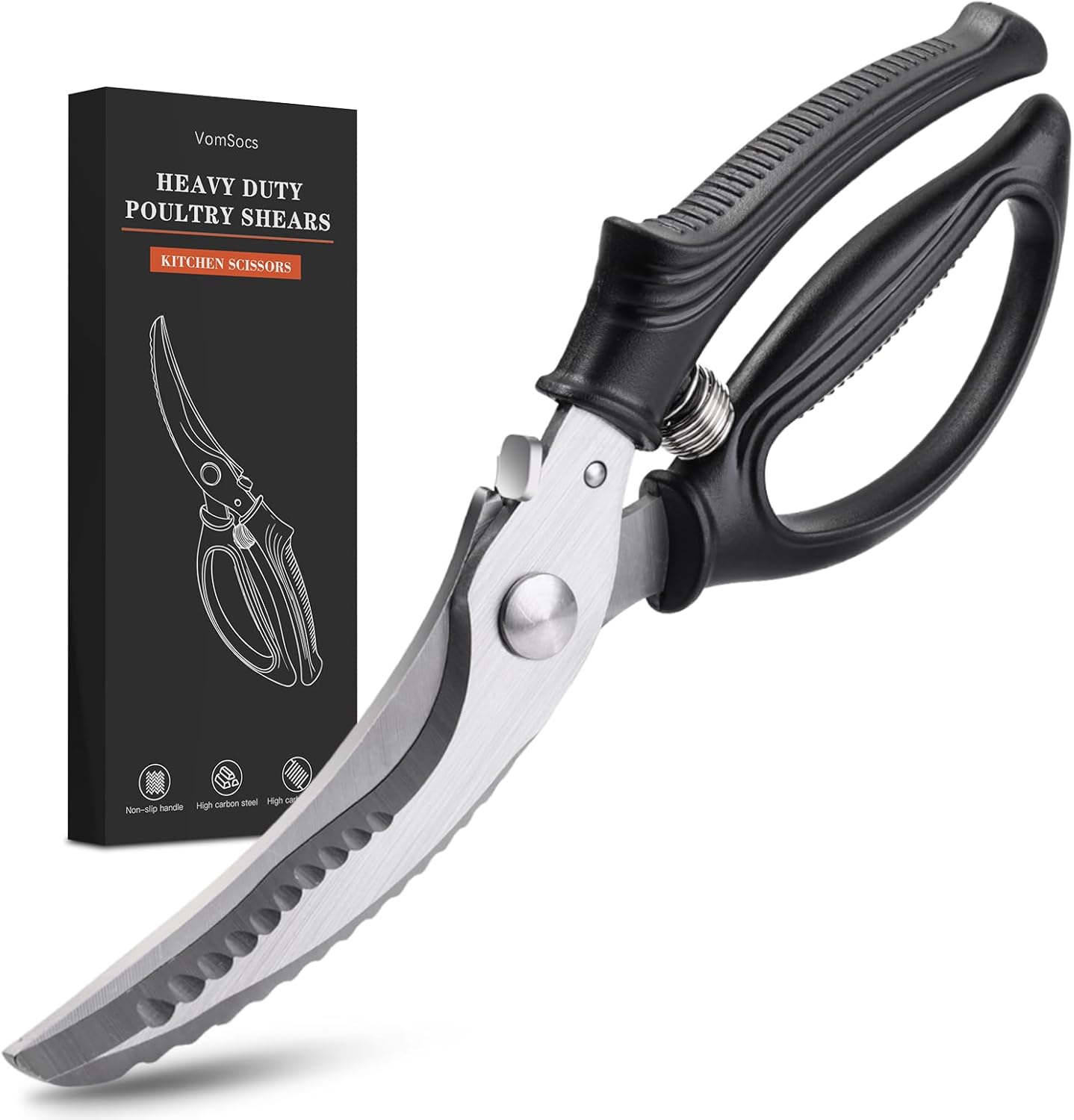
Designed to replace multiple tools, these shears cut meat, seafood, herbs, and tough chicken bones. The reinforced blades and spring provide strong cutting power, but the heavier weight may tire hands during long sessions. They suit cooks who want versatility beyond just spatchcocking.
Brand: Brand: vomsocs · Price when checked: $15.99 · Rating: 4.5 out of 5 (64336 ratings)
Pros
- Extra-thick stainless steel blades
- Anti-slip ergonomic handle
- Safety lock and dishwasher safe
Cons
- Heavier than typical poultry shears
- Spring feels stiff when new
Best general kitchen and poultry use: SimCoker Heavy Duty Kitchen Shears
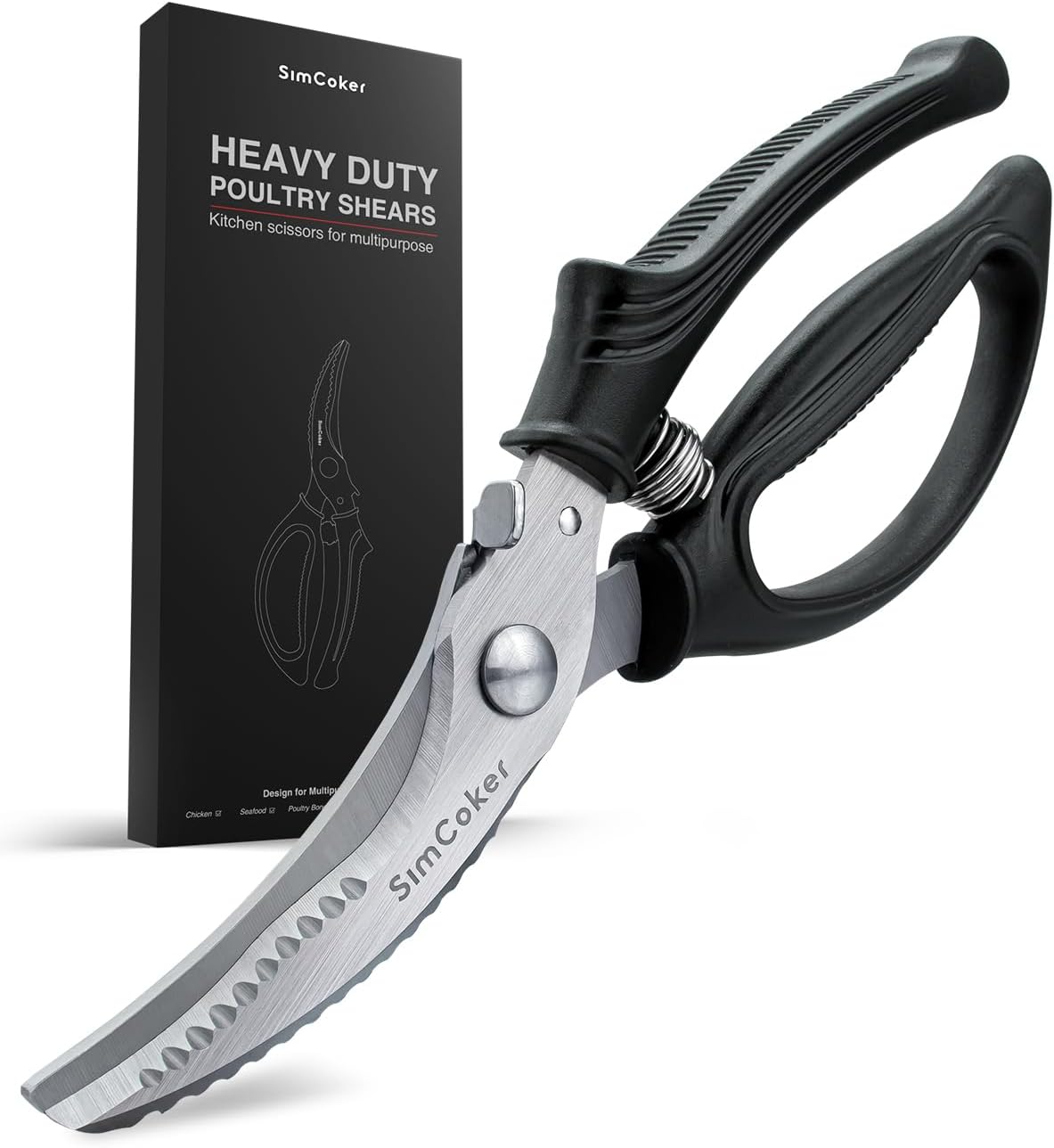
SimCoker’s shears offer a balance of strong cutting and general kitchen use with a spring-loaded mechanism and safety lock. They are less curved in the blade, which can reduce grip on bones, making them more suitable for cooks who do occasional spatchcocking alongside other tasks.
Brand: SimCoker · Price when checked: $19.99 · Rating: 4.6 out of 5 (64336 ratings)
Pros
- Spring-loaded with safety lock
- Non-slip handle for better control
- Dishwasher safe
Cons
- Blade curvature less suited for bone gripping
- Not specialised for heavy-duty poultry only
Best for precision and tight access: OXO Good Grips Spring-Loaded Poultry Shears

These shears feature curved, tapered blades with a notch for securely holding bones during cuts. The handle loop prevents your hand sliding forward, improving control on delicate or awkward cuts. They require hand washing and are priced higher, but excel in precision.
Brand: 4.7 4.7 out of 5 stars · Price when checked: $29.95 · Rating: 4.7 out of 5 (64336 ratings)
Pros
- Curved blades with bone notch
- Ergonomic handle loop
- Safety lock for storage
Cons
- Not dishwasher safe
- Higher price point
Best for herb prep and delicate cuts: Dalstrong Japanese Stainless Steel Kitchen Scissors

Dalstrong’s shears stand out for scalpel-sharp edges that make quick work of herbs and green onions, as well as trimming asparagus. While they cut poultry, they are less ideal for heavy bone cutting due to thinner blades and focus on precision. They are a niche choice for cooks who want a multi-use tool emphasising fine cuts.
Brand: Dalstrong · Price when checked: $69.00 · Rating: 4.6 out of 5 (27 ratings)
Pros
- Scalpel-sharp edges for herbs and vegetables
- Balanced and comfortable handle
- High-quality Japanese stainless steel
Cons
- Not designed for heavy bone cutting
- Relatively expensive
Choosing the right kitchen shears for your needs
If you spatchcock chickens frequently or prepare whole poultry for roasting or grilling, investing in a pair of spring-loaded shears with thick, curved blades is worth it. These shears handle backbone bones with less effort and provide better control, reducing fatigue and risk of slipping.
For cooks who only occasionally spatchcock or want a multi-purpose kitchen shear, models with slightly lighter blades and added features like safety locks or ergonomic handles may be better. These balance poultry cutting with other kitchen tasks such as trimming herbs or cutting fish.
Avoid shears without a safety lock or non-slip handles if you plan to store them in a drawer or use them in a busy kitchen environment. The risk of accidental cuts or blade damage increases.
Finally, consider cleaning preferences. Some shears are dishwasher safe, while others require hand washing to maintain blade sharpness and prevent corrosion.
When selecting shears, also consider the weight and balance. Heavier shears with thicker blades provide durability but may cause hand fatigue during prolonged use. Conversely, lighter shears offer better maneuverability but might sacrifice cutting power. Testing the shears in hand, if possible, helps determine which balance suits your cooking style.
Additionally, pay attention to warranty and build quality. High-quality brands often offer warranties that cover spring mechanisms and blade defects, providing peace of mind. Investing in well-made shears can save money over time by reducing the need for replacements.
In summary, the ideal kitchen shears for spatchcocking combine blade strength, ergonomic design, and reliable spring mechanisms tailored to your frequency of use and kitchen tasks. Prioritizing these factors ensures efficient, safe, and comfortable poultry preparation.
Related reading
- Best Cutting Board Materials That Won’t Dull Your Knives
- Best Large & Easy-to-Clean Spoon Rests
- Cookie Scoop Sizes: What Actually Matters
Frequently Asked Questions
What makes kitchen shears better than a chef’s knife for spatchcocking?
Kitchen shears designed for spatchcocking typically have thicker, curved blades with a notch for gripping bones, which is difficult to replicate with a chef’s knife. The spring-loaded mechanism in many shears reduces hand fatigue by automatically reopening the blades, allowing faster repetitive cuts. Shears also provide greater leverage and control when cutting through the backbone, which is safer and more efficient for this task compared to using a knife alone.
Can I use regular kitchen scissors for spatchcocking chicken?
Regular kitchen scissors often have thinner blades and lack spring mechanisms or bone-gripping notches, making them less effective for cutting poultry backbone. They may bend or dull quickly and require more force, increasing the risk of slipping and injury. For safe and efficient spatchcocking, it’s better to use kitchen shears specifically designed with heavier-duty blades and ergonomic features.
Are spring-loaded kitchen shears dishwasher safe?
Some spring-loaded kitchen shears are dishwasher safe, but it depends on the brand and materials. For example, MAD SHARK and vomsocs models are dishwasher safe, while OXO recommends hand washing to maintain blade sharpness and prevent corrosion. Always check the manufacturer’s instructions because repeated dishwasher cleaning can dull blades or damage spring mechanisms over time.

Rimi Sultana is a home cook from Bangladesh who has cooked for her family every day for the past five years and writes about it at Smart Cooks. Perpetually testing whether internet-famous recipes actually work in a regular home kitchen. Say hello on Facebook or through the contact page.