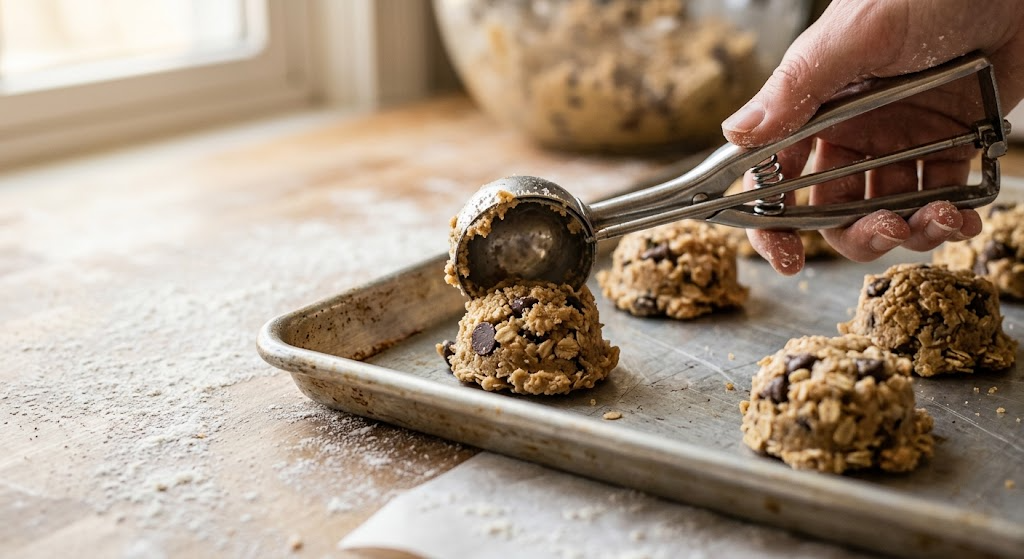
Cookie scoops are numbered like #16, #20, #40, #60, and if you’ve ever bought one blind, you’ve probably ended up with cookies twice the size you wanted or dozens of tiny ones. The numbers actually mean something specific, and once you know how to read them, picking the right scoop is easy.
Some links in this post are affiliate links. If you buy through them we may earn a small commission at no extra cost to you — it never changes which products we recommend.
What Actually Matters
What the Numbers Actually Mean
Scoop numbers refer to how many scoops it takes to fill a quart — so a #20 scoop (about 3 tablespoons) produces bigger portions than a #60 scoop (about 1 tablespoon), because it takes fewer #20 scoops to fill the same quart. Lower number, bigger cookie.
Trigger Mechanism Durability
The trigger-release mechanism is the part that fails first on cheap scoops — the spring loosens or the wire scraper bends after repeated use with stiff, cold dough. A scoop with a sturdy metal trigger and a properly tensioned spring will hold up through years of cookie dough, cold ice cream, and even meatball-forming duty.
One Scoop or a Set
If you only bake one style of cookie, a single scoop in your preferred size is enough. If you bake a range from drop cookies to bite-size, a 3-piece set covering large, medium, and small sizes saves you from repeat purchases.
From My Kitchen
I used a single #40 scoop for everything for years, and it worked fine for standard cookies but produced comically oversized bite-size cookies whenever a recipe called for them. Adding a #60 scoop to the drawer specifically for holiday bite-size batches was a small purchase that fixed a problem I’d been solving badly with a teaspoon for a long time.
Worth Considering
For a reliable single large scoop, the Spring Chef Large Stainless Steel Cookie Scoop (#20) has held up well for standard drop cookies. If you want the full size range in one purchase, the HOMURE Cookie Scoop Set covers large, medium, and small in one set.
How Scoop Numbers Actually Work
The number stamped on a cookie scoop is not a size in any intuitive sense — it is how many scoops it takes to fill one quart. That is why the numbering runs backwards: a #100 scoop is small, around two teaspoons, and a #16 scoop is large, around a quarter cup. Once you know that, the numbers become useful rather than baffling, and you can convert any recipe’s tablespoon measurement into the right scoop.
In practice, three sizes cover home baking. A #60 scoop holds about a tablespoon and suits small cookies, truffles and mini muffins. A #40 is around 1.5 tablespoons, which is the standard drop-cookie size most recipes assume. A #20 holds roughly 3 tablespoons and produces a bakery-style large cookie, as well as being the right size for filling standard muffin cups.
Quick Comparison
| Scoop number | Approximate volume | Use |
|---|---|---|
| #100 | 2 tsp | Mini cookies, truffles, garnishes |
| #60 | 1 tbsp | Small cookies, mini muffins |
| #40 | 1.5 tbsp | Standard drop cookies |
| #30 | 2 tbsp | Larger cookies, cupcake filling |
| #20 | 3 tbsp | Bakery-size cookies, muffins |
Why Uniform Size Changes the Bake
Cookies of different sizes on the same tray cannot finish at the same time. The small ones are dry and over-browned at the edges by the time the large ones have set in the middle, and there is no oven setting that resolves this — you are asking for two different bakes simultaneously. A scoop is not about neatness; it is the cheapest way to make a tray of cookies behave predictably.
The mechanism is where scoops fail, so it is worth knowing what to look for. A sweep-style scoop with a thin blade that travels around the inside of the bowl tends to bend or slip out of alignment over time, especially with stiff doughs full of chocolate chunks. Squeeze-handle designs with a spring have fewer alignment problems and handle dense dough better. Whichever style you buy, stainless steel rather than coated metal is the durable choice.
Two Scoops Worth Considering
Best single scoop: Spring Chef Large Stainless Steel Cookie Scoop
If you buy one scoop, buy the one that matches the cookies you actually bake most, and for most households that is the larger drop-cookie size. Solid stainless construction is what separates a scoop that lasts from one that develops a wobble in the release mechanism.
Pros
- Sturdy stainless build, handles stiff dough
- Comfortable squeeze handle
- Consistent release without sticking
Cons
- One size only, so no flexibility
- Large size is not right for mini cookies
Best set: HOMURE Cookie Scoop Set
Three sizes covering small, medium and large is genuinely more useful than one better scoop, because recipes vary and a mismatched scoop means adjusting bake times by guesswork. This is the sensible buy if you bake a variety of things rather than one house cookie.
Pros
- Covers small, medium and large in one purchase
- Useful beyond cookies — muffins, meatballs, truffles
- Stainless bowls clean up easily
Cons
- Individual scoops are not as robust as a premium single
- Three items to store
Frequently Asked Questions
What size cookie scoop is standard for most recipes?
A #40 scoop (about 1.5 tablespoons) matches the portion size most standard chocolate chip cookie recipes are written for, which is why it’s the most commonly recommended all-purpose size.
Can I use a cookie scoop for things other than cookie dough?
Yes — the same trigger scoops work well for portioning meatballs, muffin batter, and even melon balls, since the mechanism is really just a consistent-portion tool rather than something cookie-specific.
Why does dough stick inside the scoop?
Usually because the dough is warm or unusually sticky, and the fix is temperature rather than technique. Chill the dough for twenty minutes and it will release cleanly. For genuinely sticky doughs, dipping the scoop in warm water and shaking it dry between scoops works well — the thin film of moisture stops the dough gripping the metal, and it evaporates before it can affect the bake.
Do I need a scoop at all if I weigh my dough?
Weighing is more accurate, and if you are already doing it you do not need a scoop for consistency. What the scoop adds is speed — weighing thirty-six portions individually is slow, while scooping them takes a couple of minutes. Many bakers do both: weigh the first two or three scoops to confirm the size is right for the recipe, then scoop the rest without weighing.

Rimi Sultana is a home cook from Bangladesh who has cooked for her family every day for the past five years and writes about it at Smart Cooks. Perpetually testing whether internet-famous recipes actually work in a regular home kitchen. Say hello on Facebook or through the contact page.