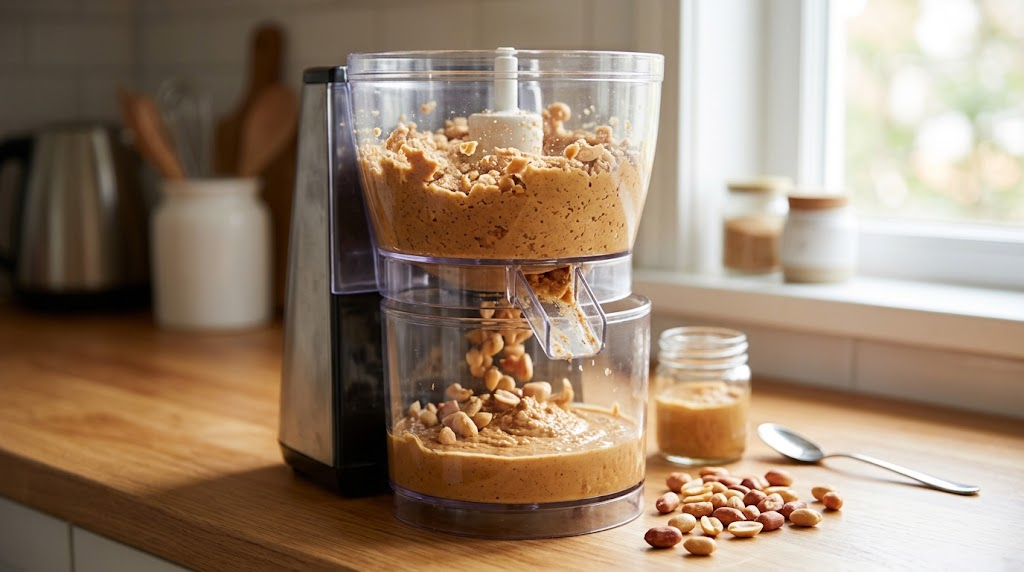
Store-bought nut butter often comes with added oils, sugar, or stabilizers that thicken the texture but dilute the flavor. Making your own sounds appealing until you consider whether a dedicated machine is worth adding to the counter.
Some links in this post are affiliate links. If you buy through them we may earn a small commission at no extra cost to you — it never changes which products we recommend.
What Actually Matters
Motor Strength Matters More Than You’d Think
Turning whole nuts into smooth butter takes sustained grinding, and underpowered motors can overheat or stall partway through, especially with drier nuts like almonds. A machine built specifically for nut butter, rather than a general food processor, usually has a motor sized for this exact job.
Batch Size and Realistic Use
Small single-serving nut butter makers are convenient for personal use but slow if you’re making a full jar at once. If you go through nut butter quickly in a household, a slightly larger-capacity machine saves you from running multiple batches back to back.
Cleanup Complexity
Nut butter is sticky and can be genuinely annoying to clean out of tight crevices. Machines with fewer removable parts and wider openings are noticeably easier to clean than ones with narrow chutes or multiple small attachments.
From My Kitchen
My first attempt at homemade almond butter in a regular blender ended with the motor straining audibly and the almonds barely past a chunky paste after ten minutes of stopping and scraping. Switching to a machine actually built for the job turned that same amount of almonds into smooth butter in about a third of the time, with far less babysitting.
Worth Considering
The Cuisinart spice and nut grinder is a versatile, well-built option that handles small batches reliably and doubles for grinding spices. For something built specifically around continuous nut butter grinding, the OEBUAFI electric peanut butter maker is designed around that single task.
What Actually Turns Nuts Into Butter
Nuts do not become butter because you grind them finely enough. They become butter because friction warms them and the oil already inside the nut is released and re-absorbed into the paste. That is why the process looks like a failure for most of its duration — the nuts go from coarse meal to damp crumbs to a stiff ball that climbs the sides, and only then, usually eight to fifteen minutes in, does it break and turn glossy. People who give up almost always give up during the ball stage, one minute before it works.
This also explains why the machine matters less than most product pages suggest. What you need is sustained running without the motor cutting out, and a bowl shape that keeps pushing the mass back into the blade instead of letting it ride up the walls. A dedicated nut butter machine is designed around exactly that; a general food processor gets there too, it just makes you stop and scrape more often.
Quick Comparison
| Dedicated nut butter machine | Food processor | Spice and nut grinder | |
|---|---|---|---|
| Batch size | Small to medium | Medium to large | Very small |
| Hands-on scraping | Minimal | Several stops needed | Constant |
| Time to smooth | Fast, purpose-built | 8–15 minutes | Struggles to get past meal |
| Other uses | Few | Everything | Spices, coffee, small grinds |
| Worth it if | You make nut butter weekly | You already own one | You mostly grind spices |
The Honest Answer on Whether to Buy One
If you already own a decent food processor and make nut butter occasionally, a dedicated machine is hard to justify — you are paying for convenience and a few minutes of scraping. It becomes genuinely worth it in two situations: you make nut butter often enough that the scraping becomes a chore, or you want it without added palm oil and sugar and have found that store-bought versions in your area all include them. Frequency is the deciding factor, not capability.
One thing that changes the maths is roasting. Warm, freshly roasted nuts release their oil far faster than room-temperature raw ones — often cutting the processing time in half. If your only complaint is that it takes too long, roasting at 350°F for eight to ten minutes and processing while still warm may solve the problem you were about to buy an appliance for.
Two Options Worth Considering
Best for small batches: Cuisinart Spice and Nut Grinder
This is the right tool if what you actually want is a small quantity, freshly made, rather than a jar in the fridge. It excels at small grinds and doubles as a spice grinder, which is the use most households get more value from over a year.
Pros
- Excellent for small quantities and spices
- Compact enough to leave out
- Simple to clean between uses
Cons
- Will not produce a large batch of smooth butter
- Needs scraping and patience for nut butter specifically
Best dedicated machine: OEBUAFI Electric Peanut Butter Maker
Built around the one job, which means less scraping and a more reliably smooth finish than a general-purpose machine. Worth it if nut butter is a regular part of your kitchen rather than an occasional experiment.
Pros
- Purpose-built, minimal hands-on scraping
- Consistent smooth texture without additives
- Straightforward to operate
Cons
- Single-purpose appliance taking counter space
- Overkill if you make nut butter a few times a year
Frequently Asked Questions
Do I need to roast nuts before making butter?
Roasting isn’t required, but it makes a noticeable difference — roasted nuts release their natural oils more easily, which means a shorter grinding time and a smoother final texture than using raw nuts straight from the bag.
How long does homemade nut butter last?
Without the preservatives found in most store-bought jars, homemade nut butter typically stays fresh for about 2-3 weeks in the refrigerator, though the oil may separate and just needs a stir before using.
Why did my nut butter seize into a dry ball?
That is not a failure, it is the normal middle stage — the nuts have broken down but the oil has not released yet. Keep going. If it genuinely will not move after several more minutes, the nuts were too dry or too cold; a teaspoon of neutral oil or a short warm-up in the oven gets it moving. Resist adding much oil, since once the nut’s own oil releases you will have a thin butter that never firms up.
Does roasting the nuts first actually matter?
It matters a great deal, for both speed and flavour. Roasted nuts are warmer and their cell structure is more brittle, so the oil releases much sooner — the difference between roughly fifteen minutes and roughly seven. Flavour-wise it is not subtle either: raw almond butter tastes flat and slightly green next to the same nuts roasted for ten minutes. Let them cool just enough to handle, then process while still warm.
Related: Soda maker vs seltzer bottle: how their carbonation methods differ

Rimi Sultana is a home cook from Bangladesh who has cooked for her family every day for the past five years and writes about it at Smart Cooks. Perpetually testing whether internet-famous recipes actually work in a regular home kitchen. Say hello on Facebook or through the contact page.