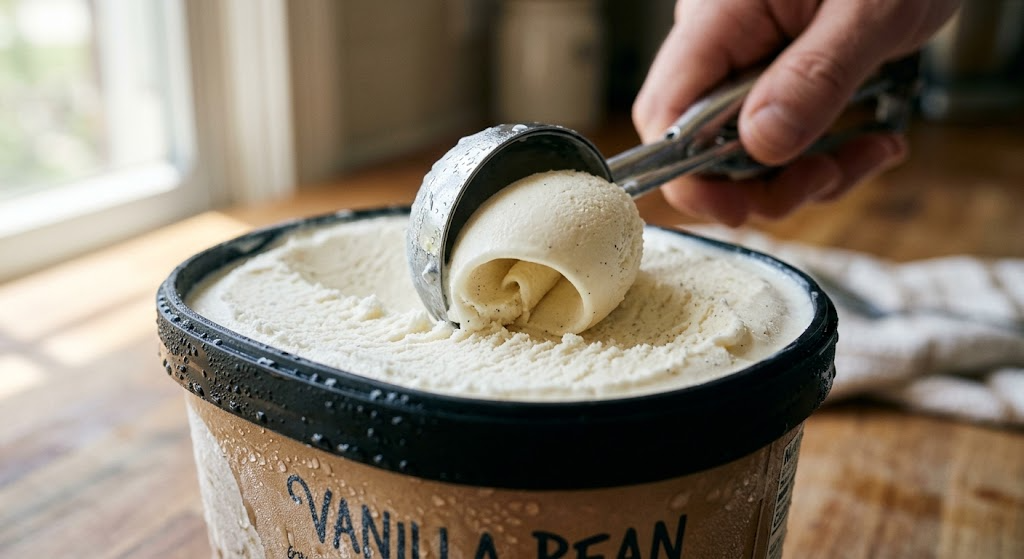
An ice cream scoop seems like the last thing worth overthinking, until you’re wrestling with rock-hard ice cream and a cheap scoop bends in your hand or the handle snaps clean off. The differences between scoops are small in price but large in how well they actually hold up.
Some links in this post are affiliate links. If you buy through them we may earn a small commission at no extra cost to you — it never changes which products we recommend.
What Actually Matters
Solid Metal vs. Hollow Metal
Cheap scoops are often hollow or thin-walled to save material cost, and that’s exactly where they flex and eventually bend under the pressure needed to scoop firm ice cream. A solid, heavier metal head resists that flex and lasts far longer.
Handle Grip and Leverage
A wider, more ergonomic handle gives you real leverage against hard ice cream without straining your wrist. Thin, narrow handles look fine on a shelf but become uncomfortable fast during actual use, especially with a full pint straight from the freezer.
Self-Warming or Anti-Freeze Designs
Some scoops use a heat-conductive fluid-filled head that warms slightly from your hand’s temperature, making it easier to cut through hard ice cream. These genuinely help with very hard-frozen ice cream, though they add a bit of cost and one more thing that can theoretically leak, though that’s rare.
From My Kitchen: The Scoop That Actually Bent
I once bought a scoop that looked identical to a solid metal one in photos but turned out to be a thin, lightweight stamped metal. The first time I tried to scoop ice cream straight from the freezer instead of letting it sit out for a few minutes, the head visibly flexed and the edge dulled unevenly within a few uses. Letting ice cream soften for 5–10 minutes before scooping helps with any scoop, but it shouldn’t be strictly necessary — a genuinely solid scoop should handle a reasonably firm scoop without deforming.
Worth Considering
Spring Chef’s heavy duty metal scoop is a solid, no-frills option built from a single solid piece rather than a hollow stamped head.
This nonstick anti-freeze aluminum scoop is worth considering if you want the heat-conductive style that makes cutting into hard ice cream noticeably easier.
Where Scoops Actually Fail
There are three common failure points and they are all structural. The first is the joint where a stamped steel bowl is welded or riveted to a handle — that joint concentrates all the force you apply, and it eventually cracks or works loose. The second is thin material: a bowl pressed from thin steel will flex and then take a permanent bend the first time it meets ice cream that is properly frozen. The third is mechanisms — lever-release scoops have a spring and a sweep blade that jam with ice cream and eventually stop returning.
A one-piece cast scoop has none of these. There is no joint to fail because the handle and bowl are the same piece of metal, and cast aluminium or zinc alloy is thick enough not to flex. This is why the scoops that survive a decade of use tend to look plain and slightly heavy rather than clever.
Quick Comparison
| One-piece cast | Stamped steel with handle | Lever release | Fluid-filled handle | |
|---|---|---|---|---|
| Resistance to bending | Excellent | Poor to moderate | Moderate | Moderate |
| Parts that can fail | None | The joint | Spring and sweep | Seal can leak |
| Clean release of the scoop | Good | Good | Excellent | Good |
| Dishwasher | Usually fine | Usually fine | Mechanism traps water | No — heat damages the seal |
| Best for | Long-term use, hard ice cream | Occasional use | Portioning, cookie dough | Marginal benefit |
Heat Does the Work, Not Force
Most bent scoops were bent by someone attacking ice cream straight out of a −18°C freezer. Hard ice cream is genuinely hard, and no scoop design makes brute force a good idea. Two things solve it properly: let the tub sit out for five minutes before serving, and dip the scoop in hot water and shake it dry between scoops. A warm scoop glides through by melting a thin film at the surface, which also gives you those neat round balls rather than shaved fragments.
That is also the honest assessment of fluid-filled handles. The fluid conducts warmth from your hand into the bowl, which does help a little — but far less than a dip in hot water, and it comes with a seal that can eventually leak and a strict no-dishwasher rule. If the marketing is the reason you are considering one, a plain cast scoop and a mug of hot water outperform it.
Two Scoops Worth Considering
Best for durability: Spring Chef Heavy Duty Metal Scoop
Solid, one-piece construction with enough thickness that it does not flex against firm ice cream. No mechanism and no joint means nothing to fail, which is exactly what you want from a tool that gets used with force.
Pros
- One-piece build with no joint to fail
- Thick enough not to bend on hard ice cream
- Comfortable weight and balance
Cons
- No release mechanism for sticky mixtures
- Heavier than lightweight scoops
Best for easy release: Nonstick Anti-Freeze Aluminium Scoop
Aluminium conducts warmth from your hand quickly, which helps the scoop move through firm ice cream without a hot water dip. The nonstick surface means the ball releases cleanly rather than clinging to the bowl.
Pros
- Warms quickly for easier scooping
- Ice cream releases cleanly from the bowl
- Light in the hand
Cons
- Nonstick coating can wear over years
- Softer metal than a heavy cast scoop
Frequently Asked Questions
Should I let ice cream sit out before scooping?
A few minutes of softening helps with any scoop and reduces strain on both the tool and your wrist, but a well-built solid scoop shouldn’t require it just to avoid bending.
Are self-warming scoops actually effective?
Yes, within reason — the fluid inside does pick up a small amount of heat from your grip, which softens the very top layer of ice cream slightly and makes the first cut easier. It’s a real, if modest, effect.
How do I know if a scoop is solid metal or hollow?
Weight is the simplest tell — a genuinely solid metal scoop feels noticeably heavier in the hand than a hollow stamped one of the same size, even before you use it.
Do antifreeze-filled scoops actually work?
They work, just far less dramatically than the packaging implies. The fluid conducts heat from your hand into the bowl, which makes a marginal difference on ice cream that was already close to scoopable. It does nothing at all on ice cream straight from a cold freezer. Given that they cannot go in the dishwasher and the seal is a potential failure point, a plain scoop plus a mug of hot water is both cheaper and more effective.
Why does my ice cream scoop keep bending?
Thin material plus hard ice cream plus leverage. If the bowl is stamped from thin steel, applying your full body weight through the handle will eventually deform it — the metal is simply not thick enough to resist. The permanent fix is a thicker one-piece scoop; the immediate fix is temperature, because a tub left out for five minutes needs a fraction of the force and will not bend anything.

Rimi Sultana is a home cook from Bangladesh who has cooked for her family every day for the past five years and writes about it at Smart Cooks. Perpetually testing whether internet-famous recipes actually work in a regular home kitchen. Say hello on Facebook or through the contact page.