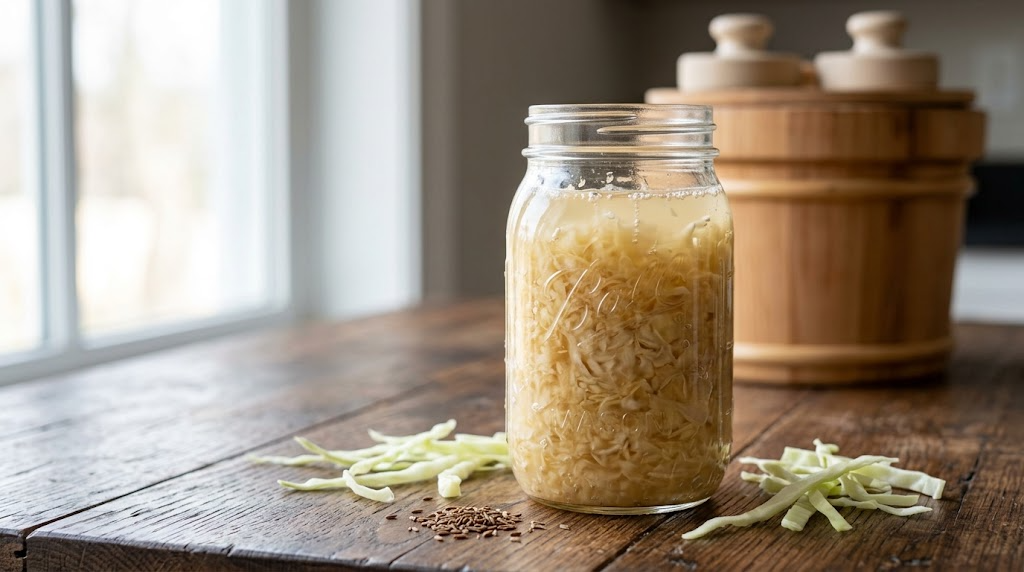
Real sauerkraut has exactly two ingredients: cabbage and salt. Everything else — the tang, the crunch, the fizz when you open the jar — comes from wild lactic acid bacteria that are already living on the cabbage leaves, given the right salty, oxygen-free environment to take over. The one piece of equipment that makes this reliable instead of a gamble is a fermentation crock with a water seal, which lets the CO2 the bacteria produce escape while keeping outside air (and mold spores) from getting in.
Ingredients You’ll Need
- 1 medium green cabbage (about 2–2.5 lbs), outer leaves removed and reserved
- 1½ tbsp non-iodized salt (kosher or pickling salt — about 2% of the cabbage’s weight)
- Optional: 1 tbsp caraway seeds or juniper berries
How to Make Homemade Sauerkraut
- Weigh your shredded cabbage after slicing it thin (a mandoline makes this fast and even). Calculate salt at 2% of that weight — for example, 1000g of shredded cabbage needs 20g of salt.
- In a large bowl, massage the salt into the shredded cabbage with your hands for 5–10 minutes. It should start releasing its own liquid and go noticeably limp — this liquid is what your cabbage will ferment in, so don’t rush this step.
- Pack the cabbage tightly into your fermentation crock, pressing down firmly in layers to force out air pockets and bring the brine up over the top of the cabbage.
- Tuck a whole reserved cabbage leaf over the shredded cabbage, then weigh it down with the crock’s fermentation weights so everything stays fully submerged under the brine.
- Fill the crock’s water seal channel with water according to the manufacturer’s instructions, and fit the lid. This lets gas escape without letting air or contaminants in.
- Let it ferment at room temperature (65–72°F / 18–22°C is ideal) for 2–4 weeks, checking every few days to top up the water seal as it evaporates.
- Start tasting around day 10. Once it hits the sourness you like, transfer it to jars and refrigerate, where it will keep fermenting very slowly.
From My Kitchen: The Batch That Grew Mold in Three Days
Before I owned a proper crock, I fermented a batch in an ordinary glass jar with a loose-fitting lid, figuring ‘airtight enough’ would work. It didn’t. Within three days there was a thin white film across the top, and by day five that had turned into visible fuzzy mold. The problem was twofold: the cabbage wasn’t fully submerged under the brine, so the exposed bits at the top were sitting in open air instead of liquid, and the loose lid was letting outside air circulate freely instead of only letting gas escape one-way. I’d assumed any closed container would do the same job as a purpose-built crock, and that assumption cost me the whole batch. A real water-seal crock solves both problems at once — the weights keep everything pinned under the brine, and the water channel lets built-up CO2 bubble out without ever letting air back in. Since switching to one, I haven’t had a moldy batch since.
Tips for the Best Sauerkraut
- Weigh your salt rather than eyeballing it — too little and you risk spoilage, too much and fermentation slows to a crawl or stops.
- Keep the crock somewhere with a stable temperature, away from direct sunlight or a spot near the oven. Big temperature swings make fermentation unpredictable.
- A little white sediment (not fuzzy) settling at the bottom is normal yeast activity, not mold — mold is fuzzy and usually colored (white, green, or black) and sits on the surface, not throughout the liquid.
- Longer fermentation isn’t automatically better — taste along the way and stop when you like the flavor. Sauerkraut can go from pleasantly tangy to overly sour and soft if left too long.
What to Serve With Homemade Sauerkraut
It’s the classic partner to sausages and pork dishes, but it’s just as good stirred cold into a sandwich, folded into mashed potatoes, or eaten straight as a probiotic-rich side. A spoonful on top of a simple fried egg is an underrated way to use it up.
Frequently Asked Questions
Do I really need a fermentation crock, or can I use a regular jar?
A jar can work if you’re careful about keeping the cabbage submerged and burping it daily to release gas, but it’s genuinely harder to get right and more prone to mold. A water-seal crock automates the two hardest parts — keeping air out and letting gas escape — which is why it’s worth it if you plan to make sauerkraut more than once.
Why is my sauerkraut not fizzy or sour after a week?
Fermentation speed is very temperature-dependent. In a cooler room, it can take considerably longer than 2 weeks to develop noticeable tang. Give it more time before assuming something’s wrong, as long as there’s no mold and the cabbage still smells pleasantly sour rather than off.
Is the white sediment at the bottom of the crock safe?
Yes, if it’s a light, cloudy sediment suspended in or settled under the brine rather than a raised, fuzzy patch on the surface. That sediment is typically just yeast, which is a normal part of the fermentation process.
How long does finished sauerkraut keep in the fridge?
Properly fermented and refrigerated sauerkraut keeps for several months, since the fermentation process itself is a preservation method. The flavor will continue to slowly develop and deepen over that time.
If you’re ready to try this properly, we compared water-seal crocks in our guide to the best fermentation crocks, including which sizes make sense for a single cabbage versus a bigger batch.

Rimi Sultana is a home cook from Bangladesh who has cooked for her family every day for the past five years and writes about it at Smart Cooks. Perpetually testing whether internet-famous recipes actually work in a regular home kitchen. Say hello on Facebook or through the contact page.