
Choosing a good mixing bowl set for baking comes down to understanding how material, size, and design affect performance and convenience. Bowls that conduct heat poorly, warp easily, or lack stability can disrupt mixing and affect dough or batter consistency.
Some links in this post are affiliate links. If you buy through them we may earn a small commission at no extra cost to you — it never changes which products we recommend.
A quality set balances durability, ease of cleaning, and storage options. It also offers sizes suited to different tasks — from whisking egg whites to kneading dough — while fitting your kitchen space and habits without unnecessary extras.
What actually matters
Not all mixing bowls are created equal, and knowing what to look for helps avoid surprises. The right set depends on three main factors that influence how they perform during baking preparation.
Material and thermal behaviour
Glass bowls retain cold well, which is useful for pastries and whipping cream, but they can be heavy and prone to breaking if dropped. Stainless steel bowls conduct heat faster, warming up ingredients more quickly, which can be a drawback for temperature-sensitive batters. Plastic bowls are lightweight and less expensive but may absorb odours and stain; they also don’t tolerate high heat or dishwasher drying temperatures well. Ceramic bowls offer aesthetic appeal and good heat retention but tend to be heavier and fragile.
The thermal conductivity of these materials significantly impacts baking outcomes. For example, stainless steel’s high conductivity (~16 W/m·K) means it transfers heat quickly, which can cause delicate mixtures like meringue to lose volume if the bowl warms too much during mixing. In contrast, glass has a much lower conductivity (~1 W/m·K), helping maintain cooler temperatures for longer periods, ideal for cold-sensitive preparations.
Durability also varies: stainless steel bowls often have a lifespan exceeding 10 years with proper care, while plastic bowls may degrade or stain within 2-3 years depending on use. Ceramic bowls, while attractive, require careful handling to avoid chips or cracks, which can harbor bacteria.
Size range and nesting
A good set includes a range of volumes to suit different recipe scales, typically from around 1 to 5 litres. Bowls that nest well save storage space but should still be easy to separate when in use. Oversized bowls can be clumsy for small tasks, while too small bowls limit mixing capacity and risk spills.
For example, a 1-litre bowl is perfect for whisking egg whites or mixing salad dressings, while a 5-litre bowl can comfortably accommodate doughs for bread or large batches of cake batter. Sets that include at least four bowls spanning this range cover most baking needs effectively.
Nesting efficiency can reduce required storage space by up to 40%, but bowls that nest too tightly may cause frustration during busy baking sessions. Manufacturers often design bowls with slightly tapered sides or silicone bases to facilitate easy separation and stability during mixing.
Additional features affecting usability
Non-slip bases or silicone rings improve stability during vigorous mixing, preventing the bowl from sliding. Lids can help with storage and prevent contamination, especially for dough rising. Pour spouts assist when transferring batters or sauces. A smooth interior without seams or ridges reduces residue buildup and simplifies cleaning.
For instance, silicone bases can reduce bowl movement by up to 70%, which is particularly beneficial when using electric mixers or whisking by hand. Airtight lids extend the freshness of dough or batter by minimizing exposure to air, which can dry out or form a crust on the surface.
Pour spouts reduce spills and waste, especially when working with thin batters or sauces, improving precision and reducing cleanup time. Additionally, bowls with seamless interiors prevent food particles from getting trapped, which can harbor bacteria and complicate thorough cleaning.
How to choose between mixing bowl sets
Think about the types of baked goods you make most often and the volume you usually work with. If you frequently prepare recipes requiring cold mixing, glass or ceramic bowls are better. For heavy doughs or large batches, stainless steel with a wide base offers stability and durability.
Consider your kitchen space and storage habits. Sets with nesting bowls save room but may be frustrating if bowls are hard to separate. If you value convenience, sets with lids or pour spouts add functionality but increase storage needs.
If you bake occasionally or need an inexpensive starter set, plastic bowls will suffice—just be aware their durability and heat resistance are limited. Avoid plastic if you mix hot ingredients or need bowls that can go in the oven.
Ultimately, no single set suits every baker perfectly. Identifying your baking style and priorities helps narrow down your choice without overspending on features you won’t use.
To illustrate, consider a baker who prepares delicate meringues and whipped cream regularly: they benefit from glass bowls’ cold retention and non-reactive surfaces. On the other hand, a baker making large batches of bread dough might prioritize stainless steel bowls for their durability and heat conduction properties, despite the risk of warming ingredients faster.
Storage space is another critical consideration. A kitchen with limited cabinet room might favor compact nesting sets with silicone bases for stability. However, these can sometimes be difficult to separate quickly, which might slow down preparation during busy baking sessions.
Price and maintenance also play roles. Stainless steel sets often cost more upfront but last longer and are dishwasher safe, while plastic sets are more affordable but prone to staining and warping. Ceramic bowls require careful handling and may not be ideal for every kitchen environment.
By weighing these factors—material properties, size, storage, and additional features—bakers can select a mixing bowl set that enhances their workflow and baking results.
| Pick | Best for | Material and capacity range | Watch out for |
|---|---|---|---|
| Pyrex Essentials 3-Piece Glass Mixing Bowls | Glass bowl versatility | Glass, 3-piece | Heavy |
| Umite Chef 8-Piece Stainless Bowls with Lids | Mixing with lids and graters | Stainless, stainless steel, 8-piece | Many parts to store |
| FineDine 6-Piece Stainless Mixing Bowls | Professional durability | Stainless, stainless steel, 6-piece | Not microwave safe |
| MIKIGEY Embossed Ceramic Mixing Bowls | Decorative serving and prep | Ceramic | Heavy |
| 3-Piece Stainless Mixing Bowl Set | Basic three-bowl set | Stainless, stainless steel, 3-piece | Largest bowl is only 3.3 qt |
| Idymere 5-Piece Non-Slip Stainless Bowls | Non-slip mixing | Stainless, silicone, 5-piece | Few reviews |
| 5-Piece Glass Mixing Bowls with Lids | Glass with lids | Glass, 5-piece | Heavy |
| Zulay 12-Piece Plastic Mixing Bowls with Lids | Compact nesting sets | Plastic, 12-piece | Plastic can stain |
| 5-Piece Thick Glass Nesting Bowls with Lids | Thick glass nesting | Glass, 5-piece | Heavy |
| OXO Good Grips 3-Piece Plastic Mixing Bowls | Budget all-rounder | Plastic | Plastic can scratch and stain |
From my kitchen
Once, while mixing a delicate sponge batter, the bowl I was using warmed up quickly and caused the egg whites to deflate prematurely. I switched to a glass bowl that retained cold and kept the mixture stable. This was a clear example of how the material’s thermal conductivity directly impacts the outcome. Since then, I always match the bowl material to the specific baking task, which saves me from unpredictable results.
Worth Considering
Best for glass bowl versatility: Pyrex Essentials 3-Piece Glass Mixing Bowls
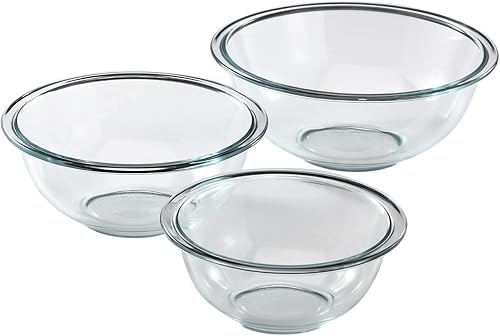
Pyrex’s three glass bowls go from mixing to microwave, preheated oven and dishwasher.
Price when checked: $17.99 · Rating: 4.8 out of 5 (30.7K ratings)
Pros
- Oven, microwave and dishwasher safe
- Classic Pyrex glass
- Huge review count
Cons
- Heavy
- Breakable
Best for mixing with lids and graters: Umite Chef 8-Piece Stainless Bowls with Lids

Eight stainless steel nesting bowls with airtight lids and grater attachments, for mixing, prepping and storing.
Price when checked: $31.99 · Rating: 4.7 out of 5 (3.6K ratings)
Pros
- Lids included
- Grater attachments
- Nest for storage
Cons
- Many parts to store
- Not microwave safe
Best for professional durability: FineDine 6-Piece Stainless Mixing Bowls
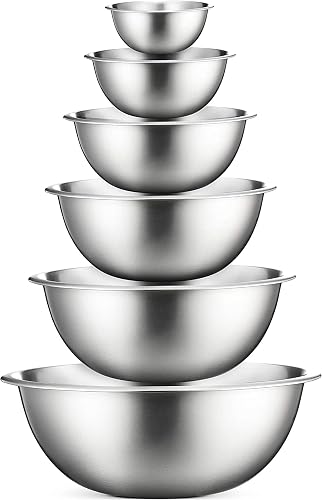
Six stainless steel nesting bowls, a durable, light set that is hard to damage.
Price when checked: $29.99 · Rating: 4.7 out of 5 (42.9K ratings)
Pros
- Stainless steel
- Six sizes
- Very widely reviewed
Cons
- Not microwave safe
- No lids
Best for decorative serving and prep: MIKIGEY Embossed Ceramic Mixing Bowls

Four embossed ceramic nesting bowls that look good enough to serve from.
Price when checked: $42.29 · Rating: 4.7 out of 5 (155 ratings)
Pros
- Decorative
- Nesting set
- Doubles as serveware
Cons
- Heavy
- Can chip
Best for basic three-bowl set: 3-Piece Stainless Mixing Bowl Set

Three stainless steel bowls of 3.3, 2 and 1.5 quarts, a simple starter set.
Price when checked: $19.99 · Rating: 4.8 out of 5 (24 ratings)
Pros
- Three useful sizes
- Stainless steel
- Low price
Cons
- Largest bowl is only 3.3 qt
- Few reviews
Best for non-slip mixing: Idymere 5-Piece Non-Slip Stainless Bowls

Five stainless bowls from 1.5 to 5.3 quarts with silicone bases that stop them sliding while you whisk.
Price when checked: $19.94 · Rating: 4.6 out of 5 (51 ratings)
Pros
- Non-slip silicone base
- Five sizes
- Nests for storage
Cons
- Few reviews
- Silicone bases add washing
Best for glass with lids: 5-Piece Glass Mixing Bowls with Lids

Five glass bowls with lids from 0.85 to 4.78 quarts, for mixing and then storing leftovers.
Price when checked: $39.99 · Rating: 4.6 out of 5 (38 ratings)
Pros
- Lids included
- Five sizes
- Glass does not stain
Cons
- Heavy
- Few reviews
Best for compact nesting sets: Zulay 12-Piece Plastic Mixing Bowls with Lids

A 12-piece set of plastic bowls with leak-proof lids that are microwave and freezer safe.
Price when checked: $32.99 · Rating: 4.7 out of 5 (1.8K ratings)
Pros
- Lids included
- Lightweight
- Microwave and freezer safe
Cons
- Plastic can stain
- Not for very hot oil or sugar
Best for thick glass nesting: 5-Piece Thick Glass Nesting Bowls with Lids

A five-piece set in thick glass with lids that nests for storage.
Price when checked: $39.99 · Rating: 4.5 out of 5 (369 ratings)
Pros
- Thick glass
- Lids included
- Well reviewed
Cons
- Heavy
- Breakable
Best budget all-rounder: OXO Good Grips 3-Piece Plastic Mixing Bowls
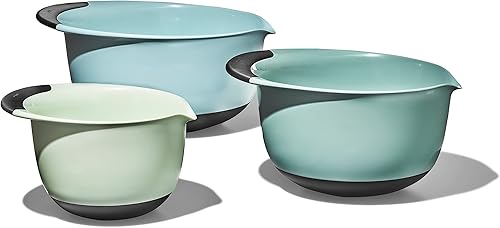
OXO’s three plastic bowls (1.5, 3 and 5 quarts) with non-slip bases and soft handles.
Price when checked: $29.95 · Rating: 4.8 out of 5 (6.4K ratings)
Pros
- Non-slip bases
- Three useful sizes
- Very well reviewed
Cons
- Plastic can scratch and stain
- Not for hot oil or sugar
How to choose between mixing bowl sets
Think about the types of baked goods you make most often and the volume you usually work with. If you frequently prepare recipes requiring cold mixing, glass or ceramic bowls are better. For heavy doughs or large batches, stainless steel with a wide base offers stability and durability.
Consider your kitchen space and storage habits. Sets with nesting bowls save room but may be frustrating if bowls are hard to separate. If you value convenience, sets with lids or pour spouts add functionality but increase storage needs.
If you bake occasionally or need an inexpensive starter set, plastic bowls will suffice—just be aware their durability and heat resistance are limited. Avoid plastic if you mix hot ingredients or need bowls that can go in the oven.
Ultimately, no single set suits every baker perfectly. Identifying your baking style and priorities helps narrow down your choice without overspending on features you won’t use.
To illustrate, consider a baker who prepares delicate meringues and whipped cream regularly: they benefit from glass bowls’ cold retention and non-reactive surfaces. On the other hand, a baker making large batches of bread dough might prioritize stainless steel bowls for their durability and heat conduction properties, despite the risk of warming ingredients faster.
Storage space is another critical consideration. A kitchen with limited cabinet room might favor compact nesting sets with silicone bases for stability. However, these can sometimes be difficult to separate quickly, which might slow down preparation during busy baking sessions.
Price and maintenance also play roles. Stainless steel sets often cost more upfront but last longer and are dishwasher safe, while plastic sets are more affordable but prone to staining and warping. Ceramic bowls require careful handling and may not be ideal for every kitchen environment.
By weighing these factors—material properties, size, storage, and additional features—bakers can select a mixing bowl set that enhances their workflow and baking results.
Related reading
- Mixing bowl set vs prep bowls: what actually differs in the kitchen
- The 10 Best Gram Scales for Precise Baking & Coffee
- The 7 Best Kitchen Scales for Meal Prepping in 2026
Frequently Asked Questions
Are stainless steel bowls better than glass for baking?
Stainless steel bowls are more durable and lighter than glass, making them easier to handle and less likely to break. However, they conduct heat quickly, which can warm cold ingredients and affect recipes requiring chilled mixing. Glass bowls retain cold better and are non-reactive but are heavier and fragile. Choose based on whether durability or temperature control is more important for your baking tasks.
What bowl size do I need for most baking recipes?
A set that includes bowls ranging from about 1 litre to 4 or 5 litres covers most baking needs. Smaller bowls (around 1 litre) work for whisking eggs or mixing small batches, while larger bowls (3-5 litres) handle doughs and bigger batters. Avoid sets with only very small or very large bowls unless your baking style is specialized.
Can I use plastic mixing bowls for hot ingredients?
Most plastic bowls are not suitable for hot ingredients as they can warp or leach chemicals when exposed to high temperatures. If you often mix warm or melted ingredients, glass, ceramic, or stainless steel bowls are safer and more stable. Always check the manufacturer’s heat resistance guidelines before using plastic bowls with hot mixtures.

Rimi Sultana is a home cook from Bangladesh who has cooked for her family every day for the past five years and writes about it at Smart Cooks. Perpetually testing whether internet-famous recipes actually work in a regular home kitchen. Say hello on Facebook or through the contact page.