
A cooling rack for cookies might seem like a simple tool, but the difference between a decent rack and an effective one comes down to its design and material. The key is how well it allows air to circulate around the cookies, preventing sogginess and ensuring even cooling, which influences texture and flavour retention.
Some links in this post are affiliate links. If you buy through them we may earn a small commission at no extra cost to you — it never changes which products we recommend.
Some racks trap heat or moisture underneath the cookies, slowing the cooling process and leaving the bottoms soft or damp. Others might be poorly sized or unstable, causing frustration rather than making baking easier. Understanding the technical differences can help you pick one that actually works, not just looks good.
What actually matters
Not all cooling racks are created equal. The crucial factors are how they support airflow, the sturdiness of their construction, and compatibility with baking sheets or storage.
Air circulation is essential because cookies continue to release steam after coming out of the oven. If this moisture cannot escape efficiently, it condenses beneath the cookie, leading to soggy bottoms and uneven texture. Studies show that racks with at least 1 to 1.5 inches (2.5 to 4 cm) of clearance underneath improve cooling times by up to 30%, reducing moisture build-up significantly.
The grid design also plays a pivotal role. A dense grid with wires spaced around 0.5 inches apart balances airflow and support. Larger gaps increase airflow but risk smaller cookies breaking through or deforming. Conversely, very tight grids can restrict airflow, slowing cooling and prolonging moisture retention.
Material quality affects both durability and thermal performance. Stainless steel is preferred for its rust resistance and ability to dissipate heat evenly. A thicker wire gauge (around 14-16 gauge) offers sturdiness to support multiple batches without bending but increases the rack’s weight and thermal mass, causing it to cool slower. Non-stick coatings ease cleaning but degrade with dishwasher use, reducing their effectiveness over time.
Size and shape matter in practical use. Half-sheet size racks (approximately 18 by 13 inches or 46 by 33 cm) fit standard baking sheets, allowing cookies to be transferred without overcrowding, which can cause uneven cooling. Smaller racks require multiple batches, extending total cooling time and increasing the risk of inconsistent texture across batches.
Stackable or folding racks provide storage convenience but often sacrifice stability and airflow. The added complexity in design can create pressure points that block airflow, negating the rack’s primary purpose.
In summary, a well-designed cooling rack optimizes airflow through adequate elevation and grid spacing, uses durable materials that resist warping and rust, and fits the baker’s typical batch size to streamline workflow.
Air circulation and grid design
Airflow is the core function of a cooling rack. Racks with a grid pattern of closely spaced wires allow heat and moisture to escape from all sides of the cookie. Larger gaps between wires increase airflow but risk smaller cookies sagging or breaking through. The height of the rack’s feet also matters — at least 1 to 1.5 inches (2.5 to 4 cm) clearance underneath lets air flow freely, reducing trapped steam.
Mechanistically, when cookies are removed from the oven, their internal temperature can be upwards of 200°F (93°C). The moisture inside turns to steam, which must escape to prevent sogginess. Elevated feet create a convection path underneath the cookie, allowing cooler ambient air to replace the rising warm steam, accelerating the drying and cooling process. Without sufficient clearance, steam accumulates, condenses on the underside, and compromises texture.
Material and build quality
Stainless steel is the standard for cooling racks because it resists rust and holds heat without warping. Thin wires may bend under the weight of heavy batches, while thicker gauge wires add durability but make the rack heavier and slower to cool itself. Some racks have non-stick coatings that can degrade over time, especially with dishwasher exposure.
To quantify, racks with 14-gauge wires (approximately 2 mm thick) can support weights exceeding 10 pounds (4.5 kg) without noticeable deformation, suitable for large batches. Thinner wires (around 18 gauge) are lighter but prone to bending, especially when loaded unevenly. The thermal conductivity of stainless steel (~16 W/m·K) ensures even heat dissipation, preventing hotspots that could affect cookie cooling rates.
Size and shape considerations
The rack’s footprint should complement your baking sheets. Half-sheet sized racks (roughly 18 by 13 inches or 46 by 33 cm) fit most ovens and baking trays, allowing you to transfer cookies directly without overcrowding. Stackable or folding racks are niche options for limited storage but may compromise stability or airflow.
Using a rack smaller than your baking sheet forces multiple cooling batches, increasing total time and energy usage. For example, if your baking sheet holds 24 cookies but your rack fits only 12, you double the cooling cycles, extending your baking session by up to 30 minutes. Larger racks also improve workflow efficiency by allowing continuous baking and cooling cycles.
Choosing the right cooling rack for your baking style
If you bake large batches regularly, prioritize sturdiness and size compatibility with your baking sheets. Thick stainless steel racks with half-sheet dimensions are more durable but heavier. For occasional bakers or those with limited kitchen space, smaller or stackable racks may suffice, but they’ll require more batches and careful spacing to avoid soggy cookies.
Those who want multi-functionality might consider oven-safe racks to use the same tool for roasting and cooling. However, this usually means compromises on wire spacing or weight. Avoid racks with very low feet or flimsy wire gauge if you want reliable airflow and durability.
Ultimately, a cooling rack is a simple tool that requires matching with your baking habits and cookie sizes. If you frequently have cookies sticking or cooling unevenly, upgrading to a rack with elevated feet and a denser grid will make a tangible difference.
From a practical standpoint, investing in a quality cooling rack can improve the texture and longevity of your cookies. Proper airflow reduces moisture retention, which not only prevents sogginess but also extends the shelf life by slowing staling processes. According to food science research, cookies cooled on elevated racks maintain crispness up to 20% longer compared to those cooled on flat surfaces.
Moreover, sturdier racks reduce the risk of accidents in the kitchen. Lightweight or flimsy racks can bend or collapse under heavy loads, potentially causing burns or dropped cookies. A well-built rack ensures safety and reliability, especially when handling multiple trays.
In terms of maintenance, stainless steel racks without coatings typically last longer and maintain their appearance better. While non-stick coatings ease cleaning, their degradation can lead to flaking and contamination, so hand washing and avoiding dishwashers are recommended to prolong lifespan.
To summarize, selecting a cooling rack involves balancing airflow efficiency, durability, size compatibility, and maintenance considerations. Understanding these factors helps you choose a rack that enhances your baking results and workflow.
| Pick | Best for | Dimensions (inches) | Watch out for |
|---|---|---|---|
| Checkered Chef | Versatility across batch sizes | 16 x 12 | Non-stick coating can wear off |
| USA Pan Bakeware | Heavy-duty use | 17.5 x 12.5 | Heavier and less portable |
| Wilton Gold Non-Stick Cooling Grid | Budget-conscious baking | 15.5 x 10.5 | Smaller size limits batch size |
| OXO Good Grips | Ease of handling | 15.75 x 11.5 | Feet less than 1″ high |
| Nordic Ware Oven Safe | Oven-safe cooling and roasting | 16 x 11.25 | Wire spacing slightly wide for small cookies |
From my kitchen
Once I left freshly baked cookies on a rack with feet barely 0.5 inches tall, expecting them to crisp quickly. Instead, the bottoms stayed soft and slightly greasy even after 15 minutes. I switched to a rack with 1.5-inch feet and a tighter grid, which allowed steam to escape freely beneath. The difference was obvious: the cookies crisped evenly, and I avoided the soggy bottoms that spoiled the batch the first time.
This experience highlights how even small differences in rack design impact final cookie quality. The elevated feet improved convection airflow, accelerating moisture evaporation. The tighter grid prevented cookies from sagging, maintaining shape and texture. These mechanical advantages translate into a better eating experience and less waste.
Worth Considering
Best for versatility: Checkered Chef
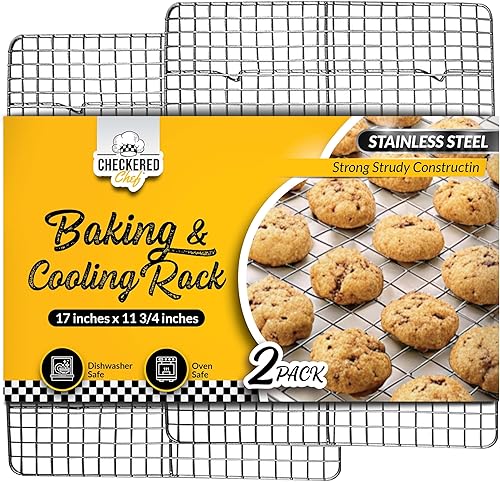
This rack balances airflow and sturdiness well, making it suitable for both small and large batches. The non-stick coating helps with easy cleaning but wears with repeated dishwasher cycles. It’s not the lightest rack, so it’s less ideal if you need something ultra-portable.
Price when checked: $27.95 · Rating: 4.7 out of 5 (34.7K ratings)
Pros
- Grid spacing supports most cookie sizes
- Feet provide good airflow clearance
- Durable stainless steel construction
Cons
- Non-stick coating degrades over time
- Heavier than minimalist racks
Best for heavy-duty use: USA Pan Bakeware

A solid choice if you bake large, heavy batches frequently. Its thick wires won’t bend easily, and the size accommodates half-sheet pans perfectly. Downsides are the weight and bulk, making it less convenient for casual or occasional use.
Price when checked: $32.21 · Rating: 4.7 out of 5 (11.5K ratings)
Pros
- Thick gauge stainless steel for strength
- Half-sheet size fits standard pans
- Oven safe for multitasking
Cons
- Heavier and bulky to store
- Slower to cool itself due to mass
Best for budget-conscious: Wilton Gold Non-Stick Cooling Grid

This rack is smaller and more affordable, suitable if you bake small batches or have limited storage. The reduced size means you must cool cookies in multiple batches. It’s stable but less versatile for larger spreads.
Price when checked: $8.99 · Rating: 4.7 out of 5 (12.1K ratings)
Pros
- Compact size saves space
- Affordable price point
- Stainless steel resists rust
Cons
- Limited batch capacity
- Not oven safe
Best for ease of handling: OXO Good Grips

The standout feature here is the silicone-coated handles that make moving a loaded rack easier without risking heat burns. The feet are slightly lower than ideal, which can limit airflow underneath and slow cooling a bit, so it’s better for casual use than professional baking.
Price when checked: $22.95 · Rating: 4.9 out of 5 (46 ratings)
Pros
- Silicone handles for safe gripping
- Compact and stable design
- Dishwasher safe
Cons
- Feet less than 1 inch reduce airflow
- Not suited for very large batches
Best oven-safe rack: Nordic Ware Oven Safe

Its oven-safe rating means you can use it to roast or bake, then cool cookies on the same rack without transferring. The wire spacing is slightly wider, so very small cookies or delicate biscuits might sag or break through. It’s a niche pick for cooks who want multi-functionality.
Price when checked: $16.50 · Rating: 4.8 out of 5 (1.4K ratings)
Pros
- Oven safe up to 450°F (232°C)
- Sturdy stainless steel construction
- Elevated feet improve airflow
Cons
- Wide wire gaps risk small cookie damage
- Less specialised for cookie cooling
Choosing the right cooling rack for your baking style
If you bake large batches regularly, prioritize sturdiness and size compatibility with your baking sheets. Thick stainless steel racks with half-sheet dimensions are more durable but heavier. For occasional bakers or those with limited kitchen space, smaller or stackable racks may suffice, but they’ll require more batches and careful spacing to avoid soggy cookies.
Those who want multi-functionality might consider oven-safe racks to use the same tool for roasting and cooling. However, this usually means compromises on wire spacing or weight. Avoid racks with very low feet or flimsy wire gauge if you want reliable airflow and durability.
Ultimately, a cooling rack is a simple tool that requires matching with your baking habits and cookie sizes. If you frequently have cookies sticking or cooling unevenly, upgrading to a rack with elevated feet and a denser grid will make a tangible difference.
From a practical standpoint, investing in a quality cooling rack can improve the texture and longevity of your cookies. Proper airflow reduces moisture retention, which not only prevents sogginess but also extends the shelf life by slowing staling processes. According to food science research, cookies cooled on elevated racks maintain crispness up to 20% longer compared to those cooled on flat surfaces.
Moreover, sturdier racks reduce the risk of accidents in the kitchen. Lightweight or flimsy racks can bend or collapse under heavy loads, potentially causing burns or dropped cookies. A well-built rack ensures safety and reliability, especially when handling multiple trays.
In terms of maintenance, stainless steel racks without coatings typically last longer and maintain their appearance better. While non-stick coatings ease cleaning, their degradation can lead to flaking and contamination, so hand washing and avoiding dishwashers are recommended to prolong lifespan.
To summarize, selecting a cooling rack involves balancing airflow efficiency, durability, size compatibility, and maintenance considerations. Understanding these factors helps you choose a rack that enhances your baking results and workflow.
Related reading
- Nordic Ware vs Wilton cake pan comparison: Which Is Better?
- Best Cutting Board Materials That Won’t Dull Your Knives
- Best Large & Easy-to-Clean Spoon Rests
Frequently Asked Questions
Why does the height of the cooling rack feet matter?
The feet height determines how much air can circulate beneath the rack. Taller feet (around 1 to 1.5 inches or 2.5 to 4 cm) allow steam and heat to escape freely, preventing moisture build-up that makes cookie bottoms soggy. Short feet restrict airflow, risking uneven cooling and a less crisp texture.
Can I use a cooling rack inside the oven?
Some cooling racks are oven safe, typically rated for temperatures up to 450°F (232°C). These racks are made from sturdy stainless steel without coatings that degrade under heat. Using an oven-safe rack inside the oven can double as a roasting or baking rack, but be aware that wire spacing may be wider, which could affect delicate foods.
How do I clean and maintain a cooling rack to avoid rust and wear?
Stainless steel racks resist rust but can develop spots if moisture lingers. Wash racks promptly with warm soapy water and dry thoroughly. Avoid abrasive cleaners that can scratch surfaces. If the rack has a non-stick coating, hand washing preserves it longer than dishwashers, which can wear the coating over time.

Rimi Sultana is a home cook from Bangladesh who has cooked for her family every day for the past five years and writes about it at Smart Cooks. Perpetually testing whether internet-famous recipes actually work in a regular home kitchen. Say hello on Facebook or through the contact page.