Choosing the right tart pan for fruit tarts hinges on more than just size or appearance. The critical factors include the pan’s material construction and its removable bottom design, which influence how the pastry bakes and releases.
Some links in this post are affiliate links. If you buy through them we may earn a small commission at no extra cost to you — it never changes which products we recommend.
A good tart pan ensures the crust cooks uniformly by conducting heat efficiently and allows easy removal of fragile tarts without damage. Pans that conduct heat unevenly or lack a removable base often produce unevenly baked crusts or make it difficult to serve the tart intact.
What actually matters
Understanding the mechanics behind tart pans clarifies why some outperform others. The construction material determines heat conduction and retention, affecting baking consistency. Meanwhile, removable bottoms simplify tart release but vary in sealing quality and durability.
Heat conduction is critical because it directly impacts the texture and doneness of the tart crust. For example, a steel pan with a thickness of around 0.8 mm can conduct heat at approximately 50 W/m·K, allowing for more even baking compared to thinner pans which may have hot spots exceeding 70°C difference. This uneven heating can cause edges to burn while the center remains undercooked, affecting the final quality of the tart.
The removable base mechanism is typically designed with a tight groove or lip that holds the base securely during baking. If the fit is too loose, batter or juices can leak, causing uneven baking and difficult cleanup. Over time, repeated expansion and contraction from heating cycles can cause the metal to warp or the joint to loosen, reducing the pan’s effectiveness and requiring replacement.
Material and heat conduction
Tart pans are commonly made from steel, aluminium, or silicone. Steel pans often have a nonstick coating but vary in thickness, which affects heat distribution. Thicker steel or carbon steel pans conduct heat more evenly by reducing hot spots, preventing undercooked or burnt edges.
For example, carbon steel pans typically have thermal conductivity around 54 W/m·K, slightly higher than regular steel, which helps achieve a crispier crust. Aluminium pans have a higher thermal conductivity (~205 W/m·K), allowing faster heat transfer, but their thinner construction and lack of coatings can cause uneven baking if not carefully monitored.
Silicone pans offer flexibility but generally provide poorer heat conduction, with thermal conductivity around 0.2 W/m·K, resulting in longer baking times and less crisp crusts. This can extend baking time by 10-15% compared to metal pans, and the crust may remain softer. Bakers using silicone should adjust oven temperature or baking time accordingly.
Removable base design
A removable base allows the tart to be lifted out cleanly, preserving the crust’s shape. The mechanism typically involves the base fitting snugly into a groove or lip in the ring. If the fit is too loose, batter or juices can leak; too tight, and removing the tart risks damage.
Durability of the removable base joint is another factor. Frequent use can loosen or warp the fit, affecting performance over time. For example, after approximately 100 uses, some pans may develop a slight gap or warping of up to 1-2 mm, which can cause leakage or difficulty in tart removal.
The materials used for the removable base also influence longevity. Stainless steel bases resist corrosion better than carbon steel, which may rust if not dried thoroughly. The thickness of the base (usually 1-2 mm) contributes to its rigidity and ability to maintain shape under pressure during removal.
Pan size and fluting details
Tart pans come in various diameters, commonly between 8 and 10 inches (20 to 25 cm). Choosing the size depends on the desired tart dimensions and oven capacity. Depth also matters; deeper pans (around 1 to 1.5 inches / 2.5 to 3.8 cm) accommodate thicker fillings but may require longer baking.
For example, a 9-inch pan with 1.25-inch depth can hold approximately 1.5 cups (350 ml) of filling, whereas a 1.5-inch deep pan can hold closer to 2 cups (475 ml). This affects baking time, as deeper fillings require up to 10-15 minutes longer to cook through.
The fluted edge creates the tart’s characteristic crust shape. Sharp, well-defined flutes help the pastry cling firmly and bake evenly along the edge, whereas shallow or uneven flutes may cause the crust to shrink or lose shape. The depth of fluting generally ranges from 0.3 to 0.5 inches (7 to 13 mm), with sharper flutes providing better mechanical grip for the dough.
Fluting also impacts heat distribution; the increased surface area at the edges can lead to slightly faster browning. However, this requires careful monitoring to prevent overbrowning or burning, especially in pans with thinner walls.
| Pick | Best for | Material and size | Watch out for |
|---|---|---|---|
| 9-Inch Nonstick Tart Pans (2-Pack) | Everyday fruit tart baking | Nonstick, carbon steel, 9-inch | Very few reviews |
| Maclia 9.5-Inch Carbon Steel Tart Pan | Even browning and crisp crusts | Carbon steel, 9.5-inch | Coating can scratch |
| Webake 4-Inch Silicone Mini Tart Moulds | Easy tart removal without damage | Silicone, 4-inch | Less crisp bottoms than metal |
| 10-Inch Removable-Bottom Tart Pans (2-Pack) | Larger tarts and deep fillings | 10-inch | Fewer reviews |
| Webake 4-Inch Mini Tart Pans (Set of 6) | Miniature fruit tarts and portion control | Nonstick, 4-inch | Small parts to wash |
| KUAYB 9-Inch Fluted Tart Pan | Sharp crust shape and presentation | Carbon steel, 9-inch | Coating durability unproven |
From my kitchen
Once, while making a raspberry tart, I used a tart pan without a removable base. The crust stuck stubbornly to the pan edges when I tried to unmold it, crushing the delicate border I’d painstakingly fluted. Switching to a pan with a removable bottom the next time let me lift the tart out cleanly, preserving the shape and avoiding any awkward repair.
Worth Considering
Best for everyday fruit tart baking: 9-Inch Nonstick Tart Pans (2-Pack)
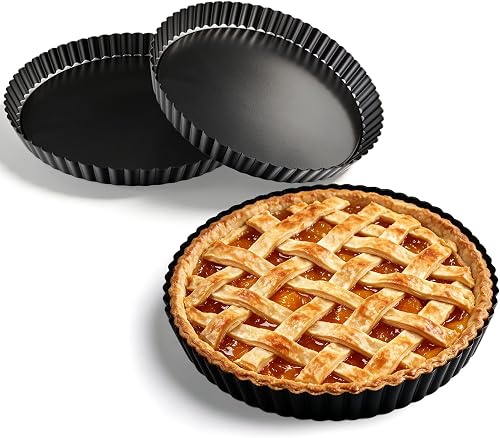
Two 9-inch nonstick carbon steel tart pans with removable bottoms and fluted sides.
Price when checked: $11.99 · Rating: 4.4 out of 5 (10 ratings)
Pros
- Removable bottom
- Two pans
- Nonstick
Cons
- Very few reviews
- Coating needs care
Best for even browning and crisp crusts: Maclia 9.5-Inch Carbon Steel Tart Pan

A 9.5-inch fluted carbon steel tart pan with a removable base. Carbon steel conducts heat well for a crisp, browned crust.
Price when checked: $8.49 · Rating: 4.5 out of 5 (280 ratings)
Pros
- Removable bottom
- Carbon steel
- Low price
Cons
- Coating can scratch
- Base can leak very thin batters
Best for easy tart removal without damage: Webake 4-Inch Silicone Mini Tart Moulds

Silicone 4-inch mini tart and quiche moulds you can peel away from delicate crusts.
Price when checked: $13.99 · Rating: 4.7 out of 5 (1.6K ratings)
Pros
- Flexible release
- Non-stick
- Good for minis
Cons
- Less crisp bottoms than metal
- Need a tray for support
Best for larger tarts and deep fillings: 10-Inch Removable-Bottom Tart Pans (2-Pack)
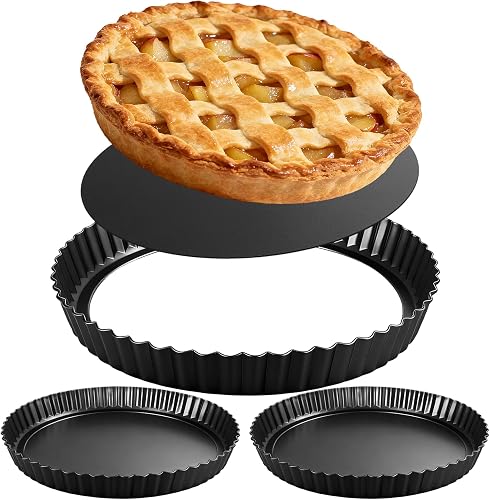
Two 10-inch removable-bottom tart pans for bigger tarts and quiches.
Price when checked: $14.99 · Rating: 4.6 out of 5 (71 ratings)
Pros
- 10-inch size
- Removable bottom
- Set of two
Cons
- Fewer reviews
- Coating needs care
Best for miniature fruit tarts and portion control: Webake 4-Inch Mini Tart Pans (Set of 6)
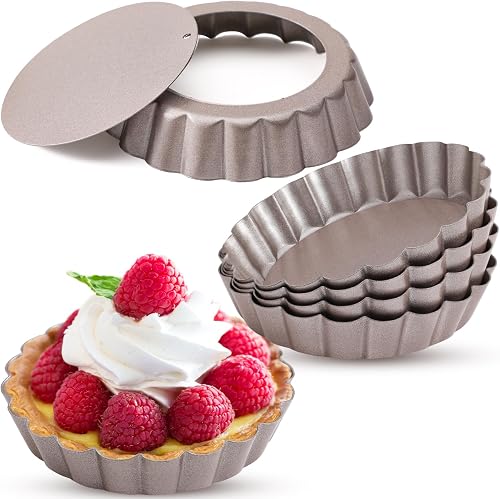
Six 4-inch nonstick tart tins with removable bottoms for individual tarts.
Price when checked: $15.99 · Rating: 4.8 out of 5 (2.5K ratings)
Pros
- Six pans
- Removable bottoms
- Well reviewed
Cons
- Small parts to wash
- Loose bases are easy to misplace
Best for sharp crust shape and presentation: KUAYB 9-Inch Fluted Tart Pan

A 9-inch fluted carbon steel tart pan with a removable base, for neat scalloped edges.
Price when checked: $8.99 · Rating: 4.6 out of 5 (368 ratings)
Pros
- Fluted edges
- Removable bottom
- Inexpensive
Cons
- Coating durability unproven
- Single pan
How to choose your tart pan and when to skip buying one
If you bake fruit tarts regularly, investing in a tart pan with a sturdy removable base is worthwhile for ease of serving and consistent crust quality. Consider the pan material based on your baking style: carbon steel for crisp crusts and even heat, silicone if you prioritise gentle release over browning.
For occasional bakers or those who prefer rustic galettes where the crust folds over freely, a tart pan may be unnecessary. In that case, a simple baking sheet or pie dish could suffice, avoiding storage space and specialized cleaning.
Size matters too: 9-inch diameter pans suit most fruit tart recipes, but if you want mini tarts or large, deep-filled tarts, choose accordingly. Pay attention to pan depth and fluting design only if presentation and crust shape are important to you.
Related reading
- Top 10 pie dishes for flaky crusts: what really shapes your bake
- Baking sheet vs jelly roll pan: practical differences for home cooks
- 7 Best Fruit & Cider Presses in 2026 (The Crusher Is Half the Machine)
Frequently Asked Questions
Why does my tart crust sometimes burn on the edges but stay soft in the middle?
Uneven heat conduction in your tart pan can cause this. Thin pans or those with hot spots heat edges faster than the centre. A thicker steel or carbon steel pan distributes heat more evenly, while an aluminium pan may require monitoring and rotating during baking to prevent burnt edges.
Can I use a silicone tart pan for fruit tarts that require a crisp crust?
Silicone pans conduct heat more slowly, so the crust may not brown as well or develop as crisp a texture compared to metal pans. They are better suited for delicate or soft-crust tarts. For crisp crusts, steel or carbon steel pans are preferable.
How do I prevent my tart from sticking to the pan?
Greasing the pan thoroughly is essential, especially if it lacks a nonstick coating. Using a removable base pan helps lift the tart out cleanly, reducing sticking risk. Additionally, chilling the tart before removing can firm up the crust and filling, making unmolding easier.

Rimi Sultana is a home cook from Bangladesh who has cooked for her family every day for the past five years and writes about it at Smart Cooks. Perpetually testing whether internet-famous recipes actually work in a regular home kitchen. Say hello on Facebook or through the contact page.