Precision in weighing ingredients is the cornerstone of consistent sourdough baking. A kitchen scale that can measure in increments of 1 gram or less ensures that hydration percentages and flour amounts remain accurate, which directly affects the dough’s texture and rise.
Some links in this post are affiliate links. If you buy through them we may earn a small commission at no extra cost to you — it never changes which products we recommend.
Capacity also plays a significant role, as sourdough recipes often involve weighing up to 5 kilograms or more of ingredients. Without sufficient capacity, the scale can be damaged or provide inaccurate readings. Reliable tare functionality is necessary to reset the weight when using containers or adding multiple ingredients sequentially.
What actually matters
When selecting a kitchen scale for sourdough, several technical factors determine usability and reliability. These are more important than brand or style alone.
Precision is critical because sourdough hydration ratios—typically expressed as percentages of water to flour by weight—directly influence the dough’s fermentation process, crumb structure, and final texture. For example, a 1% change in hydration can alter dough extensibility and gas retention, which affects oven spring and crust development. Scales that measure in increments of 1 gram or finer allow bakers to fine-tune hydration to as close as 0.1%, enabling consistent replication of recipes and adjustments based on environmental factors like humidity.
Capacity is equally important since sourdough recipes often require weighing multiple ingredients that cumulatively reach 5 kilograms or more. Using a scale with insufficient maximum load risks overloading the sensor, leading to inaccurate readings or permanent damage. Durable build materials such as stainless steel platforms not only provide longevity but also resist spills and flour dust, common in baking environments. For instance, a scale with an 8kg capacity can accommodate large batch recipes, allowing bakers to scale up without compromising accuracy.
The tare function enhances workflow efficiency and accuracy. It allows resetting the scale to zero after placing a container or bowl, so only the ingredient weight is measured. A responsive tare button that resets instantly is essential; delays or inconsistent resets can compound measurement errors across multiple ingredients, leading to hydration miscalculations. In practice, a lagging tare function can cause bakers to add slightly too much or too little water, which impacts dough stickiness and handling.
In addition to these core features, bakers should consider factors such as display readability, especially in low-light kitchen environments, and the scale’s footprint to ensure it fits comfortably on countertops alongside mixing bowls. Some scales offer backlit LCDs improving visibility, while others have touch controls that may be less reliable if hands are floury or wet.
Precision and increments
Sourdough baking relies on precise hydration ratios, typically expressed as percentages of water to flour by weight. Scales that measure in 1-gram increments or finer allow for adjustments in hydration to as close as 0.1%. Coarser increments can lead to inconsistent dough consistency, making it harder to predict fermentation and bake results.
For example, a typical sourdough recipe might call for 500 grams of flour and 350 grams of water, equating to 70% hydration. If a scale rounds to 2-gram increments, the actual water weight could vary by up to 4 grams, shifting hydration to around 70.8% or 69.2%. This seemingly small difference can affect gluten development and fermentation speed, resulting in a denser crumb or slower rise.
Capacity and durability
Most sourdough recipes require weighing between 1kg to 5kg of ingredients in total. A scale with a maximum capacity below 5kg is at risk of overload and potential damage. Durable build materials like stainless steel platforms better withstand the weight and spills common in baking environments.
For instance, a baker preparing multiple loaves or large batch recipes might weigh 2kg of flour, 1.4kg of water, plus salt and starter, totaling over 4.5kg. Using a scale with only a 3kg capacity would force multiple measurements, increasing the chance of cumulative errors. Scales with higher capacities also tend to have sturdier sensors and platforms, which prolongs the device’s lifespan under heavy use.
Tare function reliability
The tare function allows resetting the scale to zero after placing bowls or containers, enabling accurate measurement of multiple ingredients without manual calculation. A responsive, accurate tare button that resets instantly is essential; delays or inaccuracies here compound errors through the recipe.
In practice, a slow or inconsistent tare can cause fluctuations in weight readings, leading to incorrect ingredient amounts. For example, if the tare does not register zero properly before adding water, the measured water weight might be off by several grams, affecting hydration percentage and ultimately the dough’s texture and rise. Reliable tare functionality streamlines the baking process, reducing mental calculations and errors.
Choosing the right scale for you
If you bake sourdough regularly in quantities over 3kg, look for scales with at least 5kg capacity and 1-gram increments. Durability features like stainless steel platforms and stable bases are worth the investment for lasting accuracy and ease of cleaning. For example, a scale with a sturdy stainless steel surface can resist scratches and is easier to wipe down after flour spills, maintaining hygiene in the kitchen.
However, casual bakers or those working with small batch recipes may prefer more compact or budget models with smaller capacities. Such scales often offer sufficient precision for typical home baking but may lack features like backlit displays or advanced tare responsiveness.
Avoid scales without a reliable tare function; this feature is essential when measuring multiple ingredients sequentially. Also, consider the power source. Rechargeable scales eliminate battery replacements but may have less tactile control compared to physical buttons, which some bakers prefer for quick adjustments with floury hands. For instance, touch controls can sometimes misfire if hands are wet or dusty, potentially disrupting the weighing process during critical recipe steps.
In summary, selecting the right kitchen scale involves balancing precision, capacity, durability, and user interface preferences. Investing in a well-built scale with accurate increments and a reliable tare function can significantly improve sourdough baking consistency and ease.
| Pick | Best for | Max capacity (kg) | Precision (g) | Watch out for |
|---|---|---|---|---|
| Escali Primo P115 | Best overall | 5 | 1 | Limited platform size |
| Etekcity EK6015 | Best budget | 5 | 1 | Basic display |
| OXO Good Grips 11lb Digital Scale | Best upgrade | 5 | 1 | Heavier footprint |
| MyWeigh KD-8000 | Best for advanced bakers | 8 | 1 | Complex controls |
| YONCON 3000g Mini Kitchen Scale | Best compact scale | 3 | 3000g | 3 kg maximum |
| Etekcity 22 lb Rechargeable Kitchen Scale | Best rechargeable | 5 | 22 lb | Larger footprint |
From my kitchen
I once tried baking a sourdough loaf using a scale that lacked a responsive tare function. I placed my mixing bowl on the scale, hit tare, but the reading fluctuated slightly between zero and a few grams. This inconsistency caused me to add slightly too much water by the time I finished mixing, resulting in a sticky dough that was hard to shape. Switching to a scale with a reliable tare reset stopped this problem entirely, making hydration ratios dependable and predictable.
Worth Considering
Best overall: Escali Primo P115

The Escali Primo P115 balances precision and capacity with a 5kg max load and 1-gram increments. Its stainless steel platform is easy to clean but could be a bit small for larger mixing bowls. It is straightforward to use, making it a reliable all-rounder for most sourdough bakers.
Rating: 4.6 out of 5 (7.3K ratings)
Pros
- 5kg maximum capacity accommodates large batches
- 1-gram precision for accurate hydration ratios
- Simple, responsive tare function
Cons
- Platform size may not fit very large dough bowls
- Basic LCD display lacks backlighting
Best budget: Etekcity EK6015

This scale offers 5kg capacity and 1-gram precision at a budget price point. The display is simple but clear, and the tare works reliably. It lacks premium build materials but performs well for sourdough bakers who want accuracy without extras.
Rating: 4.6 out of 5 (177.3K ratings)
Pros
- Affordable price without sacrificing 1g precision
- 5kg capacity suitable for most baking needs
- Easy tare function
Cons
- Plastic platform less durable over time
- No backlight, harder to read in low light
Best upgrade: OXO Good Grips 11lb Digital Scale
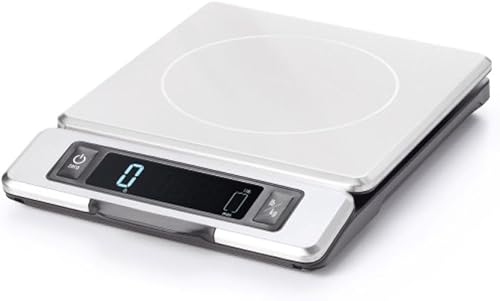
The OXO Good Grips scale has a heavier footprint that makes it stable when weighing large bowls up to 5kg. It features a well-sized stainless steel platform and a clear LCD with backlight. While not the lightest scale, its steady base and tactile buttons suit bakers who need consistent readings for complex recipes.
Price when checked: $61.70 · Rating: 4.7 out of 5 (8.9K ratings)
Pros
- Stable base for heavy bowls
- Backlit LCD enhances visibility
- 1-gram precision with 5kg max capacity
Cons
- Heavier and bulkier than alternatives
- Higher price point
Best for advanced bakers: MyWeigh KD-8000

With an 8kg capacity, this scale suits advanced sourdough bakers making large batch recipes. Precision remains at 1 gram, and the digital interface includes additional features like hold and unit conversion. However, controls can be complex, and the price is higher, so it is best for those who need extra capacity and features.
Price when checked: $49.96 · Rating: 4.6 out of 5 (2.9K ratings)
Pros
- High 8kg capacity for large doughs
- Extra functions such as hold and unit conversion
- Durable stainless steel platform
Cons
- More complex controls can slow workflow
- Higher cost limits appeal for casual users
Best compact scale: YONCON 3000g Mini Kitchen Scale

A compact 3 kg scale reading to 0.1 g, handy for spices, yeast and coffee.
Price when checked: $9.99 · Rating: 4.4 out of 5 (4.7K ratings)
Pros
- 0.1 g resolution
- Very compact
- Cheap
Cons
- 3 kg maximum
- Small platform
Best rechargeable: Etekcity 22 lb Rechargeable Kitchen Scale

A USB-rechargeable Etekcity scale with a 22 lb capacity and IPX6 water resistance.
Price when checked: $24.12 · Rating: 4.6 out of 5 (177.3K ratings)
Pros
- USB rechargeable
- 22 lb capacity
- Water resistant
Cons
- Larger footprint
- Touch buttons can be sensitive
Choosing the right scale for you
If you bake sourdough regularly in quantities over 3kg, look for scales with at least 5kg capacity and 1-gram increments. Durability features like stainless steel platforms and stable bases are worth the investment for lasting accuracy and ease of cleaning. However, casual bakers or those working with small batch recipes may prefer more compact or budget models with smaller capacities.
Avoid scales without a reliable tare function; this feature is essential when measuring multiple ingredients sequentially. Also, consider the power source. Rechargeable scales eliminate battery replacements but may have less tactile control compared to physical buttons, which some bakers prefer for quick adjustments with floury hands.
Related reading
- Easiest Pillsbury Halloween Cookies Upgrade (Ready in 15 Mins)
- Ice cream container vs tubs: what really sets them apart
- The 10 Best Gram Scales for Precise Baking & Coffee
Frequently Asked Questions
Why is 1 gram precision important for sourdough baking?
Sourdough hydration percentages are calculated by weight. Even a few grams’ difference in water or flour can alter dough consistency, fermentation, and crumb structure. Scales with 1-gram precision allow bakers to measure ingredients closely, ensuring repeatable results and better control over the dough’s properties.
Can I use a kitchen scale with less than 5kg capacity for sourdough?
You can, but it depends on your batch size. Many sourdough recipes require weighing multiple kilograms of flour and water combined. Scales with less than 5kg capacity risk overload or inaccurate readings when weighing larger batches. For small loaves or portioned recipes, smaller capacity scales may suffice.
How does the tare function affect measuring ingredients for sourdough?
The tare function resets the scale to zero after placing a container or bowl on it. This allows you to measure only the weight of the ingredient added, not the container. Reliable and immediate tare resetting is crucial for sequentially measuring ingredients accurately, avoiding manual subtraction and potential errors.

Rimi Sultana is a home cook from Bangladesh who has cooked for her family every day for the past five years and writes about it at Smart Cooks. Perpetually testing whether internet-famous recipes actually work in a regular home kitchen. Say hello on Facebook or through the contact page.