Accurate measurement is the foundation of consistent baking results. Measuring cups vary in how they deliver precision, largely due to their material, construction, and the clarity of their markings. A good set reduces guesswork and minimises errors that can come from reading volume at an angle or inconsistent material expansion.
Some links in this post are affiliate links. If you buy through them we may earn a small commission at no extra cost to you — it never changes which products we recommend.
The primary separation between a reliable measuring cup set and a poor one lies in its ability to clearly indicate volume at precise increments and maintain its shape under typical kitchen use. Some sets try to cover too many measurements or sacrifice durability, which introduces small errors that become significant over multiple ingredients.
What actually matters
Not all measuring cups are created equal — understanding the real differences helps avoid common pitfalls in baking accuracy.
When precision is critical, even a 1-2% error in volume can alter the chemical reactions in baking, affecting texture, rise, and taste. For example, a 5% excess of flour can make bread dense and dry, while too little can cause it to collapse. Therefore, the material and construction of measuring cups play a vital role in maintaining dimensional stability and clear readability over time.
The choice of material impacts thermal expansion and durability. Stainless steel, with a coefficient of thermal expansion around 16 x10^-6 /°C, maintains shape better than plastic, which can expand and warp, especially under dishwasher heat. Glass, though inert and dimensionally stable, risks chipping, which can cause inaccuracies or safety hazards.
Measurement markings must be both precise and durable. Etched or engraved markings maintain clarity after thousands of washes, while printed markings can fade by as much as 30% in visibility after just 50 dishwasher cycles. Markings placed on the outside require the user to align their eye perfectly at the liquid’s meniscus to avoid parallax error, which can cause volume misreading by up to 10%. Some advanced sets add fractional increments as small as 1/16 cup (approximately 15 ml), enabling finer control for recipes requiring small quantities of potent ingredients like baking powder or spices.
Ergonomics also influence accuracy indirectly. A well-designed handle allows steady scooping and pouring, reducing spillage and inconsistent fills. Wide, flat handles distribute pressure evenly, improving grip and control. However, compact nesting designs often trade off handle comfort for storage efficiency, which can affect user precision during measurement.
Material and construction
Measuring cups made from stainless steel resist warping and corrosion, which helps maintain precise volume over time. Stainless steel’s density and strength prevent deformation even under heavy use, ensuring that a 1-cup measure remains exactly that after years of use. Glass cups allow you to view contents from multiple angles but are prone to chipping and thermal shock, which can cause cracks that compromise volume accuracy and safety. Plastic cups are lightweight and often cheaper but can scratch, stain, and develop measurement mark wear, affecting readability. Additionally, plastics may absorb odors or discolor when exposed to certain ingredients or high dishwasher temperatures.
Measurement markings and readability
Clear, permanent markings are crucial. Etched or engraved markings do not fade, unlike printed ones. Markings placed on the inside can be obscured by contents while those on the outside require precise eye level alignment to avoid parallax error. Some cups use graduated lines at fractions (¼, ⅓, ½ cup) but others add smaller increments, which can help with precision in recipes requiring less than ¼ cup.
For example, a typical baked good recipe might require 1/3 cup of sugar; a measuring cup with only ¼ and ½ cup markings forces estimation, increasing risk of error by up to 15%. Cups with 1/8 or 1/16 cup increments reduce this uncertainty. Additionally, high-contrast markings (e.g., black or red against stainless steel or glass) improve visibility under various kitchen lighting conditions.
Ergonomics and stacking
Handle design influences ease of use and measurement stability. Wide, flat handles offer a better grip for scooping or holding heavy ingredients. Stackable sets save storage space but may sacrifice handle size or shape that affects comfort. Some cups nest tightly but with handles that overlap awkwardly, making retrieval difficult.
In practical terms, ergonomic handles reduce fatigue during repetitive measuring tasks—important for bakers preparing multiple batches or complex recipes. However, designs that prioritize compact stacking may force users to awkwardly grip handles, increasing the chance of spills or inaccurate fills. For example, a handle width under 1.5 cm can feel cramped for users with larger hands, while excessively large handles may prevent nesting and efficient storage.
How to choose the right measuring cup set for your baking
Decide which types of ingredients you measure most often. If you mainly bake with dry ingredients, a stainless steel set with etched markings offers durability and longevity. For liquid measurements, glass cups provide visual confirmation of volumes from multiple angles. Consider storage space: if your kitchen is tight, compact nesting sets save room but may compromise handle comfort.
Also assess how much precision you need. Casual bakers might tolerate faded plastic markings and approximate volumes, but those chasing consistent results in recipes with critical ratios — such as soufflés or breads — benefit from clearly marked, stable materials. Finally, factor in cleaning preferences and care: glass and stainless steel handle heat well, while plastics may stain or warp under dishwasher heat.
Quantitatively, professional bakers often require measurement accuracy within ±1 gram or ±1 ml, which translates to volume accuracy better than 2%. Selecting cups with fine increments and durable markings supports this level of precision. Additionally, consider frequency of use: sets used daily should prioritize durability and ease of cleaning to maintain accuracy over time.
Remember that the cost of a high-quality set can be offset by improved baking outcomes and reduced ingredient waste. For example, a $30 stainless steel set may last years and prevent costly recipe failures, whereas replacing faded plastic sets annually can add up to a similar expense without the same benefits.
| Pick | Best for | Material and volume range | Watch out for |
|---|---|---|---|
| TILUCK Stainless Measuring Cups and Spoons | Durability and long-term accuracy | Stainless, stainless steel | No liquid measuring jug |
| Pyrex 3-Piece Glass Measuring Cups | Viewing liquid levels clearly | Glass, 3-piece | Breakable |
| Stackable Measuring Cups and Spoons Set | Compact storage | Stainless steel | Unbranded set |
| 1-Cup Stainless Steel Measuring Cups (2-Pack) | Spare 1-cup measures | Stainless steel, 1-cup | Only one size |
| Farberware 5-Piece Plastic Measuring Cups | Budget option | Plastic | Plastic can stain |
| OXO Good Grips Magnetic Measuring Cups | Ergonomic handling | Stainless steel | Only four sizes |
| Pyrex Essentials 2-Pack Glass Measuring Cups | Niche use: liquid heavy baking | Glass, 2-cup | Breakable |
| OXO Good Grips Adjustable Measuring Cup (2 Cup) | Niche use: measuring sticky ingredients | 2 cup | One size only |
From my kitchen
Once, while measuring flour using a plastic cup with worn markings, I realised my dough was wetter than intended. The plastic’s markings had faded and I was eyeballing the level instead of reading a number. I switched to a stainless steel set with etched markings that I could see clearly, and the dough consistency improved immediately. It reminded me that the clarity and durability of measurement markings are integral to reproducible baking results.
Worth Considering
Best for durability and long-term accuracy: TILUCK Stainless Measuring Cups and Spoons

A stainless steel set of nesting measuring cups and spoons that will not warp or crack.
Price when checked: $15.99 · Rating: 4.8 out of 5 (7.6K ratings)
Pros
- Stainless steel
- Cups and spoons
- Highly rated
Cons
- No liquid measuring jug
- More pieces to store
Best for viewing liquid levels clearly: Pyrex 3-Piece Glass Measuring Cups

Pyrex’s 1, 2 and 4-cup glass measuring jugs, the standard for reading liquid levels at eye height.
Price when checked: $25.99 · Rating: 4.8 out of 5 (61.2K ratings)
Pros
- Three sizes
- Clear glass markings
- Microwave safe
Cons
- Breakable
- Not for dry ingredients
Best for compact storage: Stackable Measuring Cups and Spoons Set
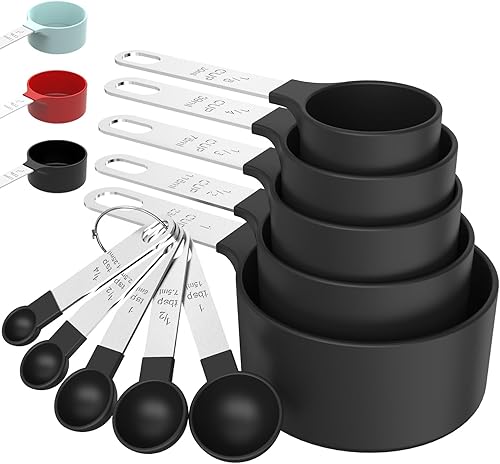
A stackable set of measuring cups and spoons with stainless steel handles that nest into a small stack.
Price when checked: $9.99 · Rating: 4.8 out of 5 (11.2K ratings)
Pros
- Nests compactly
- Cups and spoons
- Low price
Cons
- Unbranded set
- Markings may fade
Best for spare 1-cup measures: 1-Cup Stainless Steel Measuring Cups (2-Pack)

Two single 1-cup (250 ml) stainless steel measures, handy as a spare cup or scoop.
Price when checked: $9.99 · Rating: 4.7 out of 5 (133 ratings)
Pros
- Stainless steel
- Two cups
- Inexpensive
Cons
- Only one size
- Few reviews
Best budget option: Farberware 5-Piece Plastic Measuring Cups

Farberware’s plastic nesting measuring cups with a coffee scoop, a cheap and cheerful set.
Price when checked: $7.04 · Rating: 4.8 out of 5 (10.6K ratings)
Pros
- Very cheap
- Nesting design
- Coffee scoop included
Cons
- Plastic can stain
- Markings may fade
Best for ergonomic handling: OXO Good Grips Magnetic Measuring Cups

OXO’s four stainless steel measuring cups snap together with magnets for storage and have comfortable handles.
Rating: 4.8 out of 5 (6.6K ratings)
Pros
- Magnetic nesting
- Stainless steel
- Comfortable grips
Cons
- Only four sizes
- Pricier than basic sets
Niche pick for liquid-heavy baking: Pyrex Essentials 2-Pack Glass Measuring Cups

Pyrex’s 1 and 2-cup glass measuring jugs for accurate liquid measuring.
Price when checked: $15.99 · Rating: 4.7 out of 5 (7.5K ratings)
Pros
- Clear glass
- Two sizes
- Microwave safe
Cons
- Breakable
- Not for dry ingredients
Niche pick for measuring sticky ingredients: OXO Good Grips Adjustable Measuring Cup (2 Cup)

A 2-cup adjustable measuring cup: set the level, fill, then push the plunger so honey or peanut butter slides out cleanly.
Price when checked: $16.95 · Rating: 4.6 out of 5 (9.1K ratings)
Pros
- Great for sticky ingredients
- Adjustable measure
- Well reviewed
Cons
- One size only
- Plunger seal needs cleaning
How to choose the right measuring cup set for your baking
Decide which types of ingredients you measure most often. If you mainly bake with dry ingredients, a stainless steel set with etched markings offers durability and longevity. For liquid measurements, glass cups provide visual confirmation of volumes from multiple angles. Consider storage space: if your kitchen is tight, compact nesting sets save room but may compromise handle comfort.
Also assess how much precision you need. Casual bakers might tolerate faded plastic markings and approximate volumes, but those chasing consistent results in recipes with critical ratios — such as soufflés or breads — benefit from clearly marked, stable materials. Finally, factor in cleaning preferences and care: glass and stainless steel handle heat well, while plastics may stain or warp under dishwasher heat.
Quantitatively, professional bakers often require measurement accuracy within ±1 gram or ±1 ml, which translates to volume accuracy better than 2%. Selecting cups with fine increments and durable markings supports this level of precision. Additionally, consider frequency of use: sets used daily should prioritize durability and ease of cleaning to maintain accuracy over time.
Remember that the cost of a high-quality set can be offset by improved baking outcomes and reduced ingredient waste. For example, a $30 stainless steel set may last years and prevent costly recipe failures, whereas replacing faded plastic sets annually can add up to a similar expense without the same benefits.
Related reading
- Bread and Butter Pickle Recipe (So Crispy & Easy!)
- Budget vs Premium Espresso Machines: What the Price Actually Buys You
- Budget vs Premium Ice Cream Makers: What the Price Actually Buys You
Frequently Asked Questions
Why are stainless steel measuring cups better for baking?
Stainless steel measuring cups resist warping and corrosion, which helps keep volume measurements consistent over time. Their etched markings do not fade, unlike printed ones on plastic cups, ensuring long-term accuracy. They also withstand heat and abrasion during washing, making them durable tools for serious bakers.
Can I use liquid measuring cups for dry ingredients?
Liquid measuring cups are designed for easy viewing of liquids at eye level and often have spouts for pouring, but they do not provide the same accuracy for dry ingredients. Dry measuring cups allow you to fill and level off ingredients like flour or sugar flush with the rim, giving a precise volume. Using liquid cups for dry ingredients can lead to mis-measurement due to difficulty leveling and reading volume lines accurately.
How do worn or faded measurement markings affect baking?
Worn or faded markings increase the chance of misreading the volume, which can disrupt the balance of ingredients in baking. Even small deviations can affect texture, rise, and taste, especially in recipes sensitive to ratios like cakes or bread. Durable markings like engraving or etching reduce this risk by remaining visible over the lifespan of the measuring cup.

Rimi Sultana is a home cook from Bangladesh who has cooked for her family every day for the past five years and writes about it at Smart Cooks. Perpetually testing whether internet-famous recipes actually work in a regular home kitchen. Say hello on Facebook or through the contact page.