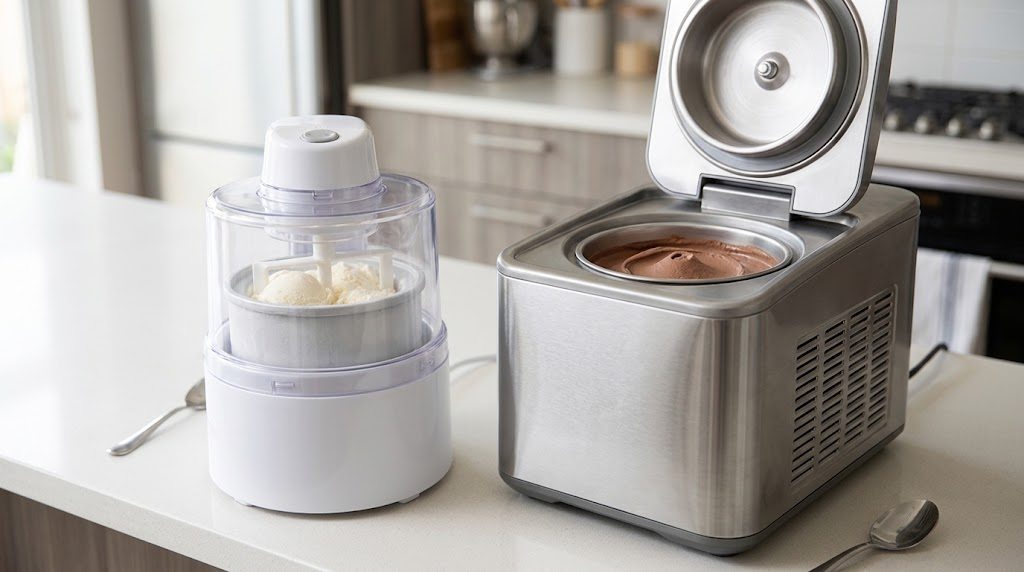
Ice cream makers span a wide price range, and it’s not always obvious what that gap actually buys. Having used both ends, the differences are real, but they matter more to some people than others.
Some links in this post are affiliate links. If you buy through them we may earn a small commission at no extra cost to you — it never changes which products we recommend.
What Budget Machines Get Right
Entry-level freezer-bowl machines produce genuinely good churned ice cream — the core physics of freezing while aerating a base doesn’t change based on price. If your only goal is a scoopable dessert with real vanilla or chocolate flavor, a budget machine does that job.
What You’re Actually Paying For at the Premium End
- A built-in compressor, removing the pre-freeze wait entirely.
- Sturdier, often stainless steel housings that hold up to more frequent use.
- More consistent churn results across different base recipes, including higher-fat or alcohol-containing bases that can be harder for cheaper motors to fully freeze.
- Often a longer warranty, reflecting the manufacturer’s own confidence in the build.
Where the Extra Cost Isn’t Worth It
If you make ice cream a few times a season rather than weekly, the premium features mostly go unused, and you’re paying for convenience and durability margins you won’t stress-test. The flavor and texture difference between a well-run budget machine and a premium one, given the same recipe, is genuinely small.
From My Kitchen: The One Premium Feature I’d Actually Pay For Again
I upgraded from a very basic machine to a mid-range one mainly for the sturdier build, after my first machine’s plastic paddle mount cracked from repeated use within about a year. The mid-range replacement has held up for several years now with heavier, more frequent use than my first one ever saw. That durability difference was the one upgrade that’s actually paid for itself — the extra flavor presets and digital timer that came with it, I basically never touch.
Worth Considering
Cuisinart’s automatic freezer-bowl machine is a reasonable budget-tier pick that covers the fundamentals well.
Whynter’s compressor model represents the premium end, with the no-pre-freeze convenience and sturdier build that comes with the higher price.
What the Price Actually Buys: A Compressor
The single biggest difference between a budget and a premium ice cream maker is whether it freezes itself. Budget machines use a pre-frozen bowl: you keep the bowl in the freezer for 12 to 24 hours, take it out, and it has enough stored cold for exactly one batch. Premium machines contain a compressor — effectively a small refrigeration unit — which chills the bowl as it churns, so you can make batch after batch with no planning at all.
Everything else that scales with price is secondary to this. A compressor machine is also considerably heavier, usually noisier while running, and takes a real footprint on the counter, because it is a fridge with a paddle in it. What you are paying for is the removal of the 24-hour planning step and the ability to run consecutive batches, which matters enormously if you make ice cream regularly and not at all if you make it twice a summer.
Quick Comparison
| Frozen-bowl machine | Compressor machine | |
|---|---|---|
| Planning needed | Bowl frozen 12–24 hours ahead | None — churn on demand |
| Back-to-back batches | No, one per frozen bowl | Yes |
| Freezer space | Bowl lives in the freezer | None |
| Counter and storage footprint | Small | Large and heavy |
| Texture from a single batch | Very good | Very good, slightly more consistent |
| Price | Low | Several times higher |
Where the Money Does Not Change the Result
This is the part worth being clear about: a good base recipe matters more to the final ice cream than the machine does. Fat content, sugar content and how thoroughly the base is chilled before churning affect texture more than churn mechanism. A well-made custard base churned in a frozen-bowl machine will beat a mediocre base in an expensive compressor machine, every time.
The practical test is frequency plus freezer space. If your freezer has room for a bowl to live permanently, and you make ice cream on days you have planned for, the budget machine is genuinely sufficient and the money is better spent elsewhere. If your freezer is full, or you want to make two flavours in an afternoon, or the idea of planning 24 hours ahead is what stops you making ice cream at all, the compressor is what you are buying.
Two Machines Worth Considering
Best value: Cuisinart Automatic Freezer-Bowl Machine
The sensible starting point for almost everyone. One batch at a time with a night of planning, and the ice cream it produces is genuinely good — the limitation is scheduling, not quality.
Pros
- Low price for very good results
- Compact and light to store
- Simple to operate and clean
Cons
- Bowl needs 12–24 hours in the freezer
- One batch per freeze cycle
Best if you make it often: Whynter Compressor Ice Cream Maker
Self-freezing, so there is no bowl in the freezer and no planning. Worth the step up specifically if you make ice cream weekly or want several flavours in one session — not because the ice cream is dramatically better.
Pros
- No pre-freezing or planning required
- Back-to-back batches in one session
- Frees up the freezer space a bowl would occupy
Cons
- Heavy and takes significant counter space
- Considerably more expensive
Frequently Asked Questions
Does a more expensive machine make better-tasting ice cream?
Not directly — flavor comes from your recipe and ingredients. What premium machines improve is consistency and convenience, not the ceiling on how good the ice cream can taste.
Are premium machines worth it for occasional use?
Usually not — the return on the extra cost comes from frequent use and the convenience of skipping pre-freezing, neither of which matters much if you’re only making ice cream a handful of times a year.
Do budget machines break down faster?
Build quality varies more than price alone predicts, but as a general pattern, cheaper machines often use lighter-duty plastic components in the parts that see the most mechanical stress, like the paddle mount.
How long does the bowl really need in the freezer?
A full 24 hours is the safe answer, and the common failure is a freezer that is not cold enough rather than not enough time. A freezer at −18°C will do it; one packed full and frequently opened may not. Two checks: the bowl should feel evenly cold across its whole surface, and if you shake it you should hear nothing sloshing inside — any liquid movement means the coolant has not fully frozen and the batch will fail.
Does a more expensive machine make smoother ice cream?
Marginally, and less than people expect. Compressor machines hold a steadier temperature through the churn, which produces slightly smaller ice crystals. But the factors that dominate texture are the recipe’s fat and sugar, how cold the base is when it goes in, and how quickly you get the finished ice cream into the freezer to harden. Chilling your base overnight before churning will do more for smoothness than upgrading the machine.

Rimi Sultana is a home cook from Bangladesh who has cooked for her family every day for the past five years and writes about it at Smart Cooks. Perpetually testing whether internet-famous recipes actually work in a regular home kitchen. Say hello on Facebook or through the contact page.