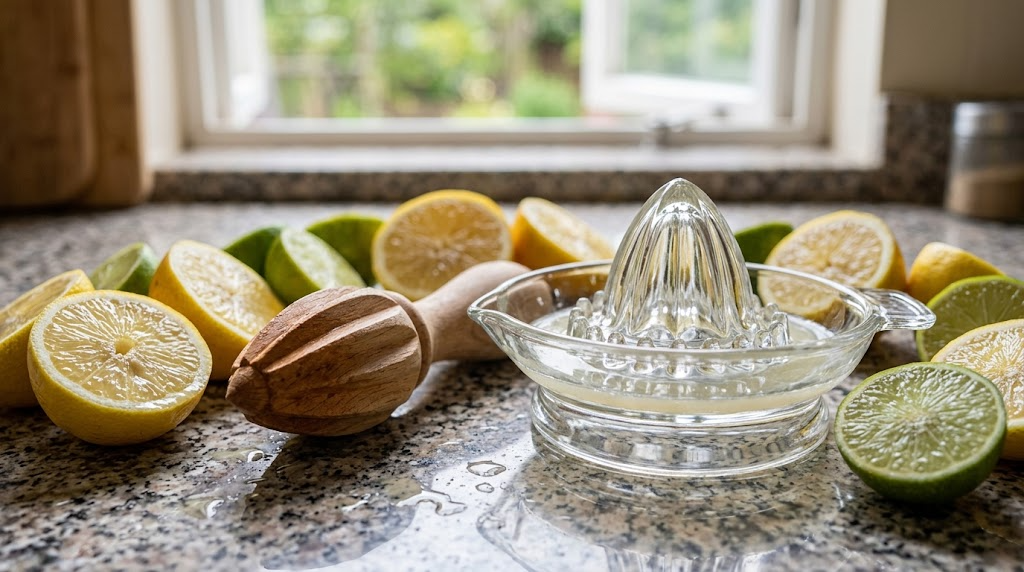
A splash of fresh lemon or lime juice can make or break a pan sauce or marinade, but squeezing citrus by hand rarely gets every drop out and leaves seeds floating in your sauce. The question is whether you need a dedicated reamer or a bowl-style juicer.
Some links in this post are affiliate links. If you buy through them we may earn a small commission at no extra cost to you — it never changes which products we recommend.
What Actually Matters
Reamer: Fast and Minimal
A simple wooden or plastic reamer is twisted directly into a halved citrus fruit over a bowl or strainer. It’s fast, easy to clean, and takes up almost no storage space, but it relies entirely on your wrist strength to extract juice thoroughly.
Bowl Juicer: More Juice, More Cleanup
A bowl-style juicer with a ridged dome and built-in strainer catches seeds automatically and generally extracts more juice per fruit, since the ridges do more of the work than your hand alone. It’s a slightly bigger item to wash and store, though.
Volume Changes the Right Choice
For a sauce recipe needing the juice of one lemon, a reamer is genuinely faster start to finish. For anything needing several citrus fruits juiced — a batch of vinaigrette or a big batch of marinade — a bowl juicer’s better extraction saves you from buying extra fruit.
From My Kitchen
I kept a wooden reamer in my utensil crock for years and never thought twice about it, until I made a beurre blanc that called for the juice of three lemons and realized how much effort — and juice left behind in the fruit — a reamer costs you at that scale. I bought a bowl juicer the next week.
Worth Considering
The classic OXO Good Grips wooden citrus reamer is a genuinely reliable, no-frills option that’s held up in my kitchen for years. For bigger batches, the OXO 2-in-1 citrus juicer has a built-in strainer and handles both small and large fruit sizes.
What Each Tool Does to the Juice Itself
A reamer twists into the cut face of the fruit and breaks the juice vesicles open with pressure and a ridged cone. Because you are working the flesh directly, you get some pulp and, if you press into the white pith at the edges, a little bitterness. A press-style juicer folds the halved fruit inside out and squeezes it from the outside, which extracts more juice per fruit and keeps most of the pith out of the bowl.
For sauces and marinades this difference actually matters. A vinaigrette or a marinade wants clean, bright juice without bitter notes that concentrate as it sits. A quick squeeze over a finished dish barely cares. And there is a case for a little pulp — in a chunky salsa or a dressing that will be shaken before use, pulp adds body that a perfectly clear juice does not have.
Quick Comparison
| Wooden reamer | Press-style juicer | |
|---|---|---|
| Juice extracted per fruit | Moderate | High |
| Pulp in the juice | More | Less |
| Bitterness risk | Higher if you work the pith | Lower |
| Seeds caught | No, unless you strain | Yes, held in the press |
| Effort for a large batch | Tiring on the wrist | Easy, leverage does the work |
| Storage | Slots in a drawer | Bulky |
Which One Your Cooking Actually Calls For
If most of your citrus use is a squeeze of lemon over fish, a lime into a dal, or half a lemon in a dressing, a reamer is enough and takes almost no storage space. If you regularly make marinades, large batches of vinaigrette, lemonade, or anything that needs half a cup of juice or more, the press earns its space quickly — both in juice yield and in how much less it punishes your hands.
One tip that applies to either tool: roll the fruit firmly on the counter under your palm before cutting it, and if it has come straight out of the fridge, warm it for fifteen seconds in the microwave. Both break down the internal structure and can meaningfully increase yield — enough that a cold, unrolled lime can give you noticeably less juice than the same lime prepared properly.
Two Tools Worth Considering
Best simple option: OXO Good Grips Wooden Citrus Reamer
A reamer does not need to be complicated, and wood has a slight grip on the flesh that plastic lacks. This is the tool for the everyday half-lemon, and it takes up almost no room in a drawer.
Pros
- Effective on the single-fruit job most of us do daily
- Takes minimal storage space
- Nothing to break or wear out
Cons
- Tiring for large batches
- Lets pulp and seeds through unless you strain
Best for batches: OXO 2-in-1 Citrus Juicer
Leverage does the work, seeds stay behind, and the yield per fruit is noticeably higher than reaming by hand. If you make marinades or dressings regularly, this is the one that stops citrus prep being the annoying part of the recipe.
Pros
- High yield with little effort
- Catches seeds automatically
- Handles both lemons and limes well
Cons
- Bulky to store compared with a reamer
- More parts to rinse after use
Frequently Asked Questions
Does a metal reamer work better than a wooden one?
Metal reamers tend to have slightly sharper ridges that grip the fruit’s flesh a bit more aggressively, extracting marginally more juice, but the difference is small enough that material mostly comes down to personal preference and durability.
Do I need to remove seeds before juicing?
No — that’s exactly what a built-in strainer in a bowl juicer or reamer catch tray is for. Just juice directly over it and the seeds stay behind while the juice passes through.
Does bottled lemon juice work in a marinade?
For tenderising, yes — the acid does its job either way. For flavour, no, and the difference is not subtle. Bottled juice is pasteurised and usually preserved, which strips the volatile aromatic compounds that make fresh citrus taste bright; what is left reads as flatly sour. In a long-cooked sauce you may get away with it. In a dressing, salsa or anything finished with citrus, fresh is doing work that bottled cannot.
Why does my lemon juice taste bitter in dressings?
You are extracting from the pith. The white layer under the peel is full of bitter compounds, and a reamer pressed hard into the very edge of the fruit brings them into the juice. Ream with moderate pressure and stop before you are grinding into the rind. Bitterness also intensifies as a dressing sits, so a vinaigrette that tasted fine when made can turn noticeably harsh in the fridge overnight for this reason.

Rimi Sultana is a home cook from Bangladesh who has cooked for her family every day for the past five years and writes about it at Smart Cooks. Perpetually testing whether internet-famous recipes actually work in a regular home kitchen. Say hello on Facebook or through the contact page.