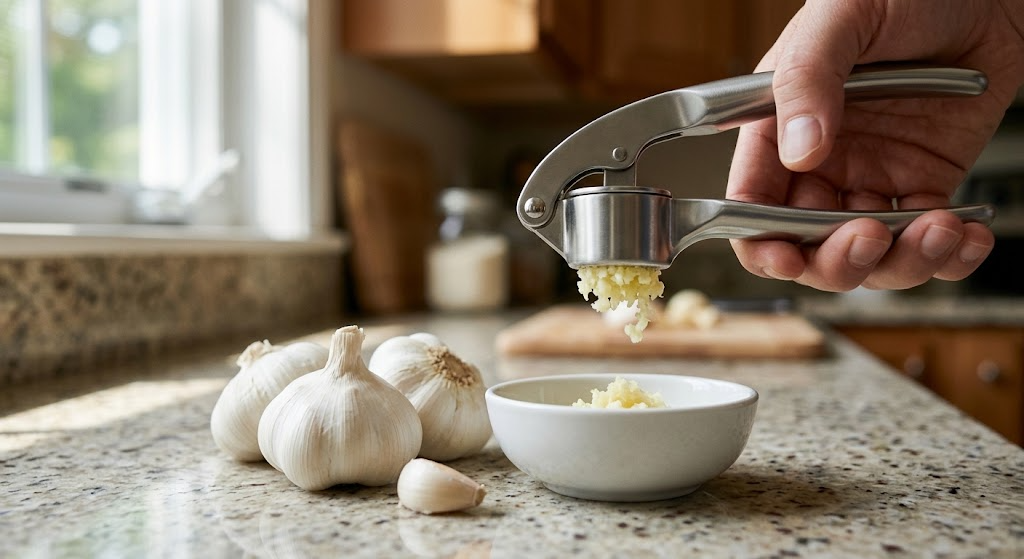
Some cooks swear a garlic press ruins the flavor of garlic compared to hand-mincing with a knife. Others can’t imagine cooking without one. For sauces specifically, the answer depends on more than just personal preference.
Some links in this post are affiliate links. If you buy through them we may earn a small commission at no extra cost to you — it never changes which products we recommend.
What Actually Matters
Texture Changes the Release of Flavor
A press crushes garlic into a near-paste, rupturing more cell walls than a knife does, which releases more allicin and gives a sharper, more immediate garlic flavor. Hand-minced garlic keeps more texture and mellows slightly as it cooks, which some sauces actually benefit from.
Speed for Sauces That Need It Fast
Sauces like a quick pan sauce or aioli often need garlic incorporated fast, before other ingredients overcook. A press turns a whole clove into usable garlic in seconds without a cutting board, which matters when you’re also managing something on the stove.
Cleanup and Peeling
Good presses handle unpeeled cloves, saving a step, but the mesh can be genuinely annoying to clean if garlic fibers get stuck. A built-in cleaner tool or dishwasher-safe design solves most of that frustration.
From My Kitchen
I resisted buying a garlic press for years, insisting a knife was ‘more authentic,’ until I timed myself making a weeknight marinara and realized mincing three cloves by hand took nearly four minutes versus twenty seconds with a press — and honestly, in a simmered sauce, I couldn’t taste the difference the purists talk about.
Worth Considering
The Zulay Kitchen garlic press handles unpeeled cloves and has a soft-squeeze handle that doesn’t strain your hand on tougher cloves. For something simpler and easier to clean, the Gourmet Easy Garlic Press skips peeling entirely and rinses clean under the tap in seconds.
What Pressing Actually Does to the Flavour
Garlic’s sharpness is not sitting in the clove waiting to be released — it is created on damage. Cutting or crushing ruptures cells and lets an enzyme meet a compound called alliin, which produces allicin, the pungent, hot-tasting molecule we recognise as raw garlic. The more cells you rupture, the more allicin forms. A press ruptures far more cells than a knife does, which is why pressed garlic tastes noticeably sharper and hotter than the same clove minced by hand.
That is the whole decision in one sentence: pressing gives you more garlic flavour from less garlic, and hand-mincing gives you a milder, sweeter, more controllable result. Neither is correct in the abstract. A quick weeknight tomato sauce benefits from the extra punch; a delicate cream or butter sauce is usually better with hand-minced garlic that will not bully everything else in the pan.
Quick Comparison
| Garlic press | Minced by hand | |
|---|---|---|
| Flavour intensity | Sharper, hotter, more pungent | Milder, rounder, sweeter |
| Texture in the finished sauce | Near-paste, dissolves completely | Visible pieces with a little bite |
| Burning risk in hot oil | High — fine pulp scorches fast | Lower — larger pieces are forgiving |
| Speed for 4–6 cloves | Faster, no peeling needed on most presses | Slower, peeling plus knife work |
| Cleanup | A tool with holes to clear | One knife and a board |
The Ten-Minute Rule Worth Knowing
Allicin does not appear instantly. Letting crushed or pressed garlic sit for about ten minutes before it hits heat lets the reaction run to completion, so the flavour survives cooking instead of being destroyed mid-formation. If you press garlic straight into hot oil, much of the enzyme is denatured before it has done its job, and the result tastes oddly flat despite smelling strong. Prep the garlic first, then chop your onion, then cook — the delay is free.
The Two Presses Worth Considering
Best overall: Zulay Kitchen Garlic Press
The thing that separates a good press from a drawer-filler is leverage and hole geometry — a short handle and thin holes mean you fight every clove. This one presses unpeeled cloves without much force and has a hopper shallow enough that the pulp actually comes out rather than staying stuck in the corners.
Pros
- Enough leverage to press unpeeled cloves
- Solid build, no flex in the handles
- Cleaning pin design clears the holes properly
Cons
- Bulkier than a simple knife in a small kitchen
- Still needs rinsing immediately or the pulp dries hard
Best for easy cleaning: Gourmet Easy Garlic Press
Cleaning is the reason most garlic presses end up unused, so a design that comes apart or has a built-in scraper is worth more than a marginal improvement in pressing force. This one is simple to clear out and light enough to keep in a drawer you actually open.
Pros
- Simple to clean between cloves
- Light and easy to store
- Handles ginger as well as garlic
Cons
- Needs peeled cloves for the cleanest result
- Less leverage than heavier cast models
Frequently Asked Questions
Does a garlic press make garlic taste more bitter?
It can, if the crushed garlic sits too long before cooking, since the exposed surface area oxidizes faster than a whole or sliced clove. Adding pressed garlic to the pan promptly avoids most of this.
Is hand-mincing really better for any specific sauces?
Sauces where you want visible flecks of garlic and a milder, sweeter cooked flavor — like a slow-simmered tomato sauce — often do better with hand-minced or thinly sliced garlic rather than pressed paste.
Why does my garlic turn bitter in sauces?
It is burning, and pressed garlic burns much faster than minced because the pieces are so fine. Fine pulp in hot oil can go from fragrant to acrid in under thirty seconds. Two fixes: add pressed garlic later than you think you should, usually after the onions are soft and there is some moisture in the pan, or start it in oil that is barely warm and let it come up to temperature together.
Does a garlic press waste a lot of the clove?
A well-designed press leaves very little behind — mostly the skin and a thin layer of pulp against the plate, which a cleaning pin recovers. Cheap presses with thick plates and small holes are the ones that waste garlic, because the pulp cannot get through and you end up throwing away half a clove each time. If you find yourself pressing hard and getting little out, the tool is the problem, not the method.
Related: Top 5 salt cellars for seasoning by hand with practical details

Rimi Sultana is a home cook from Bangladesh who has cooked for her family every day for the past five years and writes about it at Smart Cooks. Perpetually testing whether internet-famous recipes actually work in a regular home kitchen. Say hello on Facebook or through the contact page.