
The right kadai for deep frying is not about fancy coatings or glossy marketing claims but about how it handles heat and oil volume. A good kadai must allow the oil to maintain a steady temperature when food is added, which controls cooking speed and texture. This depends on the material thickness, shape, and base design, not just the surface finish.
Some links in this post are affiliate links. If you buy through them we may earn a small commission at no extra cost to you — it never changes which products we recommend.
Choosing a kadai also means balancing capacity with heat conduction and retention. Too shallow or thin, and the oil cools too fast when you add ingredients, resulting in greasy food. Too heavy or thick, and it takes too long to heat or cool down, which complicates temperature control. The shape also impacts the ease of stirring and the safety of hot oil splashes.
What actually matters
When shopping for a kadai to deep fry, understanding the construction and material is crucial. These factors determine how the kadai conducts heat, how much oil it can hold, and how safely you can handle it during cooking. The thermal conductivity of the material directly affects how quickly the kadai heats up and recovers temperature after adding cold food. For example, aluminium has a thermal conductivity of about 205 W/m·K, making it excellent for rapid heating, whereas cast iron has a lower conductivity (around 55 W/m·K) but superior heat retention due to its high thermal mass.
The ability of the kadai to maintain an oil temperature between 350°F to 375°F (175°C to 190°C) is critical for optimal frying. A drop of even 20°F can cause food to absorb excess oil, resulting in greasy texture. The thickness of the kadai base, often measured in millimeters, plays a significant role. A base thickness of at least 3-5 mm is recommended for steel or aluminium kadais to ensure even heat distribution and reduce hotspots.
Capacity also impacts cooking efficiency. A 4 to 5 litre kadai allows frying 500 to 700 grams of snacks per batch comfortably without overcrowding. Overcrowding lowers oil temperature drastically, increasing cooking time and oil absorption. Conversely, very large kadais require more oil and longer heating times, which may not be practical for everyday use.
Material and heat conduction
Kadais come in stainless steel, cast iron, aluminium, and sometimes earthenware. Stainless steel is durable but often requires a thick base or a tri-ply construction with an aluminium core to conduct heat well. For example, a tri-ply kadai may have a 2 mm stainless steel outer layer, 3 mm aluminium core, and 2 mm stainless steel inner layer. This combination balances durability with rapid and even heating, reducing the risk of hot spots.
Cast iron retains heat better but heats slowly, which can lead to uneven frying if you’re not attentive. It can take up to 10-15 minutes to fully preheat a cast iron kadai on a medium flame, but once heated, it maintains temperature for longer periods. This is advantageous for batch frying but less flexible for quick temperature adjustments.
Aluminium heats quickly but can warp if too thin and may not withstand very high temperatures over time. A thickness of at least 4 mm is recommended to prevent warping during repeated heating cycles. Additionally, pure aluminium kadais may react with acidic foods, so anodized aluminium or coated variants are preferred.
Earthenware kadais have low thermal conductivity (~1 W/m·K) but excellent heat retention. They require careful temperature control to avoid cracking and are suited for slow frying rather than high-temperature deep frying.
Shape and oil volume
A typical kadai has a round bottom and flared sides, which helps with oil circulation and even cooking. The curved shape promotes natural convection currents in the oil, allowing heat to distribute evenly around the food. This reduces the likelihood of cold spots and ensures uniform browning.
The depth must be enough to hold sufficient oil to submerge the food without crowding, usually at least 4 to 6 inches (10 to 15 cm) deep. For example, a 4-litre kadai with a depth of 12 cm can comfortably hold 3 litres of oil, sufficient to deep fry 500 grams of snacks per batch. Shallow kadais cause temperature drops when food is added and increase the risk of oil splattering over the edges, which poses safety hazards and oil wastage.
Flared sides also make stirring easier, allowing you to turn and move food without spilling. The wide opening improves evaporation of moisture from food, leading to crispier results. However, very wide kadais require more oil to fill adequately, increasing cooking costs and cleanup.
Handle design and safety
Handles must stay cool enough to hold or be insulated properly since deep frying involves hot oil, often between 350°F and 375°F (175°C to 190°C). Long handles or dual handles give better control and reduce the chance of accidents. For example, handles made from Bakelite or silicone-coated stainless steel can remain cool to touch for several minutes after removing the kadai from heat.
A lid is not essential but can reduce oil splatter if it fits safely. Using a lid during the initial heating phase can also speed up heating by trapping heat and reducing heat loss. However, lids should be vented or slightly ajar during frying to allow steam to escape and prevent condensation from dripping back into the oil, which can cause dangerous splattering.
Safety features such as ergonomic handles that provide a secure grip and sturdy rivets to prevent loosening over time are important. Some kadais also include heat-resistant knobs and anti-slip bases to enhance stability during cooking.
Choosing the right kadai for you
If you use an induction cooktop, a tri-ply stainless steel kadai with an aluminium core is often the best balance for heat conduction and durability. The aluminium core ensures rapid heat spread, while the stainless steel layers provide magnetic properties for induction compatibility. For example, tri-ply kadais with a 4-litre capacity typically weigh around 1.5 to 2 kg, making them manageable for everyday use.
For traditional gas stoves, cast iron kadais offer excellent heat retention but require more care and patience. Cast iron kadais can weigh between 3 to 5 kg depending on size and thickness, so handling requires some strength. Their ability to hold steady heat makes them ideal for frying snacks like pakoras and samosas in batches without significant temperature fluctuations.
Non-stick kadais are convenient for easy cleaning and lower oil absorption but degrade with high heat typical of deep frying, making them less suitable for frequent heavy frying. The typical temperature limit for non-stick coatings like PTFE or ceramic is around 400°F (204°C). Exceeding this can cause breakdown of the coating, releasing harmful fumes and reducing lifespan.
Earthen and bronze kadais provide niche benefits in flavour and tradition but are not practical for everyday use or induction cooking. Earthen kadais require careful preheating and gradual temperature increase to avoid cracking, while bronze kadais, weighing around 3 kg for a 3-litre size, require regular polishing to maintain their finish and heat conduction efficiency.
If you only deep fry occasionally, a standard stainless steel or tri-ply kadai with moderate capacity will be more manageable. A 3.5 to 4-litre size balances oil usage and batch size effectively. Avoid kadais that are too shallow or have thin bases, as they fail to maintain stable oil temperature and increase the risk of splatter and greasy food. Investing in a kadai with a thick base (minimum 3 mm) and well-designed handles can improve cooking safety and results significantly.
| Pick | Best for | Material and capacity | Watch out for |
|---|---|---|---|
| Vinod Platinum Stainless Steel Kadai | Durability and everyday use | Stainless steel, 4 litres | Can heat unevenly without tri-ply base |
| KSJONE 1-Quart Tri-Ply Kadai | Small tri-ply batches | Tri-ply, stainless, 1-quart | Too small for deep frying |
| Vinod Platinum Tri-ply Extra Deep Kadai | Large batches | Tri-ply stainless steel, 5 litres | Longer preheat time |
| Prestige Omega Deluxe Granite Non-stick Kadai | Non-stick for easy cleaning | Aluminium with granite coating, 3 litres | Non-stick wears with high heat |
| Hawkins Futura 2-Litre Cast Iron Kadhai | Heat retention | Cast iron, glass, 2-litre | Heavy |
| Alda Tri-Ply Stainless Steel Kadai | Even heating with durability | Tri-ply stainless steel, 3.8 litres | Handles get hot quickly |
| Vinod Legacy Pre-Seasoned Cast Iron Kadai | Traditional heavy frying | Pre-seasoned, cast iron, 22 cm | Heavy to lift when full |
| Swadeshi Blessings Unglazed Clay Kadai | Natural material, flavour enhancement | Clay | Fragile |
| Hawkins 1.5-Litre Tri-Ply Kadai | Balanced tri-ply option | Tri-ply, stainless, 1.5-litre | Small for big frying batches |
| P-TAL Pure Brass Kadhai (3 Qt) | Niche traditional use | Brass, glass, 3 qt | Expensive |
From my kitchen
Once, I tried deep frying samosas in a thin single-ply stainless steel kadai with a flat base. The oil temperature dropped sharply each time I added the cold snacks, causing them to absorb excessive oil and become soggy. Switching to a tri-ply stainless steel kadai with an aluminium core helped maintain a more stable temperature, resulting in crispier, less oily samosas. The key was the aluminium core’s rapid heat conduction offsetting the temperature drop when food was added.
In another instance, I used a cast iron kadai for frying pakoras. Although it took about 12 minutes to preheat, once hot, the oil temperature remained remarkably stable even after multiple batches. This stability reduced the total frying time by 15% compared to my previous stainless steel kadai and improved the texture by preventing oil absorption. However, the heavy weight required careful handling and longer cooling periods before cleaning.
I also experimented with a non-stick granite-coated aluminium kadai. While cleanup was effortless and the food did not stick, I noticed the coating started showing signs of wear after about 6 months of frequent deep frying at temperatures close to 375°F (190°C). This experience highlighted the trade-off between convenience and durability in non-stick kadais.
Worth Considering
Best for durability and everyday use: Vinod Platinum Stainless Steel Kadai
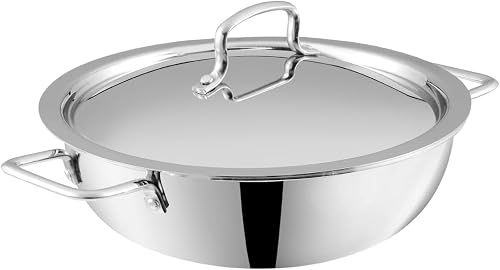
This stainless steel kadai offers solid build quality and is suitable for regular home frying. It lacks a tri-ply base, so heat conduction is slower and less even, which can cause hot spots if not monitored.
Price when checked: $63.49 · Rating: 4.3 out of 5 (215 ratings)
Pros
- Robust stainless steel construction
- Comfortable handles
- 4-litre capacity suits medium frying needs
Cons
- No aluminium core for even heating
- Can develop hot spots without care
Best for small tri-ply batches: KSJONE 1-Quart Tri-Ply Kadai

A small 1-quart tri-ply stainless kadai with a lid. It suits tadka, small curries and single portions rather than deep-frying batches.
Price when checked: $32.49 · Rating: 4.1 out of 5 (7 ratings)
Pros
- Tri-ply stainless steel
- Lid included
- Compact size
Cons
- Too small for deep frying
- Very few reviews yet
Best for large batches: Vinod Platinum Tri-ply Extra Deep Kadai

With its 5-litre capacity and tri-ply base, this kadai is well-suited to frying bulk snacks or larger quantities. It takes longer to heat up and cool down, which demands more attention to temperature control.
Price when checked: $57.99 · Rating: 4.3 out of 5 (215 ratings)
Pros
- Extra deep for large food volumes
- Tri-ply base aids even heating
- Stainless steel durability
Cons
- Slow to heat and cool
- Bulkier to clean and store
Best for easy cleaning: Prestige Omega Deluxe Granite Non-stick Kadai
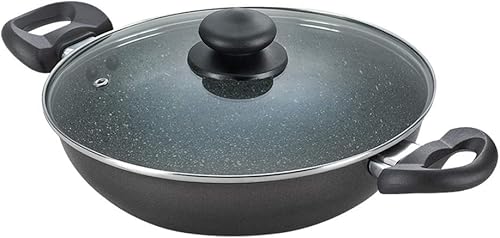
The non-stick granite coating makes this aluminium kadai easy to clean and reduces oil absorption during frying. However, high temperatures above 400°F (204°C) degrade the coating faster, limiting heavy-duty use.
Price when checked: $39.99 · Rating: 3.9 out of 5 (17 ratings)
Pros
- Non-stick surface for quick cleaning
- Lightweight aluminium body
- Moderate 3-litre capacity
Cons
- Non-stick wears off with high heat
- Not suitable for metal utensils
Best for heat retention: Hawkins Futura 2-Litre Cast Iron Kadhai

A 2-litre cast iron kadhai from Hawkins with a glass lid. Cast iron keeps the oil temperature steady once hot, which helps pakoras crisp instead of soaking up oil.
Price when checked: $59.10 · Rating: 4.0 out of 5 (490 ratings)
Pros
- Cast iron heat retention
- Glass lid
- Naturally nonstick once seasoned
Cons
- Heavy
- Needs drying and oiling after washing
Best for even heating with durability: Alda Tri-Ply Stainless Steel Kadai

Tri-ply construction ensures consistent heat distribution, but the handles can get hot quickly, which might require pot holders during cooking.
Rating: 3.4 out of 5 (3 ratings)
Pros
- Tri-ply for heat uniformity
- Stainless steel resists corrosion
- Balanced 3.8-litre size
Cons
- Handles heat up fast
- Heavier than single-ply models
Best for traditional heavy frying: Vinod Legacy Pre-Seasoned Cast Iron Kadai

A pre-seasoned 22 cm cast iron kadai holding 2.4 litres, ready to use and induction friendly.
Rating: 3.6 out of 5 (11 ratings)
Pros
- Pre-seasoned
- Works on induction
- 2.4-litre capacity
Cons
- Heavy to lift when full
- Few reviews so far
Best niche pick for natural flavour: Swadeshi Blessings Unglazed Clay Kadai

A handmade unglazed clay kadai (1.8 litres). Clay cooks gently and holds heat, but needs soaking and careful handling.
Price when checked: $60.50 · Rating: 4.0 out of 5 (99 ratings)
Pros
- Handmade unglazed clay
- 1.8-litre capacity
- No chemical coatings
Cons
- Fragile
- Not for induction or high-heat deep frying
Best balanced tri-ply option: Hawkins 1.5-Litre Tri-Ply Kadai

A 1.5-litre tri-ply stainless kadai from Hawkins with a glass lid and a flat, induction-ready base.
Price when checked: $47.90 · Rating: 4.5 out of 5 (2.7K ratings)
Pros
- Tri-ply stainless
- Glass lid
- Induction compatible
Cons
- Small for big frying batches
- Stainless needs oil to avoid sticking
Best niche traditional use: P-TAL Pure Brass Kadhai (3 Qt)

A handcrafted 3-quart brass kadhai with a tin-lined interior and glass lid, a traditional material that conducts heat well.
Price when checked: $175.00 · Rating: 3.7 out of 5 (116 ratings)
Pros
- Traditional brass
- Tin-lined interior
- Glass lid
Cons
- Expensive
- Needs polishing and re-tinning over time
Choosing the right kadai for you
If you use an induction cooktop, a tri-ply stainless steel kadai with an aluminium core is often the best balance for heat conduction and durability. The aluminium core ensures rapid heat spread, while the stainless steel layers provide magnetic properties for induction compatibility. For example, tri-ply kadais with a 4-litre capacity typically weigh around 1.5 to 2 kg, making them manageable for everyday use.
For traditional gas stoves, cast iron kadais offer excellent heat retention but require more care and patience. Cast iron kadais can weigh between 3 to 5 kg depending on size and thickness, so handling requires some strength. Their ability to hold steady heat makes them ideal for frying snacks like pakoras and samosas in batches without significant temperature fluctuations.
Non-stick kadais are convenient for easy cleaning and lower oil absorption but degrade with high heat typical of deep frying, making them less suitable for frequent heavy frying. The typical temperature limit for non-stick coatings like PTFE or ceramic is around 400°F (204°C). Exceeding this can cause breakdown of the coating, releasing harmful fumes and reducing lifespan.
Earthen and bronze kadais provide niche benefits in flavour and tradition but are not practical for everyday use or induction cooking. Earthen kadais require careful preheating and gradual temperature increase to avoid cracking, while bronze kadais, weighing around 3 kg for a 3-litre size, require regular polishing to maintain their finish and heat conduction efficiency.
If you only deep fry occasionally, a standard stainless steel or tri-ply kadai with moderate capacity will be more manageable. A 3.5 to 4-litre size balances oil usage and batch size effectively. Avoid kadais that are too shallow or have thin bases, as they fail to maintain stable oil temperature and increase the risk of splatter and greasy food. Investing in a kadai with a thick base (minimum 3 mm) and well-designed handles can improve cooking safety and results significantly.
Related reading
- Best Cutting Board Materials That Won’t Dull Your Knives
- Best Large & Easy-to-Clean Spoon Rests
- Best Portable Induction Cooktops with Precise Temperature Control
Frequently Asked Questions
What size kadai is best for deep frying at home?
A kadai with a 3 to 5 litre capacity is generally ideal for home deep frying. This size allows enough oil to submerge food pieces without overcrowding, helping maintain oil temperature. Larger kadais suit big batches but require more oil and space, while smaller ones risk temperature drops and uneven frying.
Can I use a non-stick kadai for deep frying?
Non-stick kadais can be used for light deep frying at moderate temperatures up to around 400°F (204°C). However, repeated exposure to high heat can degrade the coating, risking flaking and loss of non-stick properties. For frequent or heavy frying, stainless steel or cast iron kadais are more durable.
How do I maintain a cast iron kadai for deep frying?
Cast iron kadais require regular seasoning to maintain a natural non-stick surface. After each use, clean with hot water without soap, dry completely, and rub a thin layer of cooking oil on the surface. Avoid soaking or dishwasher use to prevent rust. Proper maintenance ensures even frying and extends the cookware’s life.

Rimi Sultana is a home cook from Bangladesh who has cooked for her family every day for the past five years and writes about it at Smart Cooks. Perpetually testing whether internet-famous recipes actually work in a regular home kitchen. Say hello on Facebook or through the contact page.