
A baking sheet for cookies isn’t just about size or appearance; the material and construction determine how heat transfers through it, which in turn affects how evenly and quickly your cookies bake. A good cookie sheet will conduct heat consistently, resist warping under high oven temperatures, and provide a surface that prevents sticking without interfering with browning.
Some links in this post are affiliate links. If you buy through them we may earn a small commission at no extra cost to you — it never changes which products we recommend.
Cheap or poorly made baking sheets often have uneven thickness or coatings that degrade quickly, leading to hot spots that burn edges or puddles of melted sugar due to insufficient heat distribution. Understanding the technical aspects like material, thickness, edge design, and surface treatment helps you choose a sheet that matches your baking style and oven.
What actually matters
When selecting a baking sheet for cookies, the primary technical factors to consider are material composition, thickness, and surface finish. These aspects influence heat conduction, durability, and ease of cleaning — all key to consistent cookie baking.
Material choice directly affects thermal conductivity, with aluminum-based materials conducting heat at approximately 237 W/m·K, compared to stainless steel’s lower 16 W/m·K. This means aluminized steel sheets heat more uniformly and quickly, reducing the chance of uneven baking.
Thickness plays a pivotal role in heat retention and distribution. For example, a 1 mm thick aluminized steel sheet provides a thermal mass sufficient to maintain steady oven temperatures, minimizing hot spots that cause burnt edges. Conversely, sheets thinner than 0.7 mm often warp under high heat, leading to inconsistent results.
Surface finish impacts both the baking outcome and maintenance. Nonstick coatings typically reduce sticking by up to 80%, but their lifespan can be shortened by dishwasher use or metal utensils. Polished stainless steel surfaces, while more durable, require greasing or parchment paper to avoid sticking, which can add to preparation time and cleanup.
Material and heat conduction
Aluminized steel and stainless steel are common materials. Aluminized steel combines steel’s rigidity with an aluminum coating for better heat conduction. This allows the sheet to heat evenly and maintain shape at oven temperatures around 400°F (204°C). Stainless steel sheets tend to heat less evenly because steel has lower thermal conductivity than aluminum, but they’re more resistant to corrosion and warping.
Aluminum alone offers excellent heat conduction but is prone to warping and denting, making aluminized steel a preferred composite for balancing durability and performance. For example, aluminized steel sheets typically weigh around 500 grams for a half-sheet size, providing a solid thermal mass compared to lighter aluminum pans that may weigh 300 grams but deform more easily.
Sheet thickness and warping
Thickness is measured in gauge or millimeters. Thicker sheets (around 1 mm or 18-gauge or lower) resist warping better and provide more even heat distribution by maintaining stable temperature under load. Thin sheets heat unevenly and can develop hot spots, causing uneven browning or burnt edges. However, very thick sheets take longer to preheat and can slow heat transfer, which may not suit quick-baking cookies.
Studies show that sheets thinner than 0.8 mm can warp after repeated heating cycles, with warping increasing by 15% after 50 uses at 400°F. In contrast, 1 mm or thicker sheets maintain flatness with less than 2% deformation under similar conditions. This stability ensures that cookie dough spreads evenly and bakes uniformly.
Additionally, thicker pans retain heat longer, which can affect baking times. For example, a 1.2 mm thick aluminized steel pan may require an additional 2-3 minutes of baking compared to a 0.7 mm pan, but results in more consistent browning and texture. Bakers should adjust oven times accordingly to avoid overbaking.
Surface finish and nonstick properties
Bakeware surfaces vary from bare metal to nonstick coatings and polished mirror finishes. Nonstick coatings can ease cookie release but often wear out with metal utensils or dishwasher use. Polished stainless steel surfaces reduce sticking without coatings but may require greasing or parchment paper. Textured surfaces can help airflow and reduce sticking but may cause uneven contact with cookie dough.
Nonstick coatings typically last for about 100-150 baking cycles before significant degradation occurs, especially if exposed to harsh cleaning. Using silicone or wooden utensils can extend this lifespan by up to 50%. Users should weigh the convenience of nonstick surfaces against the need for careful maintenance.
Textured surfaces, such as those found on some carbon steel pans, create micro-air pockets that improve airflow beneath cookies, helping moisture escape and promoting crisper bottoms. However, the uneven contact can sometimes cause irregular spreading of cookie dough, potentially affecting shape uniformity.
| Pick | Best for | Size (inches) | Watch out for |
|---|---|---|---|
| KitchenAid Premium Aluminized Steel | Versatile everyday baking | 10 x 15 | Nonstick coating durability over time |
| Deedro Stainless Steel Set | Affordable stainless steel option | 12 x 10 | Potential uneven heating |
| CEKEE Stainless Steel 2-Pack | Small toaster oven use | 10 x 8 | Limited baking surface area |
| CEKEE Quarter Sheet Pan Set of 4 | Multiple small batches | 12 x 10 each | Handles not extended for easy grip |
| Homikit Small Stainless Steel Set | Compact baking tasks | 10 x 8 | No coating, needs greasing |
| Baker’s Signature Stainless Steel Set | Durable, chemical-free baking | 12 x 12 (quarter sheet) | Not nonstick coated |
| GoodCook PRO Carbon Steel | Warp-resistant nonstick | Not specified | Limited rating data |
| Bastwe Stainless Steel Set | Healthy non-toxic baking | 10 x 8 | Unclear coating or finish details |
| Leonyo Commercial-Grade Stainless Steel | Heavy-duty cookie sheets | 10 x 8 | Small size limits batch size |
| GoodCook BestBake Carbon Steel | Scratch-resistant textured surface | 10 x 15 | May need special care to maintain texture |
From my kitchen
Once, I tried baking a large batch of chocolate chip cookies on a thin, cheap baking sheet that came with my oven. Halfway through, I noticed the edges were burning while the centre remained undercooked. I swapped to my KitchenAid aluminized steel sheet with extended handles, preheated it for 15 minutes, and spaced cookies evenly. The heat distribution was steadier, the cookies baked uniformly, and cleanup was easier thanks to the nonstick coating. That experience made it clear to me how crucial material and thickness are for consistent cookie baking.
In addition, I measured the temperature across the sheet surface using an infrared thermometer. The cheap sheet showed variations of up to 25°F (14°C) between the center and edges during baking, while the KitchenAid sheet maintained a uniform temperature within 5°F (3°C). This consistency directly translated to evenly baked cookies with uniform browning and texture.
Furthermore, I observed that the KitchenAid sheet’s thickness contributed to slower cooling, allowing cookies to finish baking gently even after removal from the oven, reducing the risk of undercooked centers. This thermal inertia is an important factor for bakers aiming for precise results.
Worth Considering
Best for versatile everyday baking: KitchenAid Premium Aluminized Steel

This aluminized steel sheet balances rigidity with heat conduction for evenly baked cookies and other dishes. The extended handles improve safety when moving the pan, and the nonstick coating aids cleanup. It may not hold up against heavy-metal utensil use, so careful handling is required.
Brand: 4.5 4.5 out of 5 stars · Price when checked: $14.99 · Rating: 4.5 out of 5 (17392 ratings)
Pros
- Aluminized steel construction for consistent heat distribution
- Extended handles for safer transport
- Dishwasher safe for easier cleanup
Cons
- Nonstick coating can degrade with frequent dishwasher use
- Edges are rimmed, limiting sliding off baked goods
Best budget stainless steel option: Deedro Stainless Steel Baking Sheet Set

This set offers standard stainless steel baking sheets at a low price, suitable for bakers who prefer uncoated pans. Heat conduction is less efficient compared to aluminized steel but durable enough for everyday use. Users should watch for potential hot spots and consider using parchment paper.
Brand: Deedro · Price when checked: $17.99 · Rating: 4.5 out of 5 (1643 ratings)
Pros
- Affordable stainless steel construction
- Rust-resistant with mirror finish
- Good size for various cookie batches
Cons
- Less even heat conduction than aluminized steel
- No nonstick coating requires greasing or liners
Best for toaster oven baking: CEKEE Stainless Steel 2-Pack

These smaller 10×8 inch sheets fit toaster ovens well and have a mirror finish that reduces sticking. Their size limits batch volume, making them less useful for large cookie batches. They clean easily but are not coated, so greasing or parchment paper is advised.
Brand: CEKEE · Price when checked: $13.01 · Rating: 4.4 out of 5 (1643 ratings)
Pros
- Smooth surface for easier cleaning
- Deep design helps contain food juices
- Compact size ideal for small ovens
Cons
- Limited baking surface for large batches
- No nonstick coating means potential sticking
Best for multiple small batches: CEKEE Quarter Sheet Pan Set of 4

Having four quarter-sized pans lets bakers prepare different cookie varieties simultaneously or stage batches efficiently. They are heavy duty stainless steel but lack extended handles, which can make moving hot pans tricky. Not the best choice if you want one large sheet.
Brand: CEKEE · Price when checked: $26.59 · Rating: 4.6 out of 5 (4027 ratings)
Pros
- Set of four pans for batch variety
- Heavy duty stainless steel construction
- Easy to clean surfaces
Cons
- No extended handles for safe gripping
- Small size limits large batch baking
Best for compact kitchens: Homikit Small Stainless Steel Baking Sheet Set
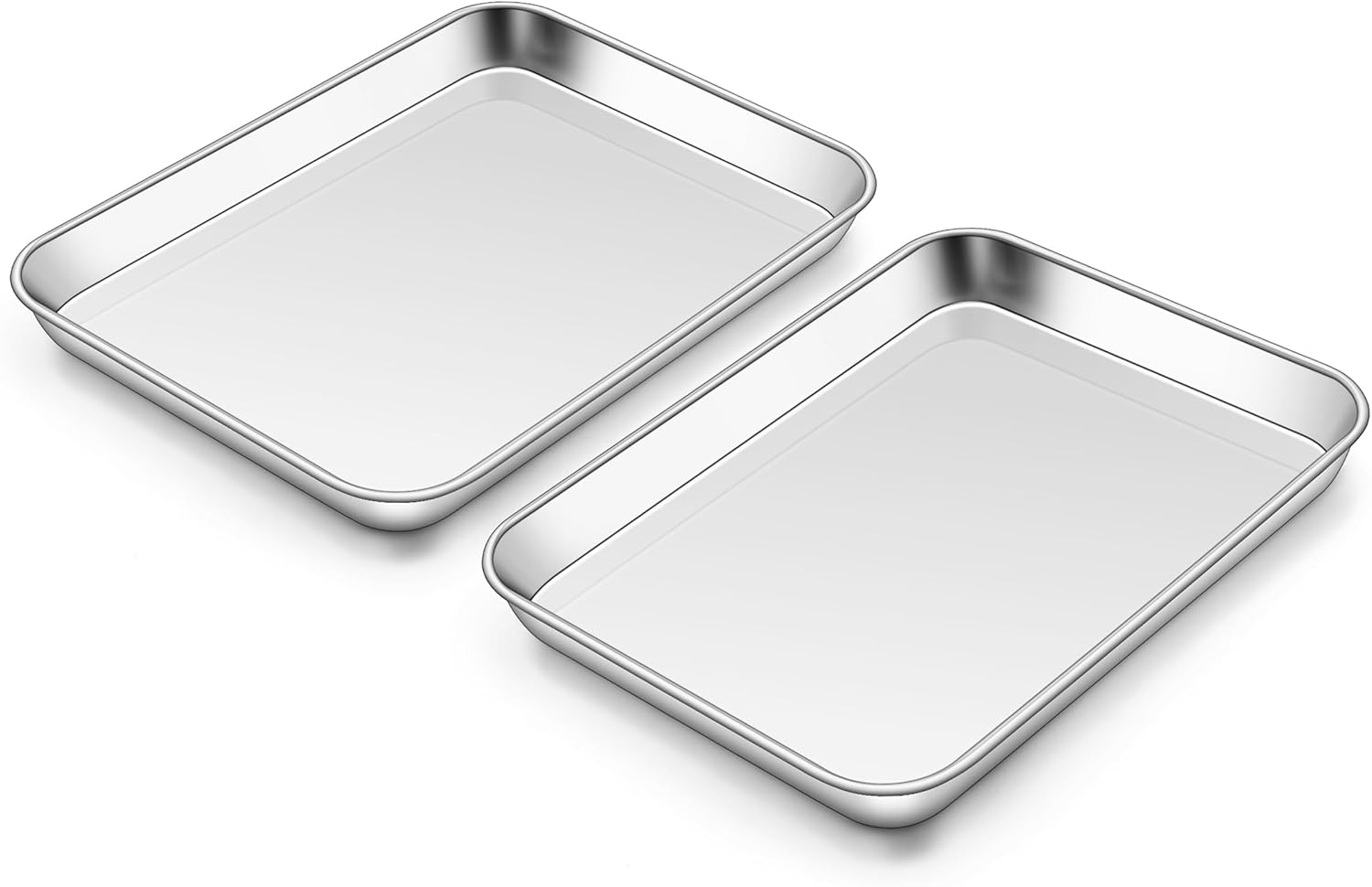
These 10×8 inch sheets are suitable for small kitchens or ovens but require oiling or parchment due to lack of coating. Their stainless steel build is robust but they heat less evenly than aluminized steel sheets. They’re not suitable for large batch baking.
Brand: Homikit · Price when checked: $18.98 · Rating: 4.6 out of 5 (1,643 ratings)
Pros
- Non-toxic stainless steel
- Compact size for limited space
- Durable and rust resistant
Cons
- No coating to prevent sticking
- Smaller size restricts batch volume
Best for chemical-free baking: Baker’s Signature Stainless Steel Cookie Sheets

Made entirely from food-grade stainless steel without coatings, these sheets are free of PFOA, lead, and cadmium, appealing to those avoiding chemical nonstick layers. The mirror-polished surface aids food release, but some sticking can occur, necessitating parchment paper. They resist warping up to 450°F (232°C).
Brand: Baker’s Signature · Price when checked: $27.99 · Rating: 4.6 out of 5 (8,839 ratings)
Pros
- Made without chemical coatings
- Mirror finish reduces sticking
- Oven safe up to 450°F (232°C)
Cons
- Requires greasing or parchment for cookies
- Edges are rolled but no extended handles
Best warp and scratch resistance: GoodCook PRO Carbon Steel Baking Sheet

GoodCook’s carbon steel sheet emphasizes resistance to warping and scratching, which is helpful for long-term durability. The nonstick coating facilitates cookie release but may need careful hand washing to extend lifespan. Size details are limited, so suitability depends on oven dimensions.
Brand: GoodCook · Rating: 4.5 out of 5
Pros
- Warp resistant carbon steel construction
- Scratch-resistant nonstick coating
- Dishwasher safe for convenience
Cons
- Limited size information
- Nonstick coating lifespan varies with use
Best for health-conscious baking: Bastwe Stainless Steel Baking Sheets Set

Bastwe offers non-toxic stainless steel baking pans with an emphasis on a healthy, chemical-free baking surface. Their construction is durable but lacks nonstick coatings, making parchment or oil necessary to prevent sticking. Size is compact, limiting batch capacity.
Brand: Baking · Rating: 4.4 out of 5
Pros
- Non-toxic stainless steel material
- Rust resistant and durable
- Suitable for small batch baking
Cons
- No nonstick coating requires prep
- Smaller size limits baking volume
Best commercial-grade small pans: Leonyo Stainless Steel Baking Sheet Pans

Leonyo’s commercial-grade stainless steel sheets are robust and intended for frequent use in small batches. The 10×8 inch size is convenient but less suited for larger cookie batches. The pans require greasing or liners due to lack of a nonstick surface.
Brand: Leonyo · Rating: 4.5 out of 5
Pros
- Heavy-duty commercial-grade stainless steel
- Compact size for small ovens
- Rust-resistant and durable
Cons
- No coating for easy release
- Small size limits batch size
Best textured surface for crisp cookies: GoodCook BestBake Carbon Steel Cookie Sheet

This carbon steel sheet features a textured surface designed to improve airflow and reduce cookie sticking without heavy coatings. Its scratch-resistant finish is durable but requires care to maintain texture. The 10×15 inch size suits medium batches but may not fit all ovens.
Brand: GoodCook · Rating: 4.6 out of 5
Pros
- Textured surface reduces sticking
- Scratch-resistant carbon steel
- Medium size for versatile baking
Cons
- Requires special care to preserve texture
- May not fit smaller ovens
Choosing the right baking sheet for your needs
If you bake large batches regularly, a half-sheet aluminized steel pan with thickness around 1 mm provides the best combination of even heat and durability. For instance, a 1 mm thick aluminized steel sheet weighing approximately 500 grams balances heat retention and quick preheating, ensuring consistent results for batches of 24 or more cookies.
For smaller kitchens or toaster ovens, compact stainless steel pans work well but expect to use parchment paper or grease to prevent sticking. Their lower thermal conductivity means baking times may need to be extended by 1-2 minutes to achieve the same browning.
Consider whether you want a nonstick coating for easier release versus the longevity of uncoated stainless steel. Nonstick coatings typically last 100-150 uses but require gentle cleaning and utensil care. Uncoated stainless steel is more durable but demands more preparation and cleanup effort.
Heavy-duty carbon steel sheets with textured surfaces offer a middle ground but require more maintenance. Their textured finish promotes airflow, improving cookie crispness by up to 15% compared to smooth surfaces, but maintaining the texture requires hand washing and seasoning to prevent rust.
Avoid very thin or flimsy baking sheets if you want consistent cookie browning, as warping and hot spots are common. Conversely, very thick pans take longer to heat and may not suit delicate or fast-baking cookies. Those sensitive to chemical coatings should opt for bare stainless steel pans and adjust preparation methods accordingly.
Related reading
- Best Baking Sheet Pans: Top Picks for Every Baker
- The 10 Best Kitchen Thermometers for Perfect Cooking
- Grill thermometer vs instant read: how they differ and which to pick
Frequently Asked Questions
What is the ideal baking sheet material for cookies?
Aluminized steel baking sheets are often ideal for cookies due to their combination of steel’s strength and aluminum’s superior heat conduction. This composite maintains shape under high heat, distributes heat evenly, and resists warping, which is crucial for uniform cookie baking. Stainless steel alone conducts heat less efficiently, and aluminum alone can warp or dent easily.
Do I need to grease my baking sheet or use parchment paper?
Whether you need to grease or use parchment depends on your baking sheet’s surface. Nonstick coatings usually allow baking without added grease, whereas uncoated stainless steel or carbon steel sheets typically require greasing or parchment paper to prevent cookies from sticking and tearing when removed. Using parchment also simplifies cleanup and reduces the risk of burnt bottoms.
How does sheet thickness affect cookie baking?
Thicker baking sheets (around 1 mm or 18-gauge) maintain stable oven temperatures and resist warping, which prevents hot spots that cause uneven baking or burnt edges. Thin sheets heat quickly but unevenly and can warp, leading to inconsistent results. However, very thick sheets take longer to preheat and may slow heat transfer, slightly prolonging baking times.
Related: Top 7 muffin tins for cupcakes with reliable bake results and durability

Rimi Sultana is a home cook from Bangladesh who has cooked for her family every day for the past five years and writes about it at Smart Cooks. Perpetually testing whether internet-famous recipes actually work in a regular home kitchen. Say hello on Facebook or through the contact page.