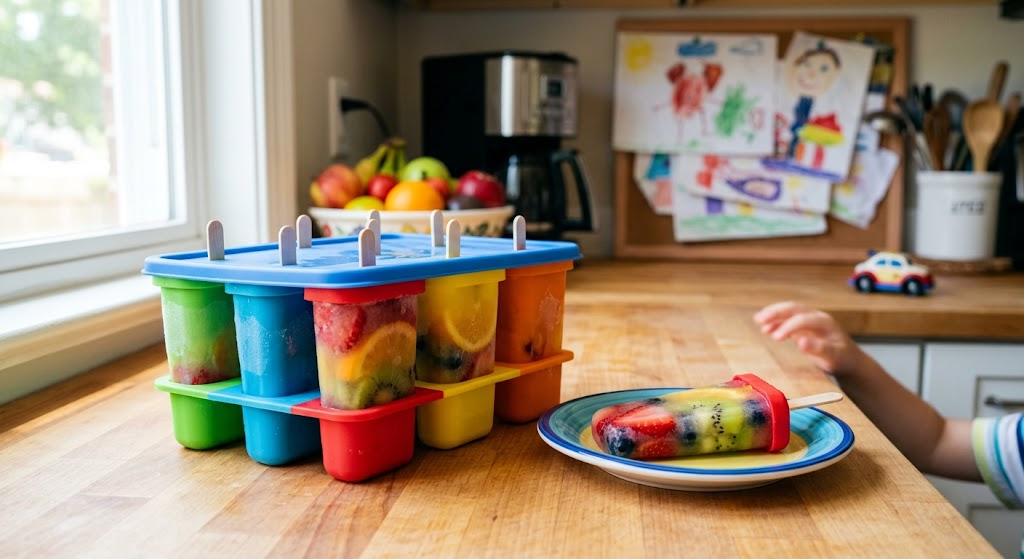
Popsicle molds look interchangeable at a glance, but the differences that matter most to parents — how easily the popsicle actually comes out, whether the sticks stay put, and how well the pieces survive a dishwasher — aren’t visible in a product photo.
Some links in this post are affiliate links. If you buy through them we may earn a small commission at no extra cost to you — it never changes which products we recommend.
What Actually Matters
Silicone vs. Hard Plastic
Silicone molds flex, which makes releasing a finished popsicle far easier than with rigid plastic — you can gently push from the outside rather than yanking on the stick and risking it pulling free of the popsicle entirely. Silicone is also generally more dishwasher-durable long term.
Stick Design
Molds with a built-in stick holder or wide stick base tend to keep the stick centered while freezing, rather than tilting to one side. Loose-fitting sticks are the single most common source of frustration — the popsicle looks fine until you try to pull it out and the stick separates from the ice.
Cavity Size for Younger Kids
Standard molds are sized for older kids and adults. If you’re making treats for toddlers, smaller mini-cavity molds reduce mess and the risk of an overwhelming amount of sugar or fruit puree at once.
From My Kitchen: The Stick Problem I Didn’t See Coming
My first set of molds had a loose-fitting stick hole, and more than half the popsicles separated from their sticks the moment I tried to remove them from the mold — the ice stayed behind while I was left holding a bare stick. It turned out the issue was that I wasn’t filling to the fill line, which meant the stick wasn’t held snugly by ice on both sides at the base. Filling exactly to the recommended line, not just eyeballing it, solved the problem almost completely with the same mold.
Worth Considering
This 10-cavity silicone mold set with reusable sticks is a solid standard-size option for most families.
These mini silicone molds for toddlers are worth it specifically if smaller portions matter more than standard adult-size popsicles.
Quick Comparison
| Silicone moulds | Hard plastic moulds | Stainless moulds | |
|---|---|---|---|
| Releasing the popsicle | Easiest — flex the mould | Needs a warm water dip | Needs a warm water dip |
| Stick stability | Depends on the lid | Usually good, fixed lid | Good |
| Durability | Can tear at thin edges | Cracks if dropped when frozen | Effectively permanent |
| Staining and odour | Can pick up strong fruit colours | Minimal | None |
| Best for | Young children, easy release | Everyday family use | Long-term, plastic-free |
Freeze Times and Cavity Sizes for Children
A 2 to 3 ounce cavity is right for toddlers and young children — large enough to feel like a treat, small enough to be finished before it melts down an arm. Standard 4 ounce moulds suit older children and adults. Freeze times run roughly four to six hours for small cavities and six to eight for larger ones, and the honest advice is to make them the night before rather than trying to rush a batch on a hot afternoon.
Two details make a real difference with children specifically. Drip guards — the small discs that sit where the stick meets the popsicle — catch most of what would otherwise run down a hand, and they are the difference between a popsicle eaten outside and a popsicle eaten over a bath. And a mould where the lid holds every stick upright and centred matters more than it sounds, because a stick frozen at an angle pulls out sideways and takes half the popsicle with it.
Two Moulds Worth Considering
Best for easy release: 10-Cavity Silicone Mould Set With Reusable Sticks
Silicone flexes, which means a popsicle comes out with a gentle push from below rather than a tug on the stick. With children that matters — the failure mode of a rigid mould is a stick in one hand and the popsicle still frozen in place.
Pros
- Flexible walls release without a warm water dip
- Ten cavities covers a family batch
- Reusable sticks, nothing to run out of
Cons
- Silicone can stain with strong fruit purees
- Needs a tray underneath when carrying to the freezer
Best for toddlers: Mini Silicone Moulds for Toddlers
Smaller cavities freeze faster and get finished before they melt, which is the practical problem with standard-size popsicles and small children. The reduced portion also suits parents who would rather not hand over a full-size sugary treat.
Pros
- Small portions suit young children
- Faster freeze time than full-size moulds
- Easy for small hands to hold
Cons
- Too small to satisfy older children
- More cavities to fill and wash per batch
Frequently Asked Questions
Why do my popsicles keep separating from the sticks?
This is almost always an underfilling issue — the ice needs to fully surround the base of the stick to hold it in place. Filling exactly to the mold’s fill line, not below it, usually solves this.
Are silicone molds actually better than plastic?
For ease of release, yes — the flex in silicone lets you gently coax a popsicle free without pulling hard on the stick, which is the main failure point with rigid plastic molds.
How long do homemade popsicles take to freeze solid?
Most fruit or juice-based popsicles need at least 4–6 hours, and cream-based ones can take a bit longer. Freezing overnight is the safest way to guarantee they’re fully set.
Why are my homemade popsicles icy instead of creamy?
Because there is too much water and not enough of anything that interferes with ice crystal formation. Pure fruit juice freezes into essentially flavoured ice. Adding sugar, a spoonful of yoghurt or coconut milk, or blending whole fruit rather than using juice all lower the freezing point and add body, which gives a softer, creamier texture. Straining fruit puree makes it clearer and icier — leaving the pulp in helps.
How do I stop popsicles dripping everywhere?
Use moulds with built-in drip guards if you are buying new. With moulds you already own, push the stick through the centre of a cupcake liner or a small plastic lid before serving — it catches the runs before they reach a hand. It also helps to take popsicles out of the freezer and let them sit for two minutes before handing them over; a rock-hard popsicle is licked slowly, which gives the outside more time to melt and run.

Rimi Sultana is a home cook from Bangladesh who has cooked for her family every day for the past five years and writes about it at Smart Cooks. Perpetually testing whether internet-famous recipes actually work in a regular home kitchen. Say hello on Facebook or through the contact page.