A trivet’s primary role is to protect kitchen counters and tables from high temperatures that can cause burns, marks, or permanent damage. What distinguishes a good trivet from a bad one is its material’s ability to resist heat transfer and its construction to prevent damage to both the surface beneath and the trivet itself.
Some links in this post are affiliate links. If you buy through them we may earn a small commission at no extra cost to you — it never changes which products we recommend.
Simply stating that a trivet is heat resistant overlooks how heat moves through materials. Some trivets absorb and dissipate heat slowly, while others deflect it entirely, and some fail to do either effectively. The best trivets maintain a clear barrier between a hot pot and your surface, while also enduring repeated use without warping, staining, or losing grip.
What actually matters
Trivets may look simple, but the choices behind materials and design are crucial to how well they work and last. Understanding the mechanisms behind heat protection and surface safety will guide your purchase better than brand claims.
Heat transfer occurs primarily through conduction when a hot pot contacts a trivet, and the trivet then conducts heat to the surface beneath. The ability of a trivet to interrupt this conduction depends on its thermal conductivity, thickness, and the presence of insulating air pockets. For example, cotton’s low thermal conductivity combined with trapped air pockets slows heat flow but only up to certain temperatures. Silicone’s polymer chains resist heat conduction more effectively and maintain flexibility at higher temperatures, while ceramic’s dense structure disperses heat evenly but can accumulate heat if not elevated.
The consequences of insufficient heat resistance include scorch marks, warping, or permanent damage to delicate surfaces like wood or laminate. Over time, repeated exposure to heat can degrade the trivet itself, causing brittleness, cracking, or loss of insulating properties. Therefore, investing in a trivet that balances heat resistance with durability is essential for long-term kitchen protection.
Material and heat resistance
The key function of any trivet is to block heat transfer from hot cookware to your table or countertop. Materials like cotton, silicone, ceramic, metal, and wood differ in how they handle heat. Cotton trivets rely on thickness and trapped air to insulate but can absorb heat and may char under very high temperatures exceeding 400°F (204°C). Silicone offers a non-slip, flexible surface that withstands up to around 450°F (232°C) without melting or degrading, thanks to its synthetic polymer structure. Ceramic trivets resist high temperatures well and disperse heat evenly but can crack under sudden temperature changes. Metal trivets, often cast iron or stainless steel, conduct heat quickly, so they usually have design elements like legs or gaps to raise hot pots off the surface.
To quantify, cotton’s thermal conductivity ranges from 0.04 to 0.06 W/m·K, making it a moderate insulator when layered thickly. Silicone’s conductivity is slightly higher but compensated by its heat capacity and flexibility, allowing it to tolerate temperatures up to 450°F (232°C) without deformation. Ceramic materials vary widely, but typical stoneware ceramics have conductivity around 1.5 W/m·K, which is higher but offset by their heat capacity and thickness. Metal trivets, with conductivities exceeding 15 W/m·K, require design strategies such as raised legs or hollow patterns to minimize direct conduction to surfaces.
Size, shape, and stability
Trivets should be large enough to accommodate the base of your pots or pans with some margin. A trivet that is too small risks tipping or direct contact between the hot cookware and the surface. Shape affects stability; circular or geometric patterns with a broad base prevent wobbling. Raised edges or textured surfaces increase grip but may trap dirt or be harder to clean. Legs or feet that elevate the trivet off the surface improve air circulation, helping heat dissipate faster and preventing heat buildup directly beneath.
For example, a trivet diameter of 7 to 8 inches (17.8 to 20.3 cm) typically suits most medium-sized pots and pans, while larger cookware may require 9 inches (22.9 cm) or more. Stability is enhanced by a low center of gravity and wide footprint; trivets with multiple legs spaced evenly distribute weight and reduce rocking. Some designs incorporate silicone or rubber feet to prevent sliding on smooth surfaces. In terms of heat dissipation, elevating the trivet by 0.5 to 1 inch (1.3 to 2.5 cm) can reduce heat transfer by up to 30% compared to flat trivets, as airflow removes residual heat.
Durability and maintenance
Regular kitchen use exposes trivets to spills, stains, heat cycling, and weight. Durable materials will resist staining, retain shape after washing, and not degrade under repeated heat exposure. Cotton trivets can be machine washed but may shrink or lose thickness over time. Silicone trivets hold their shape well and clean easily but can attract lint. Ceramic trivets require careful handling to avoid chips and cracks. Metal trivets can rust if not properly coated or dried. Consider your kitchen habits and cleaning preferences when selecting.
Quantitatively, cotton trivets may lose up to 10-15% of their loft and insulating capacity after 20 wash cycles, depending on washing conditions. Silicone trivets maintain their structural integrity over hundreds of uses but may accumulate surface contaminants that require regular cleaning with mild detergents. Ceramic trivets, while robust under heat, can suffer from microfractures after repeated thermal shocks, reducing lifespan. Metal trivets with stainless steel coatings can resist rust for years if dried promptly, but uncoated cast iron may rust within days if exposed to moisture.
Choosing the right trivet for your kitchen
Selecting a trivet depends primarily on how you cook and what surfaces you want to protect. Cotton trivets are versatile and gentle on delicate surfaces but have heat limits and require washing and drying care. Ceramic trivets suit occasional use with hot dishes and can enhance kitchen aesthetics but are fragile. Silicone trivets excel in heat resistance and grip but sometimes lack space for larger pots.
If you rarely use hot pots or mainly serve dishes at moderate temperatures, a simple cotton or silicone trivet may suffice. For heavy cookware like cast iron or Dutch ovens, opt for sturdier options such as thick cotton or ceramic with raised feet. Those who frequently clean trivets should consider machine-washable cotton or easily wiped silicone. Ultimately, avoid trivets that show any signs of wear, melt, or cracking as these will fail when you need protection most.
Mechanistically, the choice of trivet material affects not just heat resistance but also longevity and maintenance. For instance, cotton trivets’ porous nature allows them to absorb spills, which can lead to staining and bacterial growth if not cleaned promptly. Silicone’s non-porous surface resists stains and bacteria but can become sticky or attract lint, requiring periodic washing. Ceramic trivets combine aesthetic appeal with high heat tolerance but necessitate careful handling to avoid damage. Considering your cooking style—whether frequent use of heavy pots or occasional serving of hot dishes—helps determine the best balance of durability, heat resistance, and ease of maintenance.
In terms of consequences, using an unsuitable trivet can lead to costly surface damage. For example, a wooden countertop scorched by a hot cast iron pan can require sanding and refinishing or replacement. Replacing damaged trivets frequently adds to kitchen costs and inconvenience. Investing in a quality trivet that matches your cooking habits and kitchen surfaces can save money and preserve your kitchen’s appearance over time.
| Pick | Best for | Diameter / Size | Watch out for |
|---|---|---|---|
| PUPILLEMON cotton 7″ (B0FS1M5YV5) | Everyday heat protection with style | 7 inches (17.8 cm) | Cotton can absorb stains and has limited heat resistance beyond 400°F (204°C) |
| PUPILLEMON cotton 7″ (B0FS1S351R) | Affordable multi-pack with design variety | 7 inches (17.8 cm) | Similar heat limits as other cotton trivets; not ideal for very heavy cookware |
| GICDSX Gardenia cotton 8″ (B0DR47N7LV) | Machine washable thick cotton, organised storage | 8 inches (20.3 cm) | Thicker cotton may take longer to dry after washing |
| ELFULLY ceramic 6.7″ (B0F1MHHXBZ) | Decorative ceramic for moderate heat | 6.7 inches (17 cm) | Can crack if exposed to sudden temperature changes; fragile |
| KITLAB 8″ cotton (B0CP7RD8KS) | Large cotton trivets, easy to clean | 8 inches (20.3 cm) | Avoid microwave use; cotton can lose loft over time |
| QPIX DIGITAL silicone 6″ (B091H8BSMG) | Non-slip silicone for hot and wet surfaces | Approx. 6 inches (15.2 cm) | Smaller size may not fit wider pots; silicone can attract lint |
From my kitchen
Once, I placed a heavy cast iron pan directly on a thin cotton trivet without verifying its heat tolerance. The trivet compressed and the bottom of the pan transferred enough heat to leave a faint scorch mark on my wooden table. That incident taught me to always check trivet thickness and material properties before using it with heavy or very hot cookware. Switching to a thicker cotton trivet with a raised weave and adding a silicone trivet underneath prevented any further heat damage.
This experience highlights the importance of understanding both the thermal resistance and mechanical properties of trivets. Thin cotton trivets may lack the structural integrity to support heavy cookware without compressing, which increases heat transfer. Combining materials, such as layering cotton with silicone, can provide both cushioning and enhanced heat resistance, offering superior protection. Regularly inspecting trivets for wear and replacing them when compressed or damaged is essential to maintain kitchen surface safety.
Worth Considering
Best for everyday heat protection with style: PUPILLEMON cotton 7″

This cotton trivet pack combines six different designs, adding subtle variety to your kitchen while providing a 7-inch diameter surface that fits most pots and pans. It uses thick cotton layers to trap air for insulation, protecting surfaces from heat up to roughly 400°F (204°C). Not suited for very heavy or extremely hot cookware, as it can compress and transfer heat more quickly.
Brand: PUPILLEMON · Price when checked: $6.49 · Rating: 4.7 out of 5 (452 ratings)
Pros
- Varied designs suit different kitchen decor
- Cotton material is soft, protecting delicate surfaces
- Lightweight and easy to store
Cons
- Limited heat resistance for extremely hot pots
- Cotton absorbs stains and can retain moisture
Best for affordable multi-pack with design variety: PUPILLEMON cotton 7″
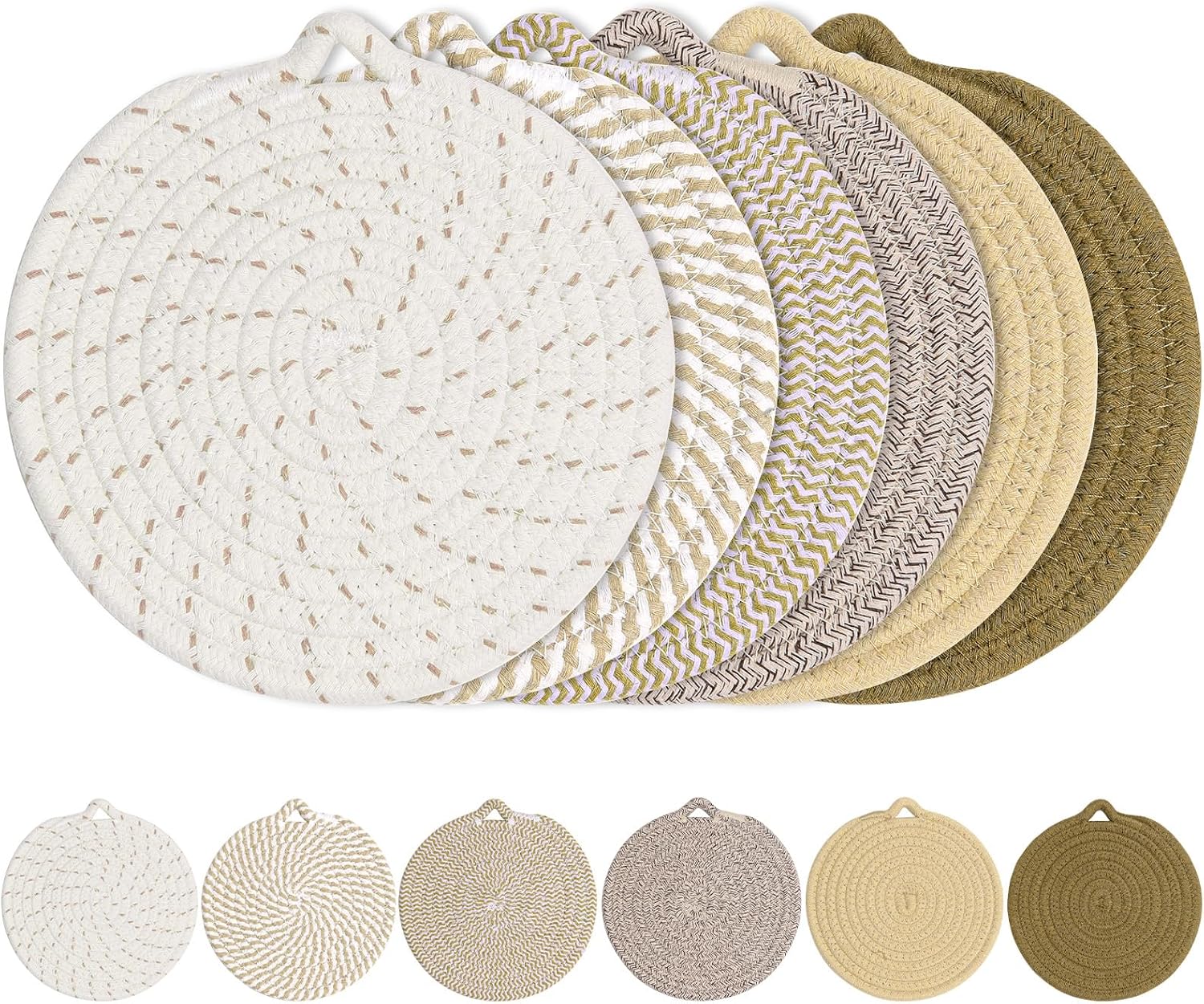
This alternative PUPILLEMON pack shares the same features as its sibling but at a slightly higher price with more buyer reviews. It offers reliable heat protection for everyday use and enough surface area to stabilise most cookware without tipping. Not ideal for use with cast iron or very hot pans directly from the stove as cotton insulation limits apply.
Brand: PUPILLEMON · Price when checked: $7.99 · Rating: 4.7 out of 5 (1,311 ratings)
Pros
- Six-piece set with consistent sizing
- Protects counters from scratches and heat
- Cotton construction is machine washable
Cons
- Absorbs spills easily
- Limited use with extremely hot cookware
Best for machine washable thick cotton with storage: GICDSX Gardenia cotton 8″

These 8-inch cotton trivets come with a storage basket, helping reduce clutter and keep your kitchen organised. The thicker cotton design offers extra cushion and heat insulation, extending protection for delicate surfaces like quartz countertops. However, they can hold moisture longer when washed and take time to dry thoroughly, which may be inconvenient in busy kitchens.
Brand: Brand: GICDSX Gardenia · Price when checked: $16.99 · Rating: 4.8 out of 5 (2,686 ratings)
Pros
- Includes storage basket for neat organisation
- Thicker cotton improves heat insulation
- Machine washable and durable
Cons
- Longer drying time after washing
- Bulkier to store compared to thin trivets
Best decorative ceramic option: ELFULLY ceramic 6.7″

This set of ceramic trivets offers good heat resistance and an elegant retro pattern to complement kitchen or dining room decor. Ceramic’s hard, smooth surface resists heat transfer effectively up to high temperatures but is vulnerable to cracking if exposed to sudden temperature shocks or dropped. Not suitable for rough handling or frequent repositioning.
Brand: ELFULLY · Price when checked: $17.99 · Rating: 4.5 out of 5 (2,686 ratings)
Pros
- High heat resistance typical of ceramic
- Attractive retro patterns for decor
- Hard surface easy to wipe clean
Cons
- Fragile, prone to cracks and chips
- Smaller diameter may not fit larger pots
Best large cotton trivets for ease of cleaning: KITLAB 8″ cotton

With an 8-inch diameter, these cotton trivets provide ample room for most pots and pans and can be machine or hand washed. The larger size reduces risk of cookware wobbling or edge contact. However, cotton trivets should be kept away from microwave use and can flatten over time, reducing insulation efficiency.
Brand: KITLAB · Price when checked: $14.99 · Rating: 4.8 out of 5 (267 ratings)
Pros
- Spacious 8-inch surface for stability
- Easy to clean by hand or machine wash
- Soft on surfaces preventing scratches
Cons
- Cotton can compress and lose loft with use
- Avoid microwave exposure to prevent damage
Best non-slip silicone option: QPIX DIGITAL silicone 6″

Made from food-grade silicone, these trivets resist heat up to approximately 450°F (232°C) and offer a honeycomb pattern that prevents slipping on smooth surfaces. They are lightweight and flexible, ideal for kitchens where grip and ease of cleaning matter more than the largest surface area. The smaller size means they may not suit wider pots or pans.
Brand: QPIX DIGITAL · Price when checked: $15.59 · Rating: 4.8 out of 5 (943 ratings)
Pros
- High heat tolerance typical of silicone
- Non-slip honeycomb pattern for stability
- Easy to hang and store
Cons
- Smaller diameter limits pot size support
- Silicone attracts lint and can be sticky
Choosing the right trivet for your kitchen
Selecting a trivet depends primarily on how you cook and what surfaces you want to protect. Cotton trivets are versatile and gentle on delicate surfaces but have heat limits and require washing and drying care. Ceramic trivets suit occasional use with hot dishes and can enhance kitchen aesthetics but are fragile. Silicone trivets excel in heat resistance and grip but sometimes lack space for larger pots.
If you rarely use hot pots or mainly serve dishes at moderate temperatures, a simple cotton or silicone trivet may suffice. For heavy cookware like cast iron or Dutch ovens, opt for sturdier options such as thick cotton or ceramic with raised feet. Those who frequently clean trivets should consider machine-washable cotton or easily wiped silicone. Ultimately, avoid trivets that show any signs of wear, melt, or cracking as these will fail when you need protection most.
Mechanistically, the choice of trivet material affects not just heat resistance but also longevity and maintenance. For instance, cotton trivets’ porous nature allows them to absorb spills, which can lead to staining and bacterial growth if not cleaned promptly. Silicone’s non-porous surface resists stains and bacteria but can become sticky or attract lint, requiring periodic washing. Ceramic trivets combine aesthetic appeal with high heat tolerance but necessitate careful handling to avoid damage. Considering your cooking style—whether frequent use of heavy pots or occasional serving of hot dishes—helps determine the best balance of durability, heat resistance, and ease of maintenance.
In terms of consequences, using an unsuitable trivet can lead to costly surface damage. For example, a wooden countertop scorched by a hot cast iron pan can require sanding and refinishing or replacement. Replacing damaged trivets frequently adds to kitchen costs and inconvenience. Investing in a quality trivet that matches your cooking habits and kitchen surfaces can save money and preserve your kitchen’s appearance over time.
Related reading
- Proofing basket vs bowl proofing: what really shapes your dough
- Steamer basket vs bamboo steamer: practical differences explained
- Top 10 Banneton Bread Proofing Basket
Frequently Asked Questions
Can I use any trivet with cast iron pans?
Cast iron pans retain and transfer significant heat, often exceeding 450°F (232°C) on their base. Not all trivets can handle such temperatures safely. Cotton trivets thinner than 1 cm may compress and allow heat to pass through, risking surface damage. Ceramic trivets with sturdy construction and heat resistance are preferable but must be handled carefully to avoid cracking. Silicone trivets rated for high temperatures can also work if large enough to stabilize the pan. Always check the trivet’s heat tolerance and size before use.
How do I clean and maintain cotton trivets?
Cotton trivets can usually be machine washed to remove stains and spills, but frequent washing may cause shrinkage or loss of thickness, reducing heat insulation. Air drying flat preserves shape better than tumble drying. Spot cleaning with mild detergent and immediate drying also helps maintain fabric integrity. Avoid ironing trivets to prevent flattening the insulating fibres. Store trivets dry to prevent mildew or odours.
Why do some trivets have raised legs or feet?
Raised legs or feet increase airflow beneath the trivet, reducing heat build-up on the surface below. This design improves heat dissipation and lowers the risk of heat damage to wooden or laminated tables. Additionally, elevation keeps the hot cookware stable and prevents direct contact with the table surface in case of spills or moisture, adding an extra layer of protection.

Rimi Sultana is a home cook from Bangladesh who has cooked for her family every day for the past five years and writes about it at Smart Cooks. Perpetually testing whether internet-famous recipes actually work in a regular home kitchen. Say hello on Facebook or through the contact page.