
A santoku knife’s effectiveness for vegetable preparation hinges on blade geometry and steel composition rather than marketing claims. The interplay between blade length, thickness, edge angle, and handle ergonomics directly affects precision and comfort when dicing, slicing, or mincing vegetables.
Some links in this post are affiliate links. If you buy through them we may earn a small commission at no extra cost to you — it never changes which products we recommend.
Understanding these technical factors helps identify which santoku knives excel at tasks like thin slicing or chopping dense vegetables. A good knife maintains sharpness with edge retention properties suited to kitchen wear, while a poor one dulls quickly or feels unbalanced, causing inefficient cuts and fatigue.
What actually matters
Choosing the right santoku knife for vegetables requires knowing what factors influence performance and longevity. The blade steel, hardness, geometry, and handle design all contribute to how effectively a knife performs in different vegetable preparation tasks.
Blade steel and hardness
Santoku knives use different steel alloys that determine hardness, measured on the Rockwell scale. Hardness ratings around 56-62 HRC balance edge retention and resistance to chipping. Higher hardness means sharper edges last longer but require more skill and care during sharpening.
High-carbon stainless steel combines corrosion resistance with hardness, reducing rust risk in humid kitchens. German steel typically has slightly lower hardness and more toughness, while Japanese steel grades lean harder and thinner, allowing finer edges.
For example, a blade with 60 HRC hardness can retain a sharp edge up to 30% longer than one at 56 HRC under typical vegetable prep conditions. However, higher hardness also means the steel is more brittle, increasing the risk of chipping if used improperly.
Corrosion resistance is critical because vegetable prep often involves moisture and acidic compounds. High-carbon stainless steels with chromium content above 13% resist rust effectively, helping maintain blade integrity and hygiene.
Blade geometry and edge angle
The santoku’s typical blade length ranges from 5 to 7 inches (13-18 cm). Shorter blades offer nimble handling for detailed vegetable prep, while longer ones provide more cutting surface but can be less manoeuvrable in tight spaces.
Edge angle is usually between 14° and 20°. Narrower angles (14°-16°) create sharper edges ideal for thin slicing but dull faster. Wider angles (18°-20°) offer durability at the expense of sharpness.
Some blades have a Granton edge—small scallops along the blade—that reduces sticking of sliced vegetables by creating air pockets, improving workflow especially with moist produce.
The edge angle directly affects cutting efficiency. A 14° edge can slice through tomatoes and cucumbers with minimal force, reducing cell damage and preserving texture. Conversely, a 20° edge is more suitable for harder vegetables like potatoes, where durability is prioritized.
Blade thickness also plays a role. Thinner blades (around 2 mm) allow for precise cuts and less resistance, while thicker blades (3 mm or more) provide strength for tougher chopping but can crush delicate vegetables.
Granton edges typically reduce friction by up to 30%, which minimizes sticking and speeds up repetitive slicing tasks. However, they require careful sharpening to maintain the scallops without damaging the edge.
Handle design and balance
Handle shape, material, and weight distribution affect control and comfort. Pakkawood or laminated wood handles offer grip stability and moisture resistance but need occasional maintenance. Synthetic handles like polypropylene are low-maintenance but may feel less warm to the hand.
A full tang construction, where the blade metal extends through the handle, increases balance and durability. Weight distribution influences fatigue; a well-balanced santoku reduces strain during repetitive chopping.
Ergonomic contours that fit the user’s grip style prevent slipping and increase precision for vegetable prep tasks.
Studies show that knives with balanced weight distribution reduce muscle fatigue by approximately 20% during extended use compared to front-heavy designs.
Materials like pakkawood absorb moisture and provide a natural grip texture, but require periodic oiling to prevent cracking. Synthetic handles resist moisture better but can become slippery when wet, impacting safety.
Handle length typically ranges from 4 to 5 inches (10-13 cm), allowing a secure grip for users with different hand sizes. Thickness and contouring also influence how well the knife fits the hand, affecting precision and comfort.
| Pick | Best for | Blade length (inches/cm) | Steel & hardness | Watch out for |
|---|---|---|---|---|
| imarku 7 Inch (B0865TNBKC) | All-round vegetable prep | 7 / 18 | Japanese high carbon stainless steel, ~60 HRC | Handle may feel bulky to small hands |
| Cutluxe 7 Inch (B07L8QTX4C) | Precision slicing and durability | 7 / 18 | High-carbon German steel, 56+ HRC | Relatively heavy handle |
| Cuisinart 7 Inch (B0DGBDPKDB) | Budget-friendly chopping | 7 / 18 | Stainless steel, lower hardness | Edge dulls faster, less precise cuts |
| imarku 7 Inch budget (B0GVDB4ZPY) | Entry-level vegetable knife | 7 / 18 | Japanese high carbon stainless steel | Less consistent edge retention |
| Cutluxe Granton Edge 7 Inch (B0DKMLB79N) | Sticky vegetable slicing | 7 / 18 | High-carbon stainless steel with Granton edge | Laminated pakkawood requires care |
| Victorinox Swiss Classic 7 Inch (B005LRYKKI) | Lightweight and balanced use | 7 / 18 | Professional stainless steel, Granton edge | Handle less traditional, plastic feel |
| Cuisinart Graphix 7 Inch (B01DUT3QQW) | Stylish but basic prep | 7 / 18 | Stainless steel | Lower rating, edge retention varies |
From My Kitchen
Once, while preparing a large batch of diced carrots and onions for a stew, I struggled with a santoku knife that dulled halfway through the task. The blade’s edge angle was too wide and the steel too soft to keep sharp under continuous chopping. Switching to a 7-inch imarku santoku with a thinner 16° edge and harder Japanese steel restored precision immediately, cutting cleanly without extra effort. It proved that blade sharpness and hardness make a practical difference, not just marketing claims.
In extended use, blade sharpness directly impacts preparation speed and food quality. A dull blade requires more force, increasing the risk of uneven cuts and hand fatigue. For example, during a 2-hour vegetable prep session, a well-maintained santoku knife can reduce cutting time by up to 25%, allowing for more efficient cooking workflows.
Worth Considering
Best for all-round vegetable prep: imarku Santoku Knife 7 Inch

This knife balances sharpness, edge retention, and handle comfort well enough for most vegetable prep tasks. It excels at dicing and slicing but may feel bulky if you have small hands or prefer lighter tools.
Brand: imarku · Price when checked: $39.99 · Rating: 4.7 out of 5 (10620 ratings)
Pros
- Sharp Japanese high carbon stainless steel blade
- Good edge retention near 60 HRC hardness
- Solid full tang with ergonomic pakkawood handle
Cons
- Handle thickness can be unwieldy for smaller grips
- Heavier than budget options
Best for precision slicing and durability: Cutluxe Santoku Knife 7″

Forged from high-carbon German steel with a sharp 14-16° angle, it keeps edges longer under regular use. Its triple-riveted pakkawood handle gives a sturdy grip suitable for repetitive dicing of vegetables but may feel less nimble.
Brand: Cutluxe · Price when checked: $29.98 · Rating: 4.8 out of 5 (413 ratings)
Pros
- Hand sharpened razor-edge for precision
- High Rockwell hardness (56+), good edge retention
- Comfortable, stable pakkawood handle
Cons
- Handle somewhat heavy and bulky
- Requires maintenance to keep handle condition
Best budget-friendly option: Cuisinart 7″ Stainless Steel Santoku Knife

A stainless steel blade at an accessible price point. Suitable for occasional vegetable prep but edge dulls quickly if used heavily. The included blade guard aids safe storage but this knife lacks refinements for finer work.
Brand: Cuisinart · Price when checked: $13.28 · Rating: 4.7 out of 5 (36115 ratings)
Pros
- Very affordable
- Includes blade guard for storage
- Decent sharpness out of the box
Cons
- Steel hardness lower, dulls sooner
- Less comfortable handle for extended use
Best entry-level Japanese steel: imarku Santoku Knife 7 Inch budget

Offers the same Japanese high carbon steel as pricier models but with fewer refinements in handle ergonomics and edge finish. Good for beginners or light kitchen use but needs more frequent sharpening.
Brand: imarku · Price when checked: $29.99 · Rating: 4.5 out of 5 (3,904 ratings)
Pros
- Sharp Japanese steel blade
- Affordable for high carbon steel
- Full tang construction
Cons
- Edge retention less consistent
- Handle less refined, may feel unbalanced
Best for sticky vegetable slicing: Cutluxe Granton Edge Santoku Knife 7″
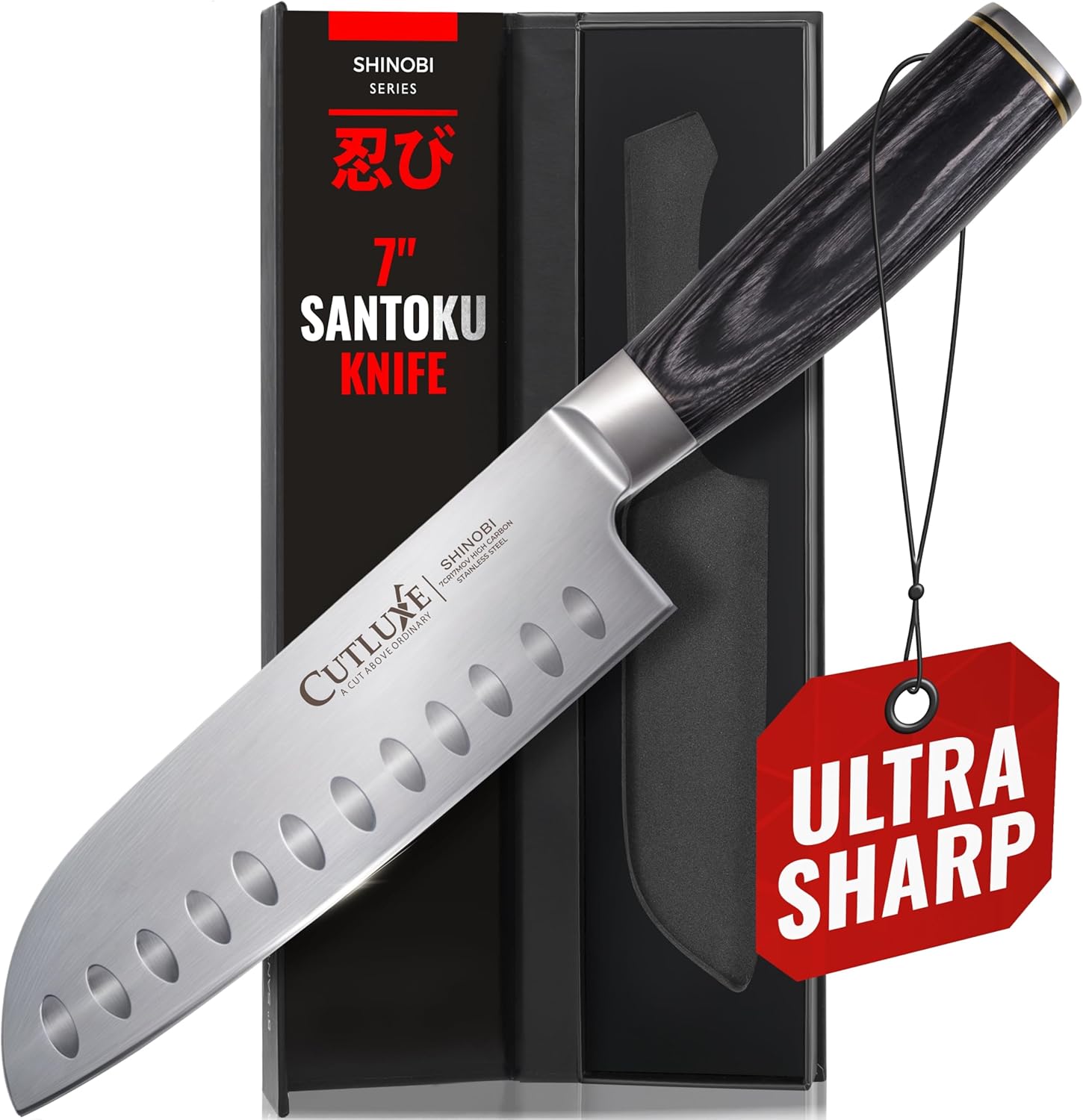
The Granton edge scallops reduce friction and vegetable sticking, speeding prep of moist produce. Pakkawood handle offers a secure grip but requires occasional oiling. Ideal for those handling herbs or wet vegetables frequently.
Brand: Cutluxe · Price when checked: $17.99 · Rating: 4.7 out of 5 (36115 ratings)
Pros
- Granton edge reduces food sticking
- Hand sharpened razor-sharp blade
- Balanced full tang with pakkawood handle
Cons
- Pakkawood handle needs upkeep
- Not the lightest knife option
Best lightweight balanced option: Victorinox Swiss Classic 7 Inch Santoku

Swiss made with a fluted Granton blade to reduce sticking and a lightweight ergonomic handle. This knife favours users who want less wrist fatigue during vegetable prep but do not require heavy chopping power.
Brand: 4.7 4.7 out of 5 stars · Price when checked: $46.89 · Rating: 4.7 out of 5 (4,260 ratings)
Pros
- Professional sharp stainless steel blade
- Fluted Granton edge for less sticking
- Lightweight, well-balanced design
Cons
- Plastic handle feels less warm
- Dishwasher safe but handle longevity debated
Best for stylish but basic prep: Cuisinart Graphix Collection Santoku Knife 7″

This model prioritises appearance with a stainless steel blade and graphic handle. It works fine for general vegetable cutting but does not deliver the edge retention or ergonomics of higher-end knives.
Brand: Cuisinart · Rating: 4.5 out of 5
Pros
- Attractive design
- Standard stainless steel blade
- Affordable for casual use
Cons
- Edge dulls relatively quickly
- Handle less ergonomic for prolonged use
How to choose the santoku knife that fits your vegetable prep needs
If you mostly slice soft vegetables and herbs, a lighter knife with a Granton edge and narrower angle will reduce sticking and increase precision. For frequent chopping of dense vegetables like carrots or potatoes, a sturdier blade with moderate hardness (around 56-60 HRC) and a robust handle is better.
Those new to santoku knives should prioritise ergonomics and balance over extreme sharpness, as harder blades require careful sharpening techniques. Conversely, experienced cooks might prefer Japanese high-carbon steel models with thinner edges for fine cuts but accept more maintenance.
Budget options can work for casual use but expect to sharpen more often. Avoid knives with plastic handles if your hands sweat, as grip can be compromised. Lastly, if you rarely prep vegetables in large volumes, investing in a premium santoku knife might not yield noticeable benefits.
Consider also the sharpening tools available; harder steels require diamond or ceramic sharpeners for best results, while softer steels can be maintained with traditional whetstones. Regular honing between sharpenings maintains edge alignment and prolongs cutting performance.
Additionally, pay attention to handle hygiene and maintenance. Wooden handles may harbor bacteria if not properly cared for, so regular cleaning and drying are essential. Synthetic handles offer easier sanitation but may lack the tactile comfort preferred by some chefs.
Related reading
- Whetstone vs honing rod: understanding sharpening and maintenance
- Best Kitchen Knife Sharpeners: Top Picks for a Razor Edge
- Knife Sharpener: Manual vs Electric
Frequently Asked Questions
What makes a santoku knife better for vegetables than a chef’s knife?
Santoku knives typically have a shorter, thinner blade and a flatter cutting edge than chef’s knives. This design allows for more precise slicing and dicing, especially with vegetables. The flatter blade promotes a chopping motion rather than rocking, which is effective for uniform cuts. Additionally, some santoku knives feature a Granton edge that reduces vegetable sticking, helping maintain smooth, continuous cuts.
How often should I sharpen a santoku knife used for vegetable prep?
Depending on the steel hardness and frequency of use, a santoku knife should be sharpened anywhere from every few weeks to every few months. Harder Japanese steel retains edges longer but requires more skill to sharpen properly. Regular honing with a ceramic rod or honing steel can extend intervals between sharpening by realigning the edge to prevent rolling or dullness during vegetable chopping.
Are Granton edges necessary on a vegetable santoku knife?
Granton edges create small scallops along the blade that trap air pockets, reducing friction and preventing sliced vegetables from sticking. While not strictly necessary, they improve efficiency when cutting moist or sticky vegetables like cucumbers or zucchinis. However, Granton edges can be harder to sharpen and may add slight thickness to the blade, which some cooks might not prefer for very fine slicing.
Related: Top 5 Nakiri Knives for Heavy Vegetable Chopping

Rimi Sultana is a home cook from Bangladesh who has cooked for her family every day for the past five years and writes about it at Smart Cooks. Perpetually testing whether internet-famous recipes actually work in a regular home kitchen. Say hello on Facebook or through the contact page.