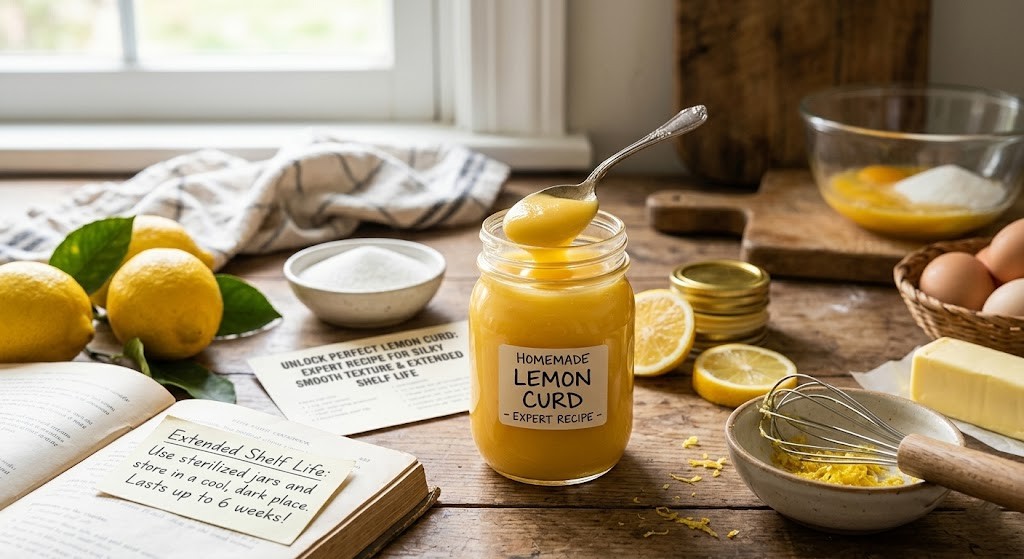
Prep time: 15 min | Cook time: 8–12 min | Chill time: 4+ hrs | Yield: ~1.5 cups
There’s a moment when bright citrus tang meets silken, creamy richness — that’s homemade lemon curd done right. Forget the pale, overly sweet jarred stuff. This version relies on precise temperature control (not guesswork) so you get a consistently smooth curd every time, plus fixes if it ever curdles on you.
Ingredients
- Lemons: 4–5 medium (Eureka or Lisbon for classic tartness) — about 2 tbsp zest and 150ml (2/3 cup) juice. Meyer lemons give a sweeter, milder curd; reduce sugar slightly if using them.
- Granulated sugar: 150g (¾ cup + 1 tbsp)
- Large egg yolks: 4 (about 18–20g each)
- Whole large egg: 1 — smooths out the richness
- Unsalted butter: 115g (1 stick), cold, cut into 1cm cubes
- Salt: a pinch (~⅛ tsp)
Equipment
- Medium heavy-bottomed saucepan (or double boiler setup)
- Heatproof bowl (for double boiler — safest method for beginners)
- Whisk
- Fine-mesh sieve (non-negotiable for silkiness)
- Rubber spatula
- Instant-read thermometer — aim for 77–82°C (170–180°F)
- Microplane zester + citrus juicer
Method
- Prep the lemons. Zest 2 tbsp of peel (avoid the bitter white pith), then juice to get 150ml. Strain out seeds and pulp.
- Combine. Whisk zest, juice, sugar, egg yolks, and whole egg together until slightly frothy and the sugar is mostly dissolved.
- Cook with precision.
- Double boiler (recommended for beginners): Simmer ~5cm of water over medium-low heat; set the bowl on top without touching the water.
- Direct heat (for experienced cooks): Cook directly over low heat.
- Whisk constantly. Watch your thermometer — you want 77–82°C (170–180°F). Below that it won’t thicken; above it, the eggs curdle. This takes 8–12 minutes (double boiler) or 5–8 minutes (direct heat). Done when the curd coats the back of a spoon and holds a clean line when you drag a finger through it.
- If it starts to curdle: pull it off the heat immediately and whisk hard, or shock it in an ice bath. If it’s already grainy, blend the warm curd through a sieve for 30–60 seconds — it often re-emulsifies, though the texture may end up slightly thinner.
- Whisk in butter. Off the heat, add cold cubed butter a few pieces at a time, whisking until each addition melts in before adding more. This also helps stop the cooking.
- Strain. Pour immediately through a fine-mesh sieve to catch any stray cooked egg bits and zest — this is what makes it silky.
- Chill. Press plastic wrap directly onto the surface (prevents a skin from forming) and refrigerate at least 4 hours, ideally overnight. It thickens more as it cools.
Adjusting to Taste
- More tart: cut sugar by 10–15g.
- Sweeter/milder: add 5–10g sugar, or use Meyer lemons.
- Firmer, for tart fillings: add 1–2 extra yolks and/or 15–20g more butter.
- Lighter, for drizzling: reduce butter by 10–15g.
Storage
- Fridge: airtight container, plastic wrap pressed onto the surface — lasts 1–2 weeks.
- Freezer: up to 3–4 months; thaw overnight in the fridge and whisk to smooth out any separation.
- Signs it’s gone bad: mold, sour/yeasty smell, a watery layer that won’t whisk back in, or an odd gummy/rubbery texture. When in doubt, throw it out.
FAQ
Why did my lemon curd curdle, and can I fix it? Usually from overheating — the egg proteins cook too fast. Pull it off heat immediately if you see white flecks, whisk hard, or ice-bath it. A quick blitz through a sieve in the blender can often rescue an already-grainy batch.
How do I make it more or less tart? Adjust sugar by 5–15g in either direction, or swap in Meyer lemons for a milder result — see the customization section above.
How long does it keep? 1–2 weeks refrigerated, 3–4 months frozen, as long as it’s stored airtight with plastic wrap pressed onto the surface.
Recipe developed and tested by Anisha Akter, Smart Cooks.

Rimi Sultana is a home cook from Bangladesh who has cooked for her family every day for the past five years and writes about it at Smart Cooks. Perpetually testing whether internet-famous recipes actually work in a regular home kitchen. Say hello on Facebook or through the contact page.