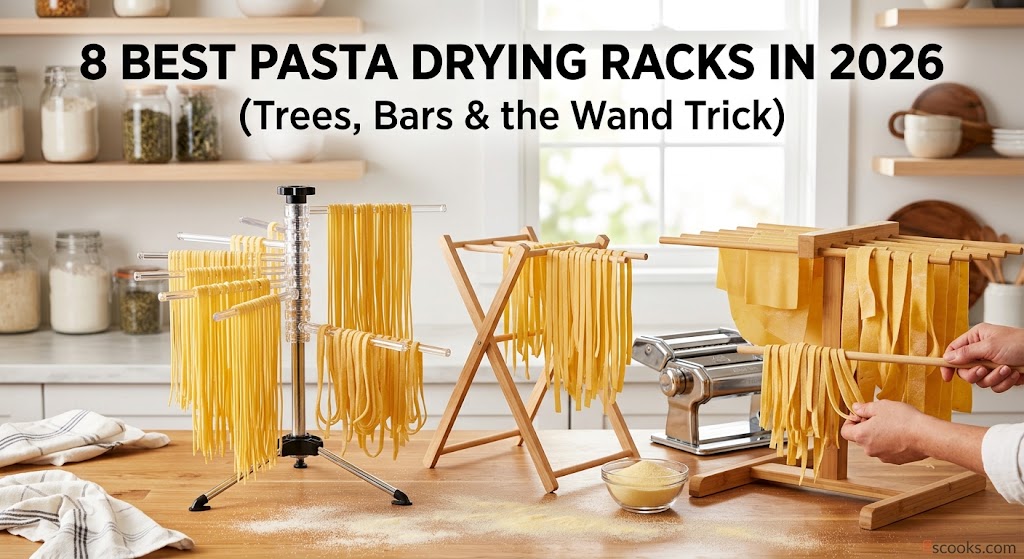
Fresh pasta has a sticking problem. The moment cut noodles touch each other, they weld — and the chair-backs, coat hangers and flour-dusted towels of kitchen legend all end the same way, with fettuccine on the floor. A drying rack solves it with elegant simplicity: arms or bars that hang each strand separately in open air, whether you are drying for storage or just holding cut pasta apart for the twenty minutes until the water boils.
That holding job is the underrated one. Even cooks who never dry pasta fully need somewhere for three batches of tagliatelle to wait untangled while the fourth goes through the machine. A rack is as much a staging area as a preservation tool.
The formats are simple — collapsible rotary trees, fixed wooden racks with removable bars, and bamboo racks with transfer wands — and the differences are practical: capacity, stability under a full load, and whether it folds flat afterwards. Eight worth buying below; pair them with our guide to the best electric pasta makers upstream of the rack.
Our Top 8 Picks for the Best Pasta Drying Rack
Best Overall: Marcato Pasta Drying Rack, Made in Italy

Marcato makes the Atlas 150 — the pasta machine of record — and their drying rack is the same philosophy: simple, correctly engineered, effectively permanent. Rotating arms fan out to hang a full batch of strands separately, the base stays planted, and the whole thing folds narrow for the cupboard.
The rotation is the working feature: spin the loaded rack to bring an empty arm to you rather than reaching over wet pasta. Buy once, dry pasta for decades.
Key Specifications
- Marcato build, made in Italy
- Rotating fold-out arms
- Collapses for storage
- Stable weighted base
Pros
- The category’s reference rack
- Rotation brings empty arms to you
- Folds genuinely flat
- Lifetime-grade construction
Cons
- Costs more than lookalikes
- Arm capacity suits home batches, not bulk
Best Value Rotary: KITCHENDAO Collapsible Pasta Rack

The sensible budget version of the rotary tree: fold-out rotating arms, a compact collapsed form, and an included transfer wand — the thin rod you drape cut pasta over to carry it from machine to rack without stretching a strand.
The plastic build is lighter than Marcato’s, which mostly matters under a heavy full load on a wobbly counter. For normal family batches it does the identical job for less.
Key Specifications
- Collapsible rotary-arm design
- Transfer wand included
- Compact folded footprint
- Lightweight build
Pros
- Cheapest good rotary format
- Wand makes transfer painless
- Stores in a drawer
- Quick setup
Cons
- Light base under maximum load
- Plastic arms bow slightly with long pasta
Best Bamboo: Bamboo Rack with Transfer Wand and 12 Bars

The fixed-frame alternative: a bamboo stand with twelve removable horizontal bars, each of which lifts out to load draped pasta and drops back in place. Twelve bars is genuinely large capacity — a double batch hangs with room to spare — and bamboo’s slight grip keeps strands from sliding into each other the way they can on slick plastic.
It breaks down flat, and the bars double as general drying dowels for herbs and, in this house’s tradition, papad.
Key Specifications
- Bamboo frame, 12 removable bars
- Transfer wand included
- Large hanging capacity
- Disassembles flat
Pros
- Biggest capacity of the group
- Removable bars load effortlessly
- Bamboo grips strands gently
- Natural material, easy repair
Cons
- Larger assembled footprint
- Bamboo wants dry storage like all wood
Best Wooden Classic: Large Collapsible Wood Pasta Rack

The nonna-kitchen aesthetic in a practical folding form: a wooden rack that looks like it belongs beside a hand-crank machine and a flour-dusted board, with the capacity for family-scale batches.
Wood’s texture, like bamboo’s, holds strands where they are placed. Keep it dry, and it becomes one of those kitchen objects that outlives its owner’s recipes.
Key Specifications
- Collapsible wooden rack
- Family-batch capacity
- Traditional workshop look
- Folding storage
Pros
- Handsome enough to leave out
- Wood surface holds strands in place
- Solid under a full load
- Folds away
Cons
- Heavier than plastic rivals
- Wood needs drying before storage
Best Budget: Ourokhome Collapsible Plastic Pasta Rack

The lowest-cost functional rack: plastic rotary arms, folds to almost nothing, washes without a thought. It is the right buy for the once-a-month pasta maker and for anyone still deciding whether fresh pasta is a phase.
Its limits are honest ones — lighter base, arms that prefer moderate loads — and at this price they are fair.
Key Specifications
- Plastic collapsible rotary rack
- Minimal folded size
- Dishwasher-tolerant
- Entry price
Pros
- Cheapest way to stop using chair backs
- Zero-maintenance material
- Tiny storage footprint
- Fine for standard batches
Cons
- Wobbly under heavy double batches
- Slick arms let strands slide together if crowded
Best Rotating Large: 360° Rotating Rack with Adjustable Arms

The capacity-plus-rotation pick: a taller tree with adjustable arms that spin smoothly under load, sized for the cook who runs long pasta in serious quantities — double batches of spaghetti, long tagliatelle that shorter racks let brush the counter.
Height is its quiet advantage: long-cut pasta needs hanging clearance, and short racks fold long strands double, creating the very contact points a rack exists to prevent.
Key Specifications
- Tall 360° rotating tree
- Adjustable arm positions
- Long-pasta hanging clearance
- Collapsible
Pros
- Clears genuinely long cuts
- Smooth rotation while loaded
- High capacity
- Adjustable geometry
Cons
- Tall assembled profile
- More joints, more wobble potential
Best Wand Design: Bamboo 12-Bar Rack, Noodle Edition

A close sibling of our bamboo pick with the same 12-bar format — listed because bamboo racks sell out seasonally and a second sourced option keeps the format available. Same lift-a-bar loading, same wand, same herb-drying second career.
Between the two bamboo racks, buy on price and availability; the format is the product.
Key Specifications
- 12-bar bamboo rack
- Transfer wand included
- Flat disassembly
- Noodle-focused format
Pros
- Same excellent bar-loading format
- Backup availability for the bamboo style
- Large capacity
- Natural material
Cons
- Interchangeable with its sibling — no need for both
- Assembly required each session unless left up
Best Premium Wood: Eppicotispai Beechwood Collapsible Rack, Made in Italy
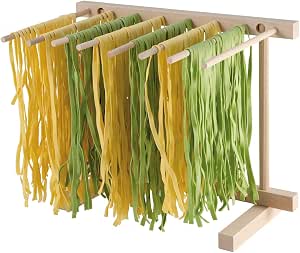
Eppicotispai’s beechwood rack is the artisan option: Italian-made, solid beech, folding flat like a wine-country easel. It is the rack for the kitchen where the pasta machine is also beautiful and also Italian.
Honestly? Mine dries far more sewai and hand-cut noodles than it ever does Italian pasta, and through the summer it holds mango and lemon slices drying for pickle. That is not a workaround. A drying rack is simply a frame that keeps air moving on every side of a thin thing, and a kitchen produces a great many thin things.
It is worth knowing that before you buy, because a rack that earns its cupboard space three times a year is a bad purchase and one that also handles herbs, papad and noodle sheets is a good one. The folding wooden trees suit this far better than the fixed dowel racks, for the simple reason that you can collapse them flat when they are not in use.
Key Specifications
- Solid beechwood, made in Italy
- Collapsible easel design
- Natural unvarnished finish
- Artisan construction
Pros
- The heirloom-grade wooden option
- Beech ages beautifully
- Folds flat despite solid build
- Italian pedigree to match your machine
Cons
- Premium price for a simple object
- Wood care rules apply
The Ultimate Buying Guide for Pasta Drying Racks
Rotary Tree vs Bar Rack
Rotary trees (Marcato, KITCHENDAO) fan arms from a central post, spin to present empty arms, and collapse smallest — the right default for most kitchens. Bar racks (the bamboo twelve-bar format) hold more pasta and load more gently — lift a bar out, drape it at counter height, slot it back — at the cost of footprint. High-volume households and long-noodle specialists lean bar; everyone else leans tree.
Staging vs True Drying
Most home racks spend their lives staging: holding cut pasta apart for minutes-to-hours before cooking, where the only goal is preventing welds. True drying for pantry storage is a slower science — pasta must dry evenly over 12 to 24-plus hours at room temperature until brittle; too fast (sun, heat vents) and it cracks, too humid and it sours. Egg-rich doughs are best staged and cooked fresh or frozen rather than shelf-dried; traditional shelf-dried pasta is semolina-and-water for a reason.
The Transfer Wand Is Not a Gimmick
Fresh strands stretch under their own weight when carried by hand. The wand — a thin dowel you catch the pasta over as it leaves the machine — carries a whole cut batch to the rack in one motion, untangled and unstretched. Kits that include one are solving a real problem; if yours does not, a clean wooden spoon handle stands in.
Practical Points
- Height matters for long cuts — spaghetti-length strands need clearance or they fold and touch
- Flour the strands lightly (semolina ideally) before hanging — insurance against sticking
- Load alternating arms on a tree so airflow reaches everything
- Wood and bamboo racks dry fully before storage, same as every wooden tool on this site
- Nests, not hangs: short shapes (farfalle, orecchiette) dry on a floured tray — the rack is for strands
Frequently Asked Questions About Pasta Drying Racks
How long should fresh pasta dry before cooking?
For same-day cooking, 15 to 30 minutes on the rack is purely logistical — it stops sticking while you finish the batch. The texture is identical either way; fresh pasta is meant to be cooked fresh. Drying only becomes a process when you intend to store it.
Can I fully dry fresh pasta for the pantry?
Semolina-and-water pasta, yes: hang until completely brittle (typically 12 to 24 hours or more depending on humidity), then store airtight. Egg pasta is the caveat — food-safety guidance treats home-dried egg pasta cautiously because eggs plus slow ambient drying is an awkward combination; freeze egg pasta in nests instead, which takes minutes and cooks from frozen perfectly.
Why does my pasta stick together on the rack?
Strands hung touching, dough too wet, or no flour dusting. Hang with daylight between strands, dust cut pasta with semolina as it leaves the machine, and firm up sticky dough with a little more flour next knead. Wood and bamboo arms also hold strands in place better than slick plastic.
Do I need a rack if I make short pasta shapes?
No — racks serve strands. Farfalle, orecchiette and cavatelli dry on a semolina-dusted sheet pan or a mesh screen. The rack earns its space the day you start cutting fettuccine.
What else is a pasta rack good for?
Drying herbs in bunches, papad and rice-paper sheets, fruit leathers draped on parchment — and in many kitchens it quietly becomes the second dish-towel rack. The bamboo bar formats are particularly good multi-taskers.
Final Thoughts
The Marcato is the buy-once rotary answer from the people who built your pasta machine; the bamboo 12-bar wins on capacity and gentle loading; and the Ourokhome is the honest few-dollars fix for anyone still draping fettuccine over chairs.
Dust with semolina, hang with space, and remember the rack’s real job: keeping the batch perfect for the pot. The machine upstream — covered in our pasta maker guide — does the glamour; the rack does the saving.
As an Amazon Associate we earn from qualifying purchases. Availability is accurate as of the date of publishing. We do not list prices because they change too often to quote honestly.

Rimi Sultana is a home cook from Bangladesh who has cooked for her family every day for the past five years and writes about it at Smart Cooks. Perpetually testing whether internet-famous recipes actually work in a regular home kitchen. Say hello on Facebook or through the contact page.