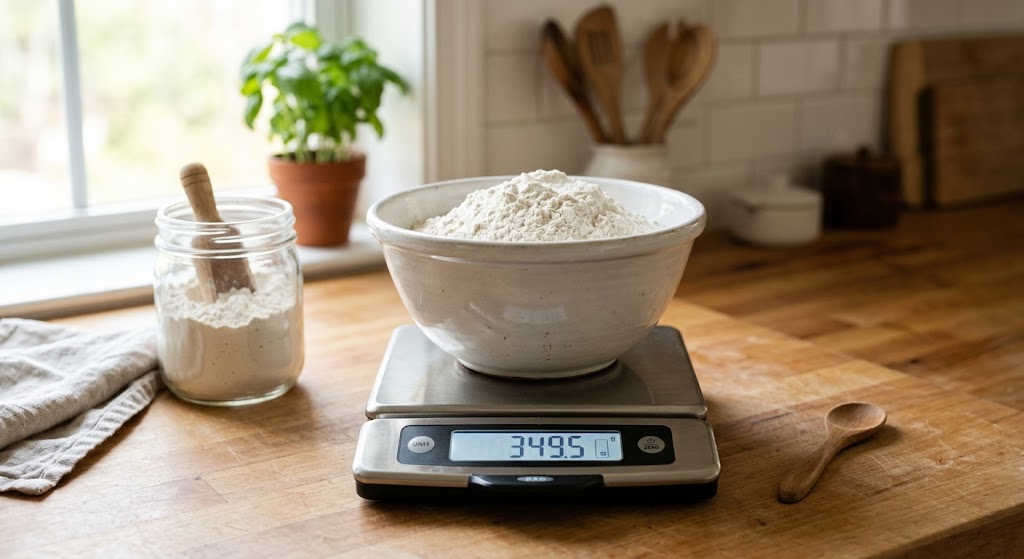
Baking by weight instead of volume measurements is the single biggest accuracy upgrade most home bakers can make, since a cup of flour can vary by as much as 20% depending on how it’s scooped. A good scale makes that shift painless; a bad one undermines the whole point.
Some links in this post are affiliate links. If you buy through them we may earn a small commission at no extra cost to you — it never changes which products we recommend.
What Actually Matters
Precision and Increment Size
Look for a scale that measures in 1-gram increments, not just 5 or 10 gram jumps. For baking, especially with small-quantity ingredients like yeast or leavening, that finer precision is what actually makes weighing worth doing over measuring cups.
Tare Function
The ability to zero out the scale with a bowl already on it, then keep adding ingredients and re-zeroing between each one, is what makes weighing multiple ingredients into one bowl fast instead of tedious. This is close to a non-negotiable feature at this point.
Platform Size and Stability
A larger, flat platform accommodates bigger mixing bowls without them wobbling or overhanging the edge. If you regularly weigh directly into your stand mixer bowl, check that the scale’s platform is large and sturdy enough for that.
Max Capacity
Most home baking scales top out between 11 and 22 pounds, which covers nearly everything except very large batch or bread-baking setups. Check this against your heaviest typical bowl-plus-ingredients weight.
From My Kitchen: Why I Stopped Trusting Measuring Cups for Flour
I used to assume my bakes were inconsistent because of oven temperature swings, until I weighed out a cup of flour I’d scooped my usual way and compared it to the same cup measured by weight from a recipe’s gram conversion. Mine was nearly 20% heavier, because I’d been scooping straight from the bag and packing it down slightly without realizing it. That single habit had been quietly throwing off every cup-measured recipe I’d made for years. Switching to weighing flour, even just for that one ingredient, fixed texture problems I’d been blaming on everything else.
Worth Considering
Etekcity’s digital kitchen scale covers the essentials — 1-gram precision and a reliable tare function — at a reasonable price.
Etekcity’s rechargeable, waterproof model is worth considering if you want to skip battery changes and don’t mind a bit more spent upfront.
Why Weighing Flour Changes Everything
A cup of flour can weigh anywhere from about 120 to 150 grams depending on whether it was scooped straight from the bag, spooned in, or sifted first. That is up to a 25 percent difference in the single ingredient that determines a recipe’s structure. It is the reason two people following the same cookie recipe get genuinely different results, and it is why almost every professional recipe is written in weight rather than volume.
Weight also removes washing up. Set a bowl on the scale, tare, add flour; tare, add sugar; tare, add butter. Everything goes into one bowl with no measuring cups involved, and the numbers are exact. Most people who switch to weighing say the speed is what keeps them doing it, not the accuracy.
Quick Comparison
| Specification | What to look for | Why |
|---|---|---|
| Resolution | 1 g | Enough for flour, sugar, liquids |
| Capacity | 5 kg or more | Heavy mixing bowls eat into capacity |
| Tare function | Essential | Lets you weigh into one bowl |
| Auto-off delay | 3 minutes or adjustable | Short timeouts switch off mid-recipe |
| Platform size | Wide, flat | A big bowl must sit stable |
| Unit switching | g, oz, ml | Useful for imperial recipes |
The Two Specifications People Regret Ignoring
Auto-off delay is the hidden annoyance. A scale that switches off after sixty seconds of a stable reading will turn itself off while you are fetching an ingredient, losing your tare and forcing you to start the bowl again. Look for three minutes or, better, an adjustable setting. It sounds trivial and it is the single most common complaint about otherwise good scales.
Capacity is the other. A heavy ceramic mixing bowl can weigh well over a kilogram empty, and on a 3 kg scale that leaves you less room than you think for a double batch of dough. A 5 kg capacity costs very little more and removes the problem entirely. The related detail is platform size — a wide bowl that overhangs is fine as long as it sits stable, but a small raised platform can make a large bowl rock.
Two Scales Worth Considering
Best value: Etekcity Digital Kitchen Scale
Covers everything home baking needs — 1 gram resolution, a reliable tare, unit switching and a flat platform that takes a mixing bowl without wobbling. There is very little reason to spend more unless you want waterproofing.
Pros
- Accurate 1 g resolution
- Simple, responsive tare
- Flat platform suits large bowls
Cons
- Battery powered rather than rechargeable
- Auto-off is not adjustable
Best for a messy kitchen: Etekcity Rechargeable Waterproof Scale
Waterproofing matters more than it sounds in a kitchen where you weigh honey, oil and wet doughs directly on the platform. Rechargeable also removes the dead-battery-mid-recipe problem, which is the usual way a scale fails you.
Pros
- Wipes clean, tolerates spills
- Rechargeable, no batteries to run out
- Same 1 g accuracy as standard models
Cons
- Costs more than a basic scale
- Needs charging occasionally
Frequently Asked Questions
Do I need to weigh every ingredient, or just flour?
Flour makes the biggest practical difference since it’s usually the largest-volume ingredient and the easiest to over- or under-pack by scooping. Weighing everything is more precise, but flour alone solves most consistency problems.
Are cheap kitchen scales accurate enough for baking?
Many are perfectly fine — accuracy has less to do with price and more to do with whether the scale offers fine enough gram increments and a stable, properly calibrated sensor.
How do I know if my scale needs recalibrating?
If a known-weight object (a coin roll, for example) consistently reads incorrectly, that’s a sign. Most digital scales don’t drift much over time under normal home use, so this is rarely an issue.
Do I need a scale that reads to 0.1 grams?
For general baking, no — 1 gram is plenty for flour, sugar, butter and liquids. It becomes genuinely useful for two things: instant yeast and salt in small-batch bread, where a gram either way is a meaningful proportion, and coffee dosing. If you need that precision, a small separate 0.1 gram scale costs very little, and it is a better solution than trying to find one scale that does both well.
Why does my scale give different readings for the same thing?
Almost always the surface. A scale needs a hard, flat, level surface — a slightly flexing worktop, a placemat or a wooden board that rocks will all produce drifting readings, because the load cell is measuring deflection. A low battery is the other common cause and often shows up as readings that creep upward. Weighing something known, like a 500 ml bottle of water, is a quick way to check whether the scale itself has drifted.
Related: Top 8 fine mesh strainers for sifting flour: precise baking tools explained
Related: Top 7 kitchen tongs for grilling with precise control and durability

Rimi Sultana is a home cook from Bangladesh who has cooked for her family every day for the past five years and writes about it at Smart Cooks. Perpetually testing whether internet-famous recipes actually work in a regular home kitchen. Say hello on Facebook or through the contact page.