The quality of a crepe pan is defined less by flashy marketing and more by how its design affects heat distribution, surface texture, and ease of crepe flipping. Thin crepes require a pan that heats quickly and holds an even temperature across its surface to avoid thick spots or tearing, which happens when heat concentrates unevenly or the pan’s edge is too high.
Some links in this post are affiliate links. If you buy through them we may earn a small commission at no extra cost to you — it never changes which products we recommend.
Beyond heat control, the surface coating and pan shape determine how easily batter spreads and releases. A truly good crepe pan balances these factors while being comfortable to handle, since flipping delicate crepes demands precision. Avoid pans that rely on vague claims about nonstick properties without explaining their material or construction.
What actually matters
Many buyers focus on pan size or brand without understanding the fundamental features that influence crepe quality. This section breaks down the real technical differences to look for in a crepe pan.
Understanding the heat conduction mechanism is crucial. Materials like carbon steel and cast iron have high thermal mass, meaning they absorb and store a large amount of heat energy, which ensures a stable cooking temperature over time. This stability prevents hot spots that can cause uneven cooking or burning. However, because they take longer to heat up, precise temperature control requires patience and experience. Aluminium, by contrast, has a lower thermal mass but higher thermal conductivity, allowing it to heat quickly and respond rapidly to temperature adjustments. This makes aluminium pans more user-friendly for beginners or quick cooking but can lead to uneven heating if the pan is too thin or poorly constructed.
Surface finish also plays a vital role in batter release. The texture of the pan surface interacts with the batter’s viscosity and spreading behavior. A slightly textured surface, such as that developed by seasoning carbon steel pans, improves mechanical grip on the batter, allowing it to spread evenly and peel off cleanly once cooked. Nonstick coatings reduce surface energy, minimizing adhesion, but their chemical composition limits maximum safe cooking temperatures to around 500°F (260°C). Exceeding these temperatures can degrade the coating, releasing harmful fumes and shortening pan lifespan. Ceramic coatings tolerate higher temperatures but generally have lower abrasion resistance, leading to faster wear.
The pan’s shape and handle design affect ergonomics and cooking technique. Low, flared sides (0.5 to 1 inch) facilitate easy insertion of a spatula to lift and flip the crepe without tearing. The diameter influences crepe size and cooking time: an 8-inch pan cooks faster but yields smaller crepes, whereas a 12-inch pan offers larger crepes but requires more batter and longer cooking times. Handles must be securely riveted or welded to the pan body to withstand repeated flipping motions without loosening. Material choice for handles impacts heat conduction; for example, stainless steel handles may heat up on the stovetop, necessitating oven mitts or silicone grips.
Material and heat conduction
Crepe pans are typically made from carbon steel, aluminium, cast iron, or nonstick-coated aluminium. Carbon steel and cast iron have high thermal mass, meaning they retain and distribute heat steadily but take longer to reach cooking temperature. Aluminium heats up quickly and responds faster to temperature changes but can have hot spots if too thin. The ideal pan material balances rapid heating with even conduction across the 8 to 12 inch (20 to 30 cm) cooking surface.
Quantitatively, carbon steel pans can weigh between 1.5 to 3 pounds (0.7 to 1.4 kg), contributing to their heat retention capacity. Aluminium pans are lighter, typically 1 to 2 pounds (0.45 to 0.9 kg), which makes them easier to handle but less stable in temperature. Cast iron pans can exceed 4 pounds (1.8 kg), providing excellent heat retention but requiring longer preheating times of up to 10 minutes on medium heat, compared to aluminium pans which may reach cooking temperature within 2 to 3 minutes.
Surface finish and batter release
A smooth, slightly textured surface allows batter to spread thinly and peel off without sticking. Traditional carbon steel pans develop a natural patina with seasoning, which improves release but requires maintenance to avoid rust. Nonstick coatings provide easier cleanup and consistent release but wear down over time and may limit pan temperature to around 500°F (260°C) to preserve coating integrity. Ceramic coatings can tolerate higher heat but often lack durability.
Seasoning a carbon steel pan involves polymerizing oils at high temperatures to create a hard, hydrophobic layer. This layer reduces surface energy and prevents batter adhesion. Maintenance includes avoiding detergents and moisture, which can degrade the seasoning. Nonstick coatings, such as PTFE-based surfaces, offer immediate release but typically last 3 to 5 years depending on usage and care. Ceramic coatings, while free from PTFE and PFOA chemicals, often last 1 to 2 years before chipping or losing effectiveness.
Shape, size and handle design
Crepe pans generally have low, flared sides between 0.5 and 1 inch (1.2 to 2.5 cm) high, which facilitate sliding a spatula underneath the crepe for flipping. Diameter ranges from 8 to 12 inches (20 to 30 cm); smaller pans cook thinner crepes quickly but limit size, while larger pans take more batter and time. The handle should be securely riveted or welded for stability and positioned to balance the pan’s weight for easy wrist movement.
Ergonomically, a well-balanced pan reduces wrist strain during repetitive flipping motions. Handles made from heat-resistant materials or designed with silicone grips minimize the risk of burns. The angle of the handle relative to the pan (typically 15 to 30 degrees) also affects control and comfort. Flared sides should be wide enough to allow spatulas of various sizes to slide under crepes without damaging them, but not so high as to impede batter spreading.
Choosing the right crepe pan for your kitchen
If you prioritise ease of use and low maintenance, a nonstick aluminium pan around 10 inches in diameter is a solid choice. However, these coatings wear out over time and can’t handle very high heat.
For those willing to invest time in seasoning and pan care, carbon steel offers superior heat retention and a natural nonstick surface that improves with use.
If you want large crepes or batch cooking, a 12-inch pan is worth considering but expect more weight and slower heating.
Electric crepe makers are niche appliances ideal for small spaces or portable use but won’t replace traditional stovetop pans for volume or crepe size.
Avoid pans with high rims or thick walls; they hinder batter spreading and crepe flipping. Similarly, pans without securely attached handles can be unsafe and frustrating.
Delving deeper into the consequences of pan choice, selecting a pan with uneven heat distribution can result in crepes that are inconsistent in texture—some areas may be overcooked and crispy while others remain undercooked and doughy. This not only affects taste but also the structural integrity of the crepe, making flipping difficult and increasing the likelihood of tearing.
From a numerical perspective, pans with a thermal conductivity less than 50 W/m·K (watts per meter-kelvin) tend to develop hot spots, whereas materials like aluminium with thermal conductivities above 200 W/m·K provide more even heat distribution. For example, carbon steel has a thermal conductivity around 54 W/m·K, which is moderate, but its thermal mass compensates by stabilizing temperature.
The thickness of the pan base also affects heat distribution. A base thickness of 3 to 5 mm is generally optimal for balancing heat retention and responsiveness. Thinner bases heat quickly but unevenly, while thicker bases provide stability but increase weight and heating time.
In terms of maintenance, neglecting seasoning on carbon steel pans can cause rust formation, which not only damages the pan but also imparts off-flavors to crepes. Rust spots can also cause batter to stick, leading to uneven cooking and tearing.
For nonstick pans, overheating beyond the recommended temperature can release toxic fumes, posing health risks and degrading the pan’s surface. Users should monitor stove settings and avoid preheating empty pans for extended periods.
Handle design impacts safety: loose or poorly attached handles risk detachment during cooking, leading to accidents. Handles that conduct heat without insulation increase burn risk, especially during prolonged cooking sessions.
| Pick | Best for | Diameter (in/cm) | Watch out for |
|---|---|---|---|
| SENSARTE 10 Inch | Budget nonstick | 10 / 25.4 | Coating durability, heavier than aluminium |
| Cuisinart Chef’s Classic 10 Inch | PFAS-free nonstick | 10 / 25.4 | Handle can get hot, medium weight |
| de Buyer Mineral B 12 Inch | Traditional carbon steel | 12 / 30.5 | Requires seasoning and care to avoid rust |
| Nordic Ware French Steel 10 Inch | Steel pan for even heat | 10 / 25.4 | Heavier, edges slightly higher |
| Kordisen 12 Inch | Large nonstick pan | 12 / 30.5 | Too large for small batches, bulky handle |
| Le Creuset Nonstick Pro 11 Inch | Premium nonstick with ratteau | 11 / 28 | Expensive, heavier than aluminium options |
| Innerwell Stainless Steel 11 Inch | Stainless steel nonstick hybrid | 11 / 28 | Requires oil for release, not true nonstick |
| Moss & Stone Electric 8 Inch | Portable electric crepe maker | 8 / 20 | Limited to electric use, small cooking surface |
| Le Creuset Enameled Cast Iron 10.25 Inch | Cast iron with enamel | 10.25 / 26 | Very heavy, slow to heat up |
| ESLITE LIFE 11-Inch Nonstick Crepe Pan | Compact nonstick pan | Nonstick, 11-inch | Very few reviews |
From my kitchen
Once I tried using a large 12-inch carbon steel pan to make a thin crepe, but I hadn’t properly seasoned it yet. The first crepe stuck stubbornly and tore apart when I flipped it, which was frustrating. To fix this, I seasoned the pan with a few layers of oil baked in at 400°F (204°C) and reduced the heat to medium-low. After that, the crepes slid off easily, and the pan’s heat retention helped maintain consistent cooking temperature.
Worth Considering
Best for budget nonstick: SENSARTE 10 Inch

This pan offers a reasonable nonstick coating for thin crepes at an accessible price. Its 10-inch diameter is versatile but the coating wears faster than more premium options. Suitable for beginners who want easy release without seasoning. Not ideal if you want a lightweight pan or long-term durability.
Price when checked: $25.99 · Rating: 4.3 out of 5 (6.9K ratings)
Pros
- Affordable nonstick surface
- 10 inch size suits most crepes
- Granite coating aids release
Cons
- Coating durability limited
- Heavier than aluminium pans
Best for health-conscious: Cuisinart Chef’s Classic 10 Inch

This pan is coated with a PFAS-free nonstick surface, appealing if you avoid traditional chemical coatings. The handle can become hot due to aluminium construction, so care is needed. It offers a good balance between performance and health safety but weighs more than aluminium-only pans.
Price when checked: $29.95 · Rating: 4.6 out of 5 (5.7K ratings)
Pros
- PFAS-free coating
- Good size for standard crepes
- Hard anodized aluminium base
Cons
- Handle heats up
- Moderate weight
Best traditional French style: de Buyer Mineral B 12 Inch

This carbon steel pan heats steadily and develops a naturally nonstick patina with seasoning, ideal for enthusiasts who prefer authentic crepe-making methods. It requires maintenance to prevent rust and a break-in period. Not suited to those wanting low maintenance or immediate nonstick performance.
Price when checked: $71.99 · Rating: 4.2 out of 5 (2.6K ratings)
Pros
- Natural seasoning improves with use
- Large 12 inch surface
- High heat tolerance
Cons
- Requires seasoning and upkeep
- Prone to rust without care
Best for even heat steel pan: Nordic Ware Traditional French Steel 10 Inch
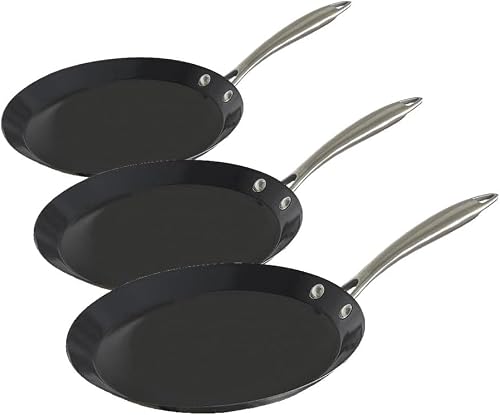
Made from carbon steel with a smooth surface, this pan offers reliable heat retention and a low rim for easy crepe flipping. Slightly heavier than aluminium, it suits cooks who value even cooking over light weight. Needs seasoning to maintain surface.
Rating: 4.4 out of 5 (529 ratings)
Pros
- Even heat retention
- Low sides for flipping
- Durable carbon steel
Cons
- Requires seasoning
- Heavier than aluminium
Best for large crepes: Kordisen 12 Inch Nonstick

The large 12-inch diameter allows bigger crepes but makes the pan bulkier and less nimble. The nonstick coating makes it easier to release batter but the pan’s size demands more storage space and can be unwieldy for quick crepe flipping. Better for experienced users who want large crepes.
Price when checked: $24.98 · Rating: 4.5 out of 5 (731 ratings)
Pros
- Large cooking surface
- Nonstick coating aids release
- Suitable for big batches
Cons
- Bulky and heavy
- Less manoeuvrable for flipping
Best for premium nonstick: Le Creuset Toughened Nonstick PRO 11 Inch

This pan combines a tough, multi-layer nonstick coating with a substantial aluminium base that heats quickly and evenly. The included ratteau (wooden spreader) is a nice bonus for batter distribution. It is heavier and more expensive than simpler pans but delivers consistent results for serious home cooks.
Price when checked: $129.95 · Rating: 4.6 out of 5 (414 ratings)
Pros
- Durable multi-layer nonstick
- Even heat distribution
- Includes batter spreader
Cons
- Higher price point
- Heavier than some aluminium pans
Best stainless steel hybrid: Innerwell Stainless Steel 11 Inch

This pan combines stainless steel with a nonstick surface, offering a metal-friendly cooking area that requires a small amount of oil for release. It resists scratching better than traditional nonstick but isn’t truly nonstick, so crepe release depends on technique. Not ideal for those wanting completely effortless cleanup.
Price when checked: $37.99 · Rating: 4.2 out of 5 (1.2K ratings)
Pros
- Durable stainless steel base
- Better scratch resistance
- Suitable for metal utensils
Cons
- Requires oil for release
- Not fully nonstick
Best portable electric: Moss & Stone Electric 8 Inch

This compact electric crepe maker is convenient for those without a compatible stovetop or who want a dedicated crepe appliance. Its 8-inch surface limits crepe size but the built-in heat control ensures consistent temperature. Not suitable for those needing large batches or traditional stovetop cooking.
Price when checked: $29.99 · Rating: 4.2 out of 5 (5.8K ratings)
Pros
- Portable electric heating
- Consistent temperature control
- Compact size
Cons
- Small cooking surface
- Limited to electric use only
Best enameled cast iron: Le Creuset Enameled Cast Iron 10.25 Inch

The enameled cast iron body holds heat exceptionally well but takes time to come up to temperature. The enamel surface provides a semi-nonstick finish after seasoning but is prone to chipping if handled roughly. This pan is very heavy and best suited for cooks prepared to manage cast iron care.
Price when checked: $189.95 · Rating: 4.6 out of 5 (540 ratings)
Pros
- Excellent heat retention
- Durable enamel surface
- Moderate size
Cons
- Very heavy
- Slow to heat up
Best compact nonstick: ESLITE LIFE 11-Inch Nonstick Crepe Pan

An 11-inch nonstick crepe and grill pan from ESLITE LIFE; there are very few reviews so far.
Rating: 4.1 out of 5 (4 ratings)
Pros
- Nonstick surface
- Doubles as a grill pan
- Lightweight
Cons
- Very few reviews
- Nonstick wears over time
Choosing the right crepe pan for your kitchen
If you prioritise ease of use and low maintenance, a nonstick aluminium pan around 10 inches in diameter is a solid choice. However, these coatings wear out over time and can’t handle very high heat.
For those willing to invest time in seasoning and pan care, carbon steel offers superior heat retention and a natural nonstick surface that improves with use.
If you want large crepes or batch cooking, a 12-inch pan is worth considering but expect more weight and slower heating.
Electric crepe makers are niche appliances ideal for small spaces or portable use but won’t replace traditional stovetop pans for volume or crepe size.
Avoid pans with high rims or thick walls; they hinder batter spreading and crepe flipping. Similarly, pans without securely attached handles can be unsafe and frustrating.
Related reading
- Le Creuset vs Staub which dutch oven is worth it: Which One is Right for You?
- Nordic Ware vs Wilton cake pan comparison: Which Is Better?
- The 10 Best Oven Mitts of 2026 (Tested and Reviewed)
Frequently Asked Questions
What size crepe pan is best for thin crepes?
A crepe pan between 10 and 12 inches (25 to 30 cm) in diameter is ideal for thin crepes. This size allows sufficient surface area for spreading the batter thinly without crowding or making crepes too small. Smaller pans under 10 inches limit crepe size, while larger ones can be heavier and slower to heat. The pan should also have low, flared sides for easy flipping.
How do I maintain a carbon steel crepe pan for best results?
To maintain a carbon steel pan, season it by coating with a thin layer of oil and heating it to around 400°F (204°C) for 30-60 minutes. This creates a natural nonstick patina. Avoid washing with soap or soaking in water; instead, wipe clean and dry immediately to prevent rust. Re-season periodically, especially if food begins sticking or rust spots appear.
Can I use metal spatulas with nonstick crepe pans?
Most nonstick coatings are vulnerable to scratching from metal utensils, which can degrade their release properties. It’s best to use silicone, wooden, or plastic spatulas with nonstick pans. If a pan specifically claims metal utensil compatibility, it usually has a harder coating, but even then, gentle use is advised to prolong pan life.

Rimi Sultana is a home cook from Bangladesh who has cooked for her family every day for the past five years and writes about it at Smart Cooks. Perpetually testing whether internet-famous recipes actually work in a regular home kitchen. Say hello on Facebook or through the contact page.