Choosing a microwave for a small apartment is less about flashy features and more about how the size, power, and control mechanisms fit your limited space and cooking needs. The best models manage to pack enough capacity and power without dominating your counter or compromising cooking quality.
Some links in this post are affiliate links. If you buy through them we may earn a small commission at no extra cost to you — it never changes which products we recommend.
Microwaves vary primarily in their internal volume, wattage, and control precision. A model that is too large wastes space, while one that is too small or underpowered can lead to uneven heating and longer cook times. Understanding these mechanical differences helps avoid common mistakes like underestimating how power levels affect food texture or overvaluing preset functions you rarely use.
What actually matters
When shopping for a microwave suited to small apartments, three technical aspects usually dictate performance and user satisfaction: capacity and footprint, power and wattage, and the control interface and cooking precision.
Capacity and footprint
Microwave capacity is measured in cubic feet and indicates the internal cooking space. For small apartments, 0.6 to 0.9 cu.ft models are common, balancing usability with compactness. The external footprint matters equally as it defines how much counter space the appliance occupies. A microwave with a large capacity but a bulky footprint may not fit well in a constrained kitchen area.
For example, a 0.7 cu.ft microwave typically fits plates up to 10 inches in diameter, which covers most standard dinnerware. However, models with larger turntables or square interiors can sometimes offer more usable space despite similar cubic feet ratings. Measuring the external dimensions, including depth and height, is crucial to ensure the unit fits your countertop or shelf without crowding other appliances.
A compact footprint also influences airflow and heat dissipation. Microwaves placed too close to walls or other objects may overheat or reduce lifespan. Therefore, selecting a model with adequate ventilation clearances is important, especially in tight kitchen setups.
Power and wattage
Wattage determines how quickly and evenly a microwave cooks food. Most small microwaves have outputs around 700 watts, which is adequate for reheating and simple cooking but may struggle with dense or large portions. Lower wattage means longer cooking times and potentially uneven heating due to less effective magnetron performance.
To quantify, a 700W microwave typically heats a cup of water in about 1.5 to 2 minutes, whereas a 1000W model accomplishes this in roughly 1 minute. This difference scales with food density and volume; for example, cooking a frozen meal might take 4-5 minutes at 700W but only 3 minutes at 1000W.
Longer cooking times at lower wattages can lead to moisture loss and uneven heating, especially in thick or layered dishes. This is because the magnetron—the component generating microwaves—operates at reduced power, causing heat to penetrate less uniformly. Users should compensate by using lower power settings and longer cook times to avoid overcooking edges while the center remains cold.
Energy consumption also varies with wattage. A 700W microwave uses less electricity per minute but requires longer operation, resulting in similar overall energy use compared to higher wattage models for the same cooking task.
Controls and cooking precision
Microwave controls range from basic dials to digital panels with presets and sensor cooking. The key difference is whether power levels can be finely adjusted. Models with 10 power levels allow for low and slow cooking alongside rapid heating, preventing common issues like overheating edges while the centre remains cold. Preset functions offer convenience but can be inconsistent across brands, so manual control is often more reliable.
Fine control over power levels enables techniques such as defrosting at 30% power or simmering sauces at 50% power, which preserve texture and flavor better than full-power cooking. For example, defrosting a 1-pound frozen chicken breast at 30% power for 8-10 minutes yields more even thawing compared to 100% power for 3 minutes, which can partially cook edges.
Sensor cooking technology uses humidity or temperature sensors to automatically adjust cooking time and power. While convenient, these systems add complexity and cost, and may increase the microwave’s size. For small apartments prioritizing space and budget, manual controls with multiple power levels often offer better value and reliability.
Additionally, features like child lock and mute functions enhance usability in shared or noise-sensitive environments. A mute option can reduce beeps and alerts, which is beneficial in apartments with thin walls or late-night cooking.
How to choose and who might skip a microwave
Selecting the right microwave depends on your kitchen space, cooking habits, and noise tolerance. If counter space is extremely limited, over-the-range microwaves with exhaust fans like the Toshiba model free up surface area but need installation and sufficient kitchen ventilation.
If you mostly reheat leftovers or make simple meals, a 700W model with multiple power levels and presets will suffice. Prioritise models with child locks and mute options if you live in shared or thin-walled apartments.
Microwaves with sensor cooking automate power adjustment based on food moisture but tend to be larger or more expensive. For those who rarely use a microwave or have access to other cooking methods, it might be worth considering skipping one entirely in favour of saving space.
Beyond size and power, consider the long-term consequences of your microwave choice. A model with insufficient wattage or poor control precision can lead to repeated undercooking or overheating, resulting in wasted food and frustration. Conversely, a well-suited microwave can save time, reduce energy consumption, and improve meal quality.
For example, in a small apartment where counter space is at a premium, choosing a 0.7 cu.ft model with 10 power levels and a mute option can reduce noise complaints and fit neatly alongside other appliances. In contrast, selecting a large 1.9 cu.ft over-the-range microwave without proper ventilation could cause installation issues or inefficient odor removal.
Also, consider maintenance and durability. Microwaves with simple interfaces and fewer moving parts tend to last longer and require less repair. Models with plastic-heavy construction might be lighter but can wear out faster under frequent use. Warranty length and customer support availability are additional factors to weigh.
In summary, balancing capacity, power, control precision, and features against your apartment’s spatial constraints and cooking needs ensures you select a microwave that enhances your daily routine without compromise.
| Pick | Best for | Capacity (cu.ft) / Power (W) | Watch out for |
|---|---|---|---|
| Sharp SMC0760KB | Compact counter use | 0.7 / 700 | Limited power for dense foods, basic presets |
| TOSHIBA Over-the-Range | Ventilated kitchen setups | 1.9 / 1000 | Large footprint, more suited to full kitchens |
| BLACK+DECKER 0.7 Cu.Ft | Budget countertop | 0.7 / 700 | Plastic-heavy build, minimal presets |
| Chefman 0.7 Cu. Ft. | Quiet operation and mute option | 0.7 / 700 | Higher price point, limited advanced features |
| COMFEE’ 0.7 Cu.Ft | Energy saving and child safety | 0.7 / 700 | Simplified interface, fewer presets |
| Emerson MW7302B | Basic, reliable use | 0.7 / 700 | No standout features, average build |
| COSTWAY 0.7 Cu.ft | Portable and minimal | 0.7 / unspecified | Limited power info, basic controls |
| BLACK+DECKER 0.7 Cu.Ft Black | Multiple presets | 0.7 / 700 | Limited mute or child lock options |
From my kitchen
Once, I tried reheating a frozen stew in a small 700W microwave without using the appropriate power level. The edges steamed and boiled over while the centre remained icy cold because the default high power cooked unevenly. Switching to a 50% power setting and letting the microwave run longer distributed heat through the stew more evenly. This episode highlighted how knowing and using power levels properly is key, especially with lower-wattage microwaves common in small apartments.
In addition, I experimented with reheating a dense casserole at full power and noticed the outside layers dried out quickly while the inside remained lukewarm. By adjusting to medium power and extending the cooking time by 30%, the heat penetrated more uniformly, preserving moisture and texture. These practical insights underscore the importance of control precision in everyday microwave use.
Worth Considering
Best for compact countertop use: Sharp SMC0760KB

This Sharp model fits well on small counters with its 0.7 cu.ft capacity and 700W power. Its LED interior lighting and 10 power levels offer reasonable control, though it lacks some advanced sensor features. It isn’t ideal for thick or frozen meals needing faster cooking.
Brand: Sharp · Price when checked: $99.99 · Rating: 4.2 out of 5 (8 ratings)
Pros
- Compact footprint with 10-inch turntable
- 10 power levels for cooking flexibility
- Child lock and auto cook menus
Cons
- 700W power limits cooking speed
- Basic defrost, no sensor cooking
Best for ventilated kitchen setups: TOSHIBA Over-the-Range

With a family-size 1.9 cu.ft capacity and 1000W power, this Toshiba is more suited to kitchens with ventilation needs thanks to its 400 CFM exhaust fan. It’s over-the-range style saves counter space but demands installation and a bigger kitchen footprint.
Brand: TOSHIBA · Price when checked: $72.99 · Rating: 4.0 out of 5 (12,389 ratings)
Pros
- High power output for faster cooking
- Built-in exhaust fan removes odors
- Large turntable and capacity
Cons
- Requires mounting and more space
- Not suitable for very small apartment counters
Best budget countertop microwave: BLACK+DECKER 0.7 Cu.Ft
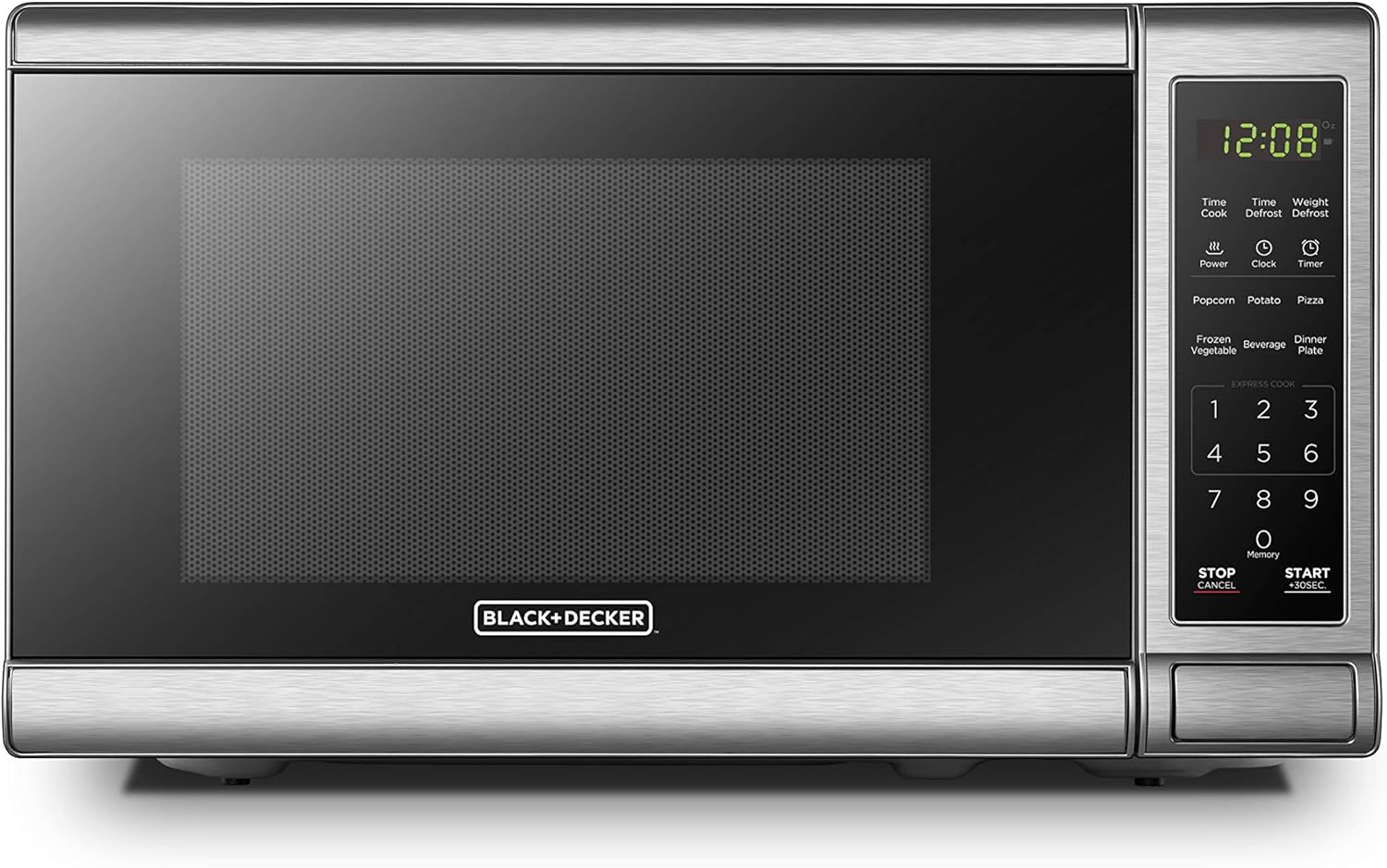
This Black+Decker offers a straightforward 0.7 cu.ft, 700W microwave experience with basic presets and a clear LED display. It’s affordable but uses more plastic components and lacks sound muting, which can be disruptive in tight apartments.
Brand: 4.2 4.2 out of 5 stars · Price when checked: $79.97 · Rating: 4.2 out of 5 (1,094 ratings)
Pros
- Multiple preset functions for convenience
- Compact size fits small spaces
- Child safety lock included
Cons
- No mute function for quiet cooking
- Build quality feels basic
Best for quiet operation and mute option: Chefman 0.7 Cu. Ft.

Chefman’s model delivers 700W power with 10 power levels and includes a mute button for silent use. Its child safety lock and sleek design suit families or apartments with thin walls, but it costs more than comparable models without adding sensor cooking.
Brand: Chefman · Price when checked: $5101 · Rating: 4.3 out of 5 (25,068 ratings)
Pros
- Mute option reduces noise
- Child safety lock on handle
- 10 power levels for precise control
Cons
- Higher price compared to peers
- No sensor or smart cooking functions
Best for energy saving and safety: COMFEE’ 0.7 Cu.Ft

COMFEE’ targets eco-conscious users with its 50% standby power reduction and two-step child lock safety. It offers the usual one-touch express cooking and defrost by weight or time. Its controls are straightforward but lack sensor cooking sophistication.
Brand: COMFEE’ · Price when checked: $68.96 · Rating: 4.4 out of 5 (16 ratings)
Pros
- Energy-saving eco mode
- Two-step child lock for safety
- Simple and quiet muting option
Cons
- Limited preset variety
- Basic power level adjustment
Best for basic, reliable use: Emerson MW7302B

The Emerson is a typical 0.7 cu.ft, 700W microwave with essential features: 10 power levels, 6 cooking presets, and weight/time defrost. It is a no-frills option, suitable if you want dependable heating without extra features or style.
Brand: Emerson · Price when checked: $84.27 · Rating: 4.2 out of 5 (1,056 ratings)
Pros
- Clear digital controls
- Multiple presets and defrost modes
- Affordable and straightforward
Cons
- No mute or advanced safety features
- Standard design with no standout
Best niche pick for portability: COSTWAY 0.7 Cu.ft

This COSTWAY microwave is a lightweight, portable model ideal for dorm rooms or very small apartments where mobility is valued. Its power and controls are minimal, making it unsuitable for frequent cooking or larger meals.
Brand: COSTWAY
Pros
- Compact and portable size
- Delayed start function
- Simple control panel
Cons
- Power rating unspecified, likely low
- Limited cooking presets and features
Best for preset variety: BLACK+DECKER 0.7 Cu.Ft Black

This Black+Decker microwave offers 6 one-touch presets and express cooking up to 6 minutes, good for users relying on quick, standard reheats. It lacks a mute function and some safety options but balances preset convenience with compact size.
Brand: BLACK+DECKER · Rating: 4.4 out of 5
Pros
- Multiple one-touch presets
- Child safety lock included
- Compact, sleek design
Cons
- No mute button for quiet use
- Limited advanced features
How to choose and who might skip a microwave
Selecting the right microwave depends on your kitchen space, cooking habits, and noise tolerance. If counter space is extremely limited, over-the-range microwaves with exhaust fans like the Toshiba model free up surface area but need installation and sufficient kitchen ventilation.
If you mostly reheat leftovers or make simple meals, a 700W model with multiple power levels and presets will suffice. Prioritise models with child locks and mute options if you live in shared or thin-walled apartments.
Microwaves with sensor cooking automate power adjustment based on food moisture but tend to be larger or more expensive. For those who rarely use a microwave or have access to other cooking methods, it might be worth considering skipping one entirely in favour of saving space.
Beyond size and power, consider the long-term consequences of your microwave choice. A model with insufficient wattage or poor control precision can lead to repeated undercooking or overheating, resulting in wasted food and frustration. Conversely, a well-suited microwave can save time, reduce energy consumption, and improve meal quality.
For example, in a small apartment where counter space is at a premium, choosing a 0.7 cu.ft model with 10 power levels and a mute option can reduce noise complaints and fit neatly alongside other appliances. In contrast, selecting a large 1.9 cu.ft over-the-range microwave without proper ventilation could cause installation issues or inefficient odor removal.
Also, consider maintenance and durability. Microwaves with simple interfaces and fewer moving parts tend to last longer and require less repair. Models with plastic-heavy construction might be lighter but can wear out faster under frequent use. Warranty length and customer support availability are additional factors to weigh.
In summary, balancing capacity, power, control precision, and features against your apartment’s spatial constraints and cooking needs ensures you select a microwave that enhances your daily routine without compromise.
Related reading
- Best Kitchen Scales for Baking and Coffee
- The 10 Best Gram Scales for Precise Baking & Coffee
- The 7 Best Kitchen Scales for Meal Prepping in 2026
Frequently Asked Questions
What microwave size is best for a small apartment?
Microwaves between 0.6 and 0.9 cubic feet offer the best balance of capacity and compactness for small apartments. These sizes can accommodate standard plates and bowls without occupying too much counter space. You should measure your available counter area and compare external dimensions to ensure a good fit.
Is 700 watts enough power for everyday microwave use?
A 700-watt microwave can handle most reheating and simple cooking tasks adequately. However, it will take longer to heat denser foods or larger portions than models with 1000 watts or more. Using the microwave’s power levels to reduce cooking speed can improve heat distribution and avoid overcooked edges or cold spots.
Do I need an exhaust fan in my microwave for apartment use?
If your kitchen lacks a dedicated ventilation system or has open-concept design, a microwave with an integrated exhaust fan helps remove cooking odors and steam, improving air quality. Over-the-range microwaves typically include this feature but require mounting space and installation, which might not be feasible in very small apartments.
Related: Top 5 portable induction cooktops for small apartments

Rimi Sultana is a home cook from Bangladesh who has cooked for her family every day for the past five years and writes about it at Smart Cooks. Perpetually testing whether internet-famous recipes actually work in a regular home kitchen. Say hello on Facebook or through the contact page.