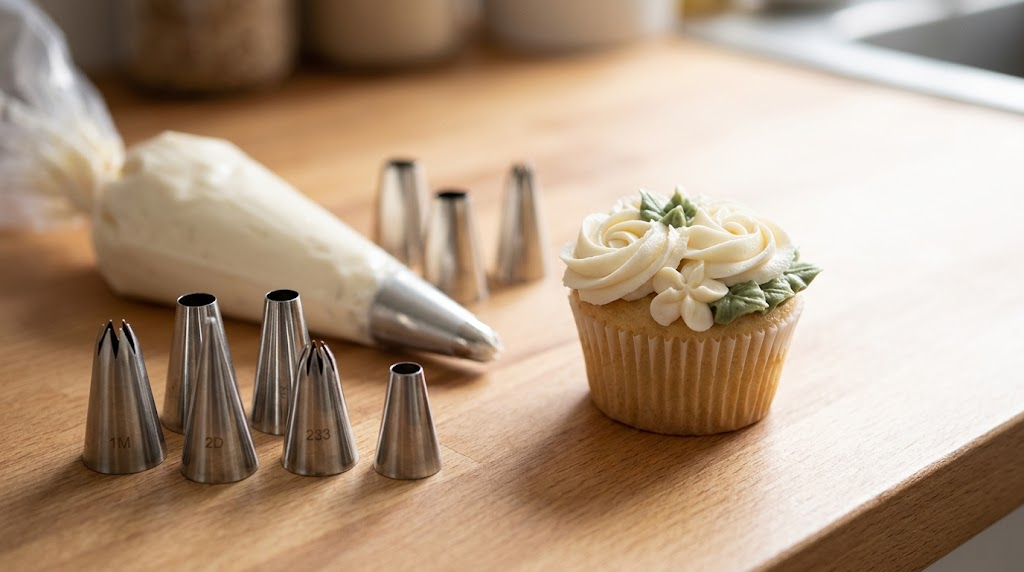
Piping tip sizing problems usually get blamed on technique or the frosting recipe, when the actual issue is often just a mismatch between the tip size and what you’re trying to pipe. These are the signs worth checking before you assume it’s you.
Some links in this post are affiliate links. If you buy through them we may earn a small commission at no extra cost to you — it never changes which products we recommend.
1. Your Frosting Splits or Tears Coming Out of the Tip
If the frosting looks stringy or torn rather than smooth as it exits, the tip opening may be too small for the frosting’s consistency, forcing it through under more pressure than the design intended.
2. You’re Squeezing Much Harder Than Feels Reasonable
A properly matched tip and frosting consistency shouldn’t require intense hand strength to pipe. If your hand is cramping quickly, either the tip is undersized for the bag’s opening or the frosting itself is too stiff for that particular tip.
3. Your Decorative Details Look Blobby Instead of Defined
Star tips, leaf tips, and other detailed shapes rely on a specific size-to-opening ratio to hold their form. A too-large tip for delicate detail work loses definition and just looks like a rounded blob instead of a crisp star or leaf.
4. The Piping Bag Keeps Slipping Off the Tip
If the coupler or bag opening doesn’t match the tip’s base diameter closely enough, frosting can leak out around the sides of the tip instead of only through the opening — a sign the tip and bag or coupler size aren’t actually compatible.
5. You Constantly Switch Tips Mid-Project Out of Frustration
If you find yourself abandoning a tip because it’s “just not working” for basic borders or writing, it’s worth checking whether you’ve been reaching for a specialty tip (like a large open star) for a job better suited to a simple round tip.
From My Kitchen: The Coupler I Didn’t Know I Needed
For a long time I assumed all my piping problems were about frosting consistency, since that’s the advice I kept finding. It turned out my actual issue was that I wasn’t using a coupler at all — I was pushing tips directly into the bag opening, which meant the bag’s own hole was often slightly larger than the tip’s base, and frosting was leaking out around the sides without me realizing that’s what was happening. A simple coupler set fixed the majority of my “technique” problems overnight.
Worth Considering
This 140-piece piping bags and tips set includes a wide enough range of sizes to match most home decorating jobs, from writing to borders to florals.
This 74-piece numbered piping tip set is a solid, more budget-conscious option that still covers the common tip sizes.
How Tip Families and Numbers Work
Piping tips are grouped into families, and the number tells you the size within that family. Round tips run from about #1 for writing up to #12 and beyond for filling and large dots. Open and closed stars — the #16 to #22 range for small work, #1M and #2D for large swirls — produce the ridged rosettes most people picture. Petal tips are numbered separately and are cut asymmetrically for roses and ruffles, and leaf tips have a V-shaped opening.
The mismatch that causes most frustration is using a tip several sizes too small for the job. A #21 star on a cupcake will take four or five passes to cover the surface, the lines will not merge cleanly, and your hand will be aching by the third cupcake. A #1M covers the same cupcake in one continuous swirl. That is not a skill difference, it is a tool difference.
Quick Comparison
| Tip family | Typical numbers | Use |
|---|---|---|
| Small round | #1–#4 | Writing, fine detail, dots |
| Large round | #10–#12 | Filling, large dots, macarons |
| Small star | #16–#22 | Borders, small rosettes, shell edging |
| Large star | 1M, 2D, 6B | Cupcake swirls, large rosettes |
| Petal | #101–#104 | Roses, ruffles, ribbons |
| Leaf | #352, #366 | Leaves and foliage |
Frosting Consistency Matters as Much as the Tip
A tip that seems wrong is often the right tip with the wrong frosting. Small tips need thinner buttercream, because forcing a stiff mixture through a #2 opening takes real hand pressure and is the most common cause of a piping bag splitting at the seam. Large star tips need stiffer frosting, because a soft mixture cannot hold the ridges and the swirl slumps within a minute of being piped.
The practical rule most decorators use is three consistencies from one batch: stiff for flowers and detailed shapes that must hold form, medium for borders and swirls, and thin for writing and fine lines. You adjust with a teaspoon of milk or a spoonful of icing sugar at a time. Trying to do all three with one consistency is what makes people conclude they need different tips.
Two Sets Worth Considering
Best comprehensive set: 140-Piece Piping Bags and Tips Set
A large set makes sense when you do not yet know which tips you will reach for — the cost per tip is low and you learn your preferences by using them. Check that it includes couplers, since swapping tips without one means emptying the bag.
Pros
- Covers every tip family for experimenting
- Includes bags and couplers
- Low cost per piece
Cons
- Many tips will never be used
- Individual tips are not premium quality
Best organised set: 74-Piece Numbered Piping Tip Set
Numbered tips matter more than people expect — unnumbered tips are almost impossible to identify once they are loose in a drawer, and recipes specify tips by number. A smaller, clearly labelled set gets used more than a large unlabelled one.
Pros
- Numbered tips are easy to identify and repeat
- Enough variety without excess
- Storage case keeps them organised
Cons
- Fewer specialist shapes than larger sets
- Case takes drawer space
Frequently Asked Questions
Do I really need a coupler, or can I just push the tip into the bag?
A coupler makes a real difference — it creates a secure, properly sized seal between the bag and tip, preventing the leaking-around-the-sides problem that mimics a sizing issue.
What size tip should a beginner start with?
A medium round tip and a medium open star tip cover the large majority of basic decorating needs — borders, writing, simple rosettes — before you need anything more specialized.
Can the wrong tip size actually damage a piping bag?
Yes, if the tip is forced into an opening that’s too small, or if excessive pressure is needed to compensate for a mismatch, it can tear the bag at the tip opening.
Why does my piping bag burst at the seam?
Too much pressure, which usually means the frosting is too stiff for the tip opening or the bag is overfilled. Fill a bag no more than about two-thirds and twist the top firmly — an overfilled bag forces you to squeeze from the middle, which puts pressure on the seam rather than driving frosting forward. If you are using a small tip, thin the buttercream slightly rather than squeezing harder.
Do I actually need couplers?
If you use more than one tip on the same frosting, yes. A coupler is a two-part screw fitting that lets you change the tip without emptying the bag, which turns a five-minute job into a five-second one. Without one, every tip change means a new bag or scraping the frosting back out. The exception is very large tips like a 1M, which are often too wide for standard couplers and are dropped straight into the bag instead.

Rimi Sultana is a home cook from Bangladesh who has cooked for her family every day for the past five years and writes about it at Smart Cooks. Perpetually testing whether internet-famous recipes actually work in a regular home kitchen. Say hello on Facebook or through the contact page.