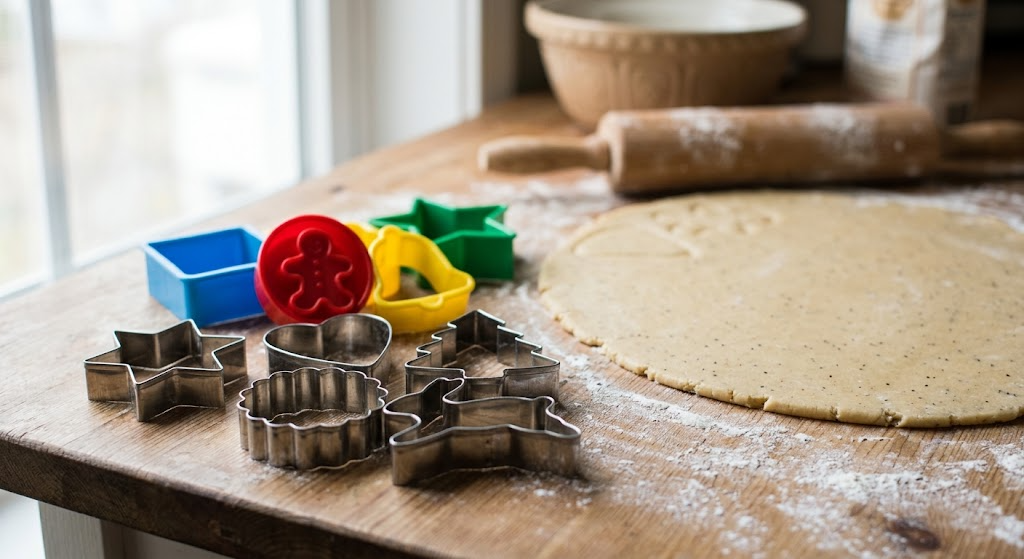
Cookie cutters seem like the simplest tool in the kitchen until you’re standing at the store trying to decide between a cheap plastic set and a pricier metal one, both promising the same star and heart shapes.
Some links in this post are affiliate links. If you buy through them we may earn a small commission at no extra cost to you — it never changes which products we recommend.
What Actually Matters
Clean Edges vs. Dragging Dough
Metal cutters, especially stainless steel with a sharp edge, slice through chilled cookie dough cleanly on the first press. Plastic cutters tend to compress the dough at the edges rather than cutting it, which can leave slightly rounded, less crisp outlines after baking.
Durability Over Time
Plastic cutters can warp if left near heat or under weight in a drawer, changing their shape subtly over time. Metal cutters hold their exact shape indefinitely, which matters if you’re trying to get uniform sizes for stacked or decorated cookies.
Safety for Kids
Plastic cutters with rounded edges are genuinely better for young kids doing their own cutting, since metal edges — while not razor sharp — can still nick fingers with enough pressure. For supervised baking with older kids or adults, metal’s precision wins out.
From My Kitchen
I switched to a metal set after a plastic star cutter I’d had for years started producing lopsided stars — the plastic had warped just enough from being stored under heavier bakeware that I didn’t notice until I lined up a batch of cookies and they were all slightly different sizes.
Worth Considering
The kinice stainless steel mini cookie cutter set comes with a storage box, which solves the classic problem of cutters scattering loose in a drawer. For simple round cutters in graduated sizes, the Bukuwa stainless steel round set is useful well beyond cookies, for biscuits and even portioning dough.
Edge Thickness Is the Whole Story
A metal cutter’s edge is a fraction of a millimetre thick, so it parts chilled dough rather than pushing through it. A plastic cutter needs a thicker wall to survive being pressed on, and that wall compresses the dough as it goes down. On a simple round you will barely notice. On anything with fingers, points or interior detail — a star, a leaf, a gingerbread figure — that compression is exactly what rounds off the shape before the cookie ever reaches the oven.
Metal has a second, quieter advantage: it takes on the temperature of the dough rather than your hand. Cutting cold dough with a cold cutter keeps the butter solid, and solid butter is what holds an edge crisp through baking. Plastic insulates, so it stays at room temperature and warms the dough slightly at every cut — a small effect on the first few cookies and a noticeable one by the end of a long batch.
Quick Comparison
| Metal cutters | Plastic cutters | |
|---|---|---|
| Cut cleanliness | Sharp, minimal dragging | Compresses the edge slightly |
| Fine detail | Holds points and thin shapes | Rounds off detail |
| Durability | Bends but lasts decades | Cracks at stress points over time |
| Safe for small children | Edges can pinch | Yes, the main reason to own them |
| Rust risk | Real if stored damp | None |
| Dishwasher | Hand wash and dry immediately | Usually fine |
Where Plastic Genuinely Wins
Plastic is the right answer more often than baking purists admit. It is the obvious choice when children are doing the cutting, and it is better than metal for fondant, modelling paste and play dough, where the thicker wall releases cleanly instead of the sticky drag you get from thin steel. Deep three-dimensional shapes and plunger-style cutters with an ejector are also almost always plastic, because the mechanism needs the wall thickness to work at all.
There is also nothing to remember about storage. A metal cutter put away with a film of moisture inside it will rust, and rust on a cutter that touches dough means the cutter is finished. If your cutters live in a drawer that occasionally gets damp, or you know they will go away without being dried properly, plastic is the honest choice.
Two Sets Worth Considering
Best for detail: kinice Stainless Steel Mini Cookie Cutter Set
Small shapes are where metal’s thin edge matters most — a mini shape cut with a thick plastic wall loses so much definition that it stops reading as a shape at all. Stainless also removes the rust worry that comes with cheaper tinned cutters.
Pros
- Thin edges hold fine detail cleanly
- Stainless steel, so no rust with reasonable care
- Small shapes suit decorating and gift boxes
Cons
- Edges can pinch small fingers
- Needs drying properly despite being stainless
Best everyday set: Bukuwa Stainless Steel Round Set
Graduated rounds are the most-used cutters in most kitchens — biscuits, scones, dumpling wrappers, layering discs, cutting circles from rolled dough. A nesting set of rounds gets pulled out far more often than any novelty shape, which makes it the sensible thing to own in metal.
Pros
- Graduated sizes cover most everyday jobs
- Nest together, so storage is easy
- Clean cut on scones and biscuits, which matters for rise
Cons
- No decorative shapes at all
- Thin rings can deform if something heavy sits on them
Frequently Asked Questions
Do cookie cutters need to be dishwasher safe?
Metal cutters generally tolerate the dishwasher fine, though hand-washing and drying immediately prevents any water spotting or rust on lower-quality steel. Plastic cutters are almost always dishwasher safe on the top rack.
Does the shape of the cutter affect how evenly cookies bake?
Slightly. Cutters with thin, delicate points — like a star or snowflake — can brown faster at the tips than the thicker center of the cookie, so it’s worth checking those shapes a minute or two before your usual bake time.
Why do my cut-out cookies lose their shape in the oven?
Usually because the butter was too warm when the tray went in. Cut your shapes, then chill them on the tray for fifteen to twenty minutes before baking — solid fat holds its edges while the structure sets, soft fat spreads before the cookie has anything to hold onto. The second culprit is leavening: a dough with baking powder is designed to puff, which is the enemy of a sharp outline. Cut-out recipes that hold detail usually have very little or none.
How do you stop dough sticking inside the cutter?
Dip the cutter in flour between every few cuts, tapping off the excess, and work with dough that is properly chilled rather than room temperature. If you are cutting something intricate, a light dusting of flour on the top surface of the dough helps more than flouring the cutter alone. For fondant or sticky doughs, a very thin wipe of neutral oil inside the cutter works better than flour, which just turns pasty.

Rimi Sultana is a home cook from Bangladesh who has cooked for her family every day for the past five years and writes about it at Smart Cooks. Perpetually testing whether internet-famous recipes actually work in a regular home kitchen. Say hello on Facebook or through the contact page.