Choosing a good cake pan for layer cakes is more about understanding the material and construction than relying on brand reputation or marketing claims. The way heat moves through the pan, how the batter behaves in it, and how easy it is to remove the cake without damage are critical factors that determine the quality of your finished cake.
Some links in this post are affiliate links. If you buy through them we may earn a small commission at no extra cost to you — it never changes which products we recommend.
Not all cake pans are created equal because thickness, metal type, coating, and even shape influence baking time and cake texture. A pan that’s too thin may cause uneven browning or burnt edges, while one that’s too heavy might slow baking or be hard to handle. Understanding these aspects helps in picking a pan that fits your specific baking style and oven.
What actually matters
Many buyers focus on size and price, but the true deciding properties are how the pan conducts heat, how the batter interacts with the surface, and the pan’s durability under repeated use. These factors directly influence the texture, crumb, and appearance of the finished cake, as well as the ease of baking and cleanup.
Heat conduction is critical because it determines how evenly and quickly the cake bakes. Uneven heat can cause the cake edges to overcook while the center remains underdone, leading to an inconsistent texture and difficulty in layering.
The interaction between batter and pan surface affects release and crust formation. A pan that promotes even browning without sticking helps maintain the cake’s shape and appearance, especially important when stacking layers.
Durability is often overlooked but essential for regular bakers. Pans that warp or degrade quickly can cause unpredictable results and increase costs over time.
Material and heat conduction
Cake pans are most commonly made from aluminum or steel, each with its own heat conduction properties. Aluminum pans conduct heat quickly and evenly because aluminum has a thermal conductivity of about 235 W/(m·K), while steel pans conduct heat more slowly, around 50 W/(m·K). This difference means aluminum pans tend to brown the cake edges faster, which can be a downside if not monitored.
Thicker pans spread heat more uniformly but take longer to heat up. Thin pans heat quickly but risk hotspots that brown some areas before others are cooked. Some pans combine a steel base with an aluminum core to balance durability and conduction.
For example, an 8-inch aluminum pan of 1.5 mm thickness typically reaches baking temperature in about 10 minutes and maintains even heat distribution, whereas a similar steel pan may take 15 minutes to heat but retains heat longer once hot, affecting baking times and outcomes.
The thermal mass of the pan also impacts how the batter cooks. Heavier pans absorb more heat, slowing the initial rise but promoting uniform crumb structure. Conversely, lightweight pans can cause quicker rise but risk collapse if the batter sets unevenly.
Surface coating and release
Nonstick coatings reduce the need for greasing and help cakes release cleanly. However, coatings wear down with use, especially if metal utensils or abrasive cleaning methods are used. After approximately 50 to 100 baking cycles, the coating effectiveness may diminish, increasing the risk of sticking.
Uncoated pans, particularly anodized aluminum or stainless steel, require more preparation such as greasing and flouring but last longer and avoid potential health concerns related to some coatings. Anodized aluminum offers a harder surface that resists scratches and corrosion, extending pan life.
Silicone pans, while flexible and nonstick, conduct heat poorly and can produce less crisp edges. Their thermal conductivity is roughly 0.2 W/(m·K), much lower than metals, leading to longer baking times by 10-20%. This can affect moisture retention and crust formation, making them better suited for delicate cakes or storage rather than traditional layered cakes.
Shape and size specifications
Depth affects baking time and cake height—typical layer cake pans are 1.5 to 2 inches (3.8 to 5 cm) deep. Deeper pans require longer baking to cook through without burning the edges. For instance, increasing depth from 1.5 to 2 inches can extend baking time by 10-15%, necessitating careful monitoring.
Diameter must match recipe scaling. Larger pans reduce batter thickness, speeding baking but risking dryness if time is not adjusted. For example, using a 10-inch pan instead of 8-inch reduces batter depth by about 36%, which can shorten baking time by up to 25%.
Graduated pan sets with different diameters allow for tiered cakes but require precise batter distribution and heat management. Uneven batter amounts or inconsistent rotation during baking can cause uneven rise or undercooked centers, especially in deeper pans.
Shape also influences heat distribution. Round pans promote even heat circulation, while square or rectangular pans may have hotter corners, affecting baking uniformity and crust texture.
How to choose the right cake pan for you
If you bake frequently and want consistent results, investing in a good set of aluminum or carbon steel pans with a reliable nonstick coating is sensible. These materials balance heat conduction, durability, and ease of release, making them suitable for most baking needs.
For bakers who prioritize longevity over convenience, uncoated anodized aluminum or stainless steel pans offer excellent durability and can last decades with proper care, though they require more effort in preparation and cleanup.
Silicone pans provide flexibility and storage benefits but come with trade-offs in heat conduction and crust quality. They are best reserved for specific uses such as delicate cakes or when storage space is limited.
Avoid pans that are too thin or cheap, as they warp easily and cause uneven baking. Warping can cause batter to pool, leading to inconsistent texture and difficulty in layering.
If you prefer very tall or tiered cakes, look for deeper pans with graduated diameters. These require longer baking times and careful heat management, including rotating pans during baking to prevent hotspots and ensure even cooking.
Those who dislike greasing pans frequently should prioritize durable nonstick coatings but be prepared to replace the pans after a few years, as coating degradation is inevitable with regular use.
If you rarely bake layer cakes, consider whether disposable parchment-lined pans or silicone molds could suffice, as investing in a high-end set may not be necessary.
| Pick | Best for | Material and size | Watch out for |
|---|---|---|---|
| Fat Daddio’s 8 x 2-Inch Aluminium Cake Pans | Even heat distribution | Aluminium, 2-inch | Not nonstick |
| tutikuki 9-Inch Nonstick Cake Pans (Set of 2) | 9-inch layers | Nonstick, carbon steel, 9-inch | Dark coating can brown edges faster |
| tutikuki 8-Inch Nonstick Cake Pans (Set of 3) | Easy release | Nonstick, carbon steel, 8-inch | Nonstick wears over time |
| TeamFar 7-Inch Stainless Cake Pans (Set of 3) | Small batches | Stainless, stainless steel, 7-inch | Stainless heats less evenly than aluminium |
| Vinino 8-Inch Silicone Cake Pans | Flexibility | Silicone, 8-inch | Floppy, so bake on a sheet tray |
| TeamFar 8 x 3-Inch Deep Cake Pans | Tiered cakes | Stainless steel, 3-inch | Deeper cakes need longer baking |
From my kitchen
Once, while baking a three-layer vanilla cake, I used a thin aluminum pan that was advertised as nonstick but wasn’t. The edges browned much faster than the center, causing the layers to shrink unevenly. To fix this, I switched to a heavier, thicker aluminum pan with a proper nonstick coating and lowered the oven temperature by 15°F (about 8°C). This slowed the cooking enough to allow the heat to penetrate evenly, and the cakes came out flat and soft, making layering simpler.
This experience highlighted how pan thickness and coating quality directly affect baking results. It also emphasized the importance of adjusting oven temperature and baking time based on pan characteristics to avoid overbaking or uneven texture.
Worth Considering
Best for even heat distribution: Fat Daddio’s 8 x 2-Inch Aluminium Cake Pans

Two 8 x 2-inch anodized aluminium pans. Aluminium heats evenly, so cake layers bake flatter with fewer domes and dark edges.
Price when checked: $24.69 · Rating: 4.7 out of 5 (25.7K ratings)
Pros
- Even-heating aluminium
- Set of two
- Very well reviewed
Cons
- Not nonstick
- Needs greasing or parchment
Best for 9-inch layers: tutikuki 9-Inch Nonstick Cake Pans (Set of 2)
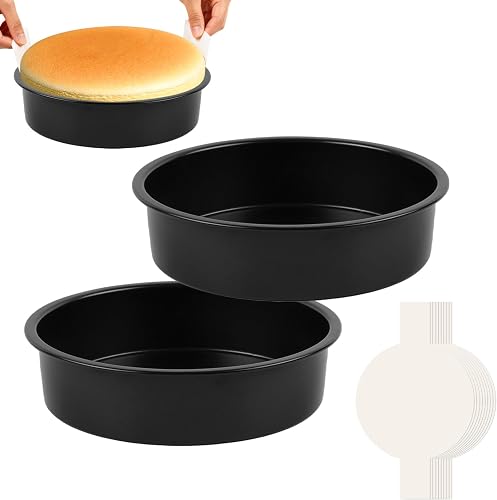
A pair of 9-inch nonstick carbon steel cake pans supplied with parchment rounds.
Price when checked: $21.99 · Rating: 4.8 out of 5 (1K ratings)
Pros
- Nonstick coating
- Parchment included
- Set of two
Cons
- Dark coating can brown edges faster
- Coating needs gentle utensils
Best for easy release: tutikuki 8-Inch Nonstick Cake Pans (Set of 3)

Three 8-inch nonstick carbon steel pans with 100 parchment rounds, aimed at clean release of layer cakes.
Price when checked: $23.99 · Rating: 4.8 out of 5 (1K ratings)
Pros
- Three pans
- 100 parchment rounds
- Nonstick
Cons
- Nonstick wears over time
- Dark finish browns quickly
Best for small batches: TeamFar 7-Inch Stainless Cake Pans (Set of 3)

Three 7-inch stainless steel pans for smaller layer cakes.
Price when checked: $15.80 · Rating: 4.7 out of 5 (57 ratings)
Pros
- Stainless steel
- Set of three
- Compact size
Cons
- Stainless heats less evenly than aluminium
- Needs greasing
Best for flexibility: Vinino 8-Inch Silicone Cake Pans

Two 8-inch silicone cake pans that flex to release the cake.
Price when checked: $11.99 · Rating: 4.6 out of 5 (359 ratings)
Pros
- Flexible release
- Easy to store
- Inexpensive
Cons
- Floppy, so bake on a sheet tray
- Browns less than metal
Best for tiered cakes: TeamFar 8 x 3-Inch Deep Cake Pans
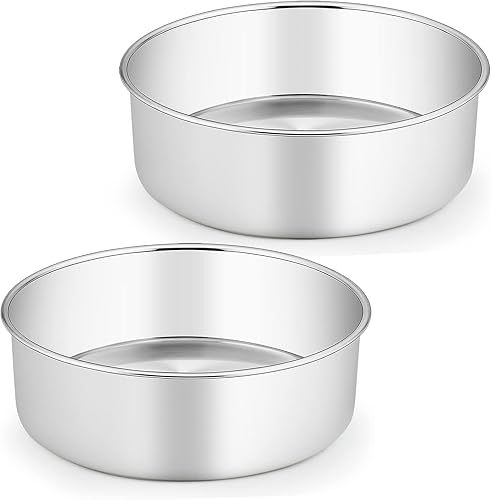
Two 8 x 3-inch stainless steel pans, deep enough for tall layered and tiered celebration cakes.
Price when checked: $18.23 · Rating: 4.7 out of 5 (1.3K ratings)
Pros
- 3-inch depth
- Stainless steel
- Set of two
Cons
- Deeper cakes need longer baking
- Not nonstick
Related reading
- The Best Large Ice Sphere Molds for Whiskey Cocktails (Keep Your Drink Chilled Longer)
- Halloween Cake Molds: Silicone vs. Metal
- Large Sphere vs. Skull Ice Molds for Whiskey Drinks: A Comparison
Frequently Asked Questions
What pan size is best for a 3-layer cake?
A common choice for a 3-layer cake is three pans of the same diameter, usually 8 or 9 inches (20 or 23 cm), with a depth of 1.5 to 2 inches (3.8 to 5 cm). This size balances ease of handling and baking time, producing layers of about 1 to 1.5 inches (2.5 to 3.8 cm) thick each after baking.
Can I use silicone pans for traditional layer cakes?
Silicone pans are flexible and nonstick, but they conduct heat poorly compared to metal pans. This can lead to longer baking times and softer edges, which might result in a less structured cake. They are better suited for delicate cakes or save space but are not ideal if you want a classic browned crust and firm layer.
How important is pan thickness for baking layer cakes?
Pan thickness affects heat distribution and retention. Thicker pans heat more slowly but distribute heat evenly, reducing hotspots that cause burnt edges and undercooked centres. Thin pans heat quickly but risk uneven baking and warping. For layer cakes, a medium-thickness pan (about 1.2 to 1.5 mm) is often best to balance these factors.

Rimi Sultana is a home cook from Bangladesh who has cooked for her family every day for the past five years and writes about it at Smart Cooks. Perpetually testing whether internet-famous recipes actually work in a regular home kitchen. Say hello on Facebook or through the contact page.