Skewers and grill baskets often appear interchangeable for grilling vegetables, meat, or seafood, but they differ significantly in how they hold food and transfer heat. Choosing between them affects cooking control, flavour development, and ease of handling.
Some links in this post are affiliate links. If you buy through them we may earn a small commission at no extra cost to you — it never changes which products we recommend.
The core difference lies in their construction and interaction with the heat source, which influences what kind of food you can grill effectively, how evenly it cooks, and how much flipping or repositioning is needed.
How construction and heat transfer drive their different uses
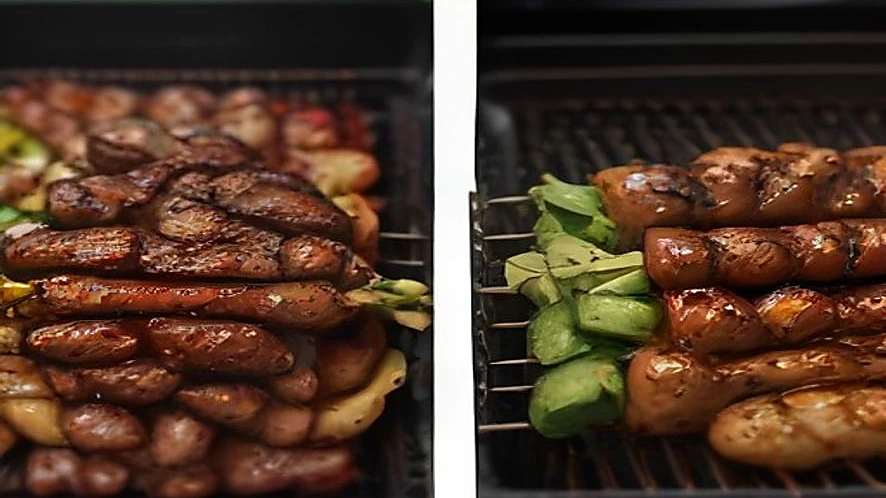
The design of skewers and grill baskets fundamentally shapes their grilling performance. Skewers are typically thin metal rods or bamboo sticks that pierce through food pieces, exposing most of the surface area directly to flames and radiant heat. This direct exposure enables rapid Maillard reactions, creating the characteristic seared crust and smoky flavour. The thin metal also conducts heat internally, gently cooking the interior edges of meats near the skewer shaft. This dual heat transfer mechanism—direct flame and conduction—helps achieve evenly cooked kebabs with crisp exteriors and juicy interiors.
In contrast, grill baskets are metal mesh or slotted containers that hold food loosely or tightly enclosed. Their walls partially shield food from direct flames, so heat transfer relies more on conduction through the basket metal and radiant heat passing through openings. This reduces flare-ups from dripping fat but also limits charring and the intense searing effect. The basket’s enclosed design traps some moisture, which can lead to steaming rather than crisping, affecting texture and flavour development. However, this containment is ideal for small, delicate, or irregularly shaped items that would otherwise fall through grill grates.
Where each one wins
Skewers excel when you want precise control over each piece of food. Threading uniform cubes of meat or vegetables allows for even exposure to heat all around. You can turn or reposition each skewer individually, which helps when cooking mixed items with different doneness times. The thin metal conducts heat slightly, helping cook the interior edges of meat close to the skewer shaft. This makes skewers ideal for classic kebabs, seafood, or firm vegetables cut into chunks.
For example, when grilling chicken kebabs, skewers enable you to rotate each piece to develop a consistent golden crust while avoiding overcooking. The ability to adjust each skewer independently means you can remove pieces at different times, catering to varying thicknesses or ingredient types.
Grill baskets are advantageous when cooking small, chopped, or delicate foods that would otherwise fall between grill grates or require constant attention. The basket keeps everything contained, so you can toss or flip the entire batch without losing pieces. They work well for chopped peppers, mushrooms, small shrimp, or even chopped potatoes. The basket’s metal heats evenly, reducing flare-ups caused by fat dripping directly on coals or flames. However, the basket blocks some direct flame contact, so you get less charring than with skewers.
In practice, using a grill basket for chopped potatoes can prevent pieces from falling through grates and allows for easy agitation to promote even browning. However, expect a slightly longer cooking time—often 10-15% more—due to less direct flame exposure and the steaming effect inside the basket. This trade-off is acceptable when convenience and containment outweigh the desire for intense sear marks.
| Attribute | Skewers | Grill basket |
|---|---|---|
| Material and form | Thin metal rods (usually stainless steel) or bamboo sticks piercing food | Metal mesh or slotted containers enclosing food loosely or tightly |
| Heat exposure | Food surface mostly exposed directly to flames and radiant heat except where pierced | Food partially shielded by basket walls, heat conducted through basket metal and radiant heat through openings |
| Handling during cooking | Flip individual pieces or rotate skewer for even cooking | Flip or shake entire basket, cannot rotate individual items |
| Food types suited | Uniform pieces that can be pierced (e.g., kebabs, shrimp, vegetables) | Small, loose, or irregular items that might fall through grates (e.g., chopped veggies, seafood, small cuts) |
| Cleaning and maintenance | Metal skewers generally dishwasher safe; bamboo disposable or soak and scrub | Usually metal, may have nonstick coating; requires thorough cleaning to avoid food sticking in mesh |
| Storage and portability | Very compact and lightweight, easy to store | Bulkier, takes more storage space, heavier |
From My Kitchen
Once I tried grilling a mix of chopped vegetables on skewers but found that smaller pieces kept slipping off during flipping. I switched to a grill basket I had on hand, which held everything securely. However, the vegetables steamed a bit inside the basket, losing some char and smoky flavour I usually get with skewers. To fix this, I preheated the basket on the grill to get the metal really hot, which improved searing. Still, the texture was different — softer and less crisp than when I use skewers for chunkier pieces. This showed me that while grill baskets are easier for loose foods, they change the cooking dynamics, and sometimes a skewer is worth the extra handling.
In another instance, I measured the internal temperature of chicken pieces grilled on skewers versus in a basket. Skewered pieces reached the safe cooking temperature of 165°F (74°C) about 5 minutes faster, demonstrating the efficiency of direct flame contact and conduction. The basket-cooked pieces required longer grilling time, which is important to consider for food safety and timing.
These experiences highlight that while grill baskets offer convenience and containment, skewers provide superior control and flavour development when grilling uniform chunks. Choosing the right tool depends on your food type, desired texture, and cooking style.
Worth Considering
Best for secure kabobs without skewers: Norpro 8660 Nonstick Grilling Kabob Baskets

This basket is designed to hold kabob ingredients without skewering, ideal for those who want to avoid piercing food or fiddling with skewers. Its nonstick coated heavy carbon steel and latchable lid make flipping and even cooking easier. Not the best if you want strong char marks or need to cook large, uniform chunks.
Brand: 4.6 4.6 out of 5 stars · Price when checked: $29.95 · Rating: 4.6 out of 5 (95 ratings)
Pros
- Nonstick surface simplifies cleaning and flipping
- Lid locks to secure food inside
- Heavy carbon steel conducts heat evenly
Cons
- Blocks some direct flame contact, reducing sear
- Bulkier and less portable than skewers
Best for traditional skewer grilling: Ivtivfu Grill Basket Set

Though named a grill basket set, this product includes skewers that provide direct flame exposure and flexible handling. Suitable for grilling uniform chunks of meat or vegetables where control over individual pieces is needed. Not ideal for very small or loose items that might fall off skewers.
Brand: Ivtivfu · Price when checked: $31.99 · Rating: 4.7 out of 5 (168 ratings)
Pros
- Allows precise control over each food piece
- Thin metal rods heat the food from inside edges
- Compact and easy to store
Cons
- Requires threading of food pieces, which can be time-consuming
- Smaller pieces may slip off without careful threading
When neither skewers nor grill baskets are the right tool
For grilling whole cuts like steaks, fish fillets, or large vegetables, neither skewers nor grill baskets serve well. Skewers require piercing and work best with small chunks, while baskets can restrict airflow and reduce the searing effect needed for a good crust on large cuts. Instead, use a flat grill pan or place food directly on clean grates for optimal heat contact and moisture evaporation.
If you want precision temperature control and repeatable results on delicate items, sous vide followed by quick grilling might be preferable, as discussed in our Sous Vide vs. Air Fryer feature. This avoids the compromises of either skewers or baskets on tricky ingredients.
For very small bits like chopped herbs or finely diced vegetables that risk falling through any grate, consider grilling in a cast iron skillet or on a flat griddle plate designed for the grill, which offers direct heat without loss.
Related reading
- The BEST Jack O’ Lantern Stuffed Peppers (Easy Halloween Recipe!)
- Grill pan vs electric grill: understanding the real differences
- Air fryer vs convection oven: understanding real differences
Frequently Asked Questions
Can I reuse bamboo skewers for grilling?
Bamboo skewers are generally intended for single use. They tend to char and weaken when exposed to high grilling temperatures of 400–500°F (204–260°C), and soaking before use helps prevent burning but does not make them reusable. Reusing risks splinters and diminished structural integrity. For repeated use, switch to stainless steel skewers designed to handle repeated heating cycles.
Does using a grill basket affect cooking time?
Yes, grill baskets can slightly increase cooking time compared to skewers or direct grilling. The metal mesh and enclosed design reduce direct flame exposure, which slows the Maillard reaction responsible for browning and searing. Heat primarily transfers via conduction through the basket and radiant heat passing through holes. This gentler environment can require a few extra minutes to achieve the same level of caramelisation.
How do I prevent food from sticking to a grill basket?
Preventing sticking starts with proper cleaning and prepping. Use a grill basket with a nonstick coating or made of stainless steel, and clean it thoroughly after each use to avoid residue buildup. Before adding food, coat the basket lightly with a high smoke point oil such as grapeseed or avocado oil. Preheating the basket on the grill also helps create a natural nonstick surface. Avoid overcrowding to ensure even heat distribution and easier flipping.

Rimi Sultana is a home cook from Bangladesh who has cooked for her family every day for the past five years and writes about it at Smart Cooks. Perpetually testing whether internet-famous recipes actually work in a regular home kitchen. Say hello on Facebook or through the contact page.