A good stock pot for bone broth is defined less by flashy features and more by how well it manages long, slow simmering without burning or losing too much liquid. The pot’s material and base construction determine heat distribution, which affects how steadily the broth cooks over several hours.
Some links in this post are affiliate links. If you buy through them we may earn a small commission at no extra cost to you — it never changes which products we recommend.
Capacity is also critical: bone broth often requires large volumes to cover bones and extract flavour fully, so a pot that is too small forces multiple batches or compromises the simmering process. Handle design and lid fit matter as well, as they influence ease of use and moisture retention during extended cooking.
What actually matters
Choosing the right stock pot for bone broth hinges on understanding three core technical factors: heat conduction, capacity, and durability. These determine how evenly the pot heats, how much broth it can hold, and how long it lasts under slow cooking conditions.
Heat conduction is critical because bone broth requires hours of simmering at low temperatures, typically between 180°F and 205°F (82°C to 96°C). Uneven heat can cause localized boiling or scorching, which not only ruins the flavor but also makes cleaning difficult. A pot with poor heat conduction may develop hot spots where the proteins and gelatin in the broth coagulate and stick, resulting in burnt residues and a bitter taste.
Capacity affects not just how much broth you can make at once but also the efficiency of extraction. For example, a 5-quart (4.7 litre) pot can generally accommodate enough bones and water for a small batch, but larger pots of 10 to 20 quarts (9.5 to 19 litres) allow for batch cooking that can reduce overall cooking time per volume and improve flavor concentration. However, larger pots require a compatible burner size to ensure even heat distribution across the base.
Durability is essential because bone broth cooking involves prolonged exposure to moisture and heat, which can degrade inferior materials. Stainless steel grades like 18/8 or 18/10 are preferred as they resist corrosion and do not react with acidic ingredients such as vinegar or wine often added to the broth. Nonstick coatings, while helpful for cleanup, tend to deteriorate after long simmering sessions and may release unwanted particles into the broth.
The pot’s shape also influences the cooking process. Tall, narrow pots reduce evaporation but may concentrate heat at the bottom, increasing the risk of scorching if the base is not sufficiently thick or conductive. Conversely, wide pots increase surface area, which can accelerate evaporation and reduce the simmering volume if not monitored carefully. The ideal pot balances depth and diameter to maintain moisture while allowing easy stirring and heat distribution.
Handle and lid design also contribute to cooking performance. Handles should be securely riveted or welded to withstand repeated handling of heavy pots filled with broth. Heat-resistant or stay-cool handles improve safety during long cooking times. Lids that fit tightly help retain moisture and heat, reducing evaporation and maintaining a consistent simmering temperature. Glass lids offer the advantage of monitoring without lifting, which prevents heat loss and evaporation spikes.
In terms of numbers, simmering bone broth typically requires 12 to 24 hours of cooking to fully extract gelatin and nutrients from bones. During this time, a pot with excellent heat conduction and a well-sealed lid can reduce liquid loss to less than 10%, preserving volume and flavor. Poorly designed pots may lose 20-30% or more through evaporation, requiring additional water to be added and diluting the broth.
Choosing a pot with an encapsulated or tri-ply base is highly recommended. For instance, a tri-ply base usually consists of an aluminum core sandwiched between two layers of stainless steel. Aluminum’s thermal conductivity is approximately 237 W/m·K, vastly superior to stainless steel’s 16 W/m·K, enabling rapid and even heat distribution. This technology minimizes hot spots and allows for precise temperature control, critical for the delicate simmering process.
In summary, the ideal stock pot for bone broth combines sufficient capacity (minimum 5 quarts), a thick multi-ply base for even heat conduction, durable stainless steel construction resistant to corrosion and acid, and practical features such as secure handles and tight-fitting lids. These factors ensure a consistent simmer, preserve flavor and nutrients, and provide ease of use and longevity.
Heat conduction and base construction
Good heat conduction prevents hot spots that burn broth proteins onto the base, which can cause unpleasant flavours and difficult cleaning. Manufacturers often use a multi-ply base combining stainless steel with an aluminium or copper core. Aluminium is especially effective because it distributes heat quickly and evenly across the pot’s surface, unlike stainless steel alone, which is slower and less uniform.
An encapsulated or tri-ply base sandwiches aluminium between layers of stainless steel, allowing efficient heat transfer while maintaining corrosion resistance and non-reactivity with acidic ingredients.
To quantify, aluminium’s thermal conductivity is roughly 15 times greater than that of stainless steel, which means heat spreads more uniformly across the base, reducing the risk of localized overheating. This is especially important for bone broth simmering, which requires maintaining a low and steady temperature over many hours.
Copper cores offer even better conductivity than aluminium but are less common due to cost and maintenance considerations. Some high-end pots incorporate copper layers to achieve rapid temperature adjustments, which can be beneficial when transitioning between simmering and boiling phases.
The thickness of the base also matters; a thicker base stores and distributes heat more evenly, preventing temperature fluctuations that can cause scorching or uneven cooking. For example, a 5 mm thick tri-ply base will perform significantly better than a thinner single-layer base.
Capacity and shape
Bone broth benefits from pots holding at least 5 quarts (4.7 litres) to accommodate bones, water, and aromatics without crowding. Larger pots, like 19 quarts (18 litres), allow batch cooking, which is more efficient but requires a sufficiently large burner for even heat.
The pot’s depth and diameter affect evaporation rates and stirring ease. Tall pots reduce evaporation but can concentrate heat at the bottom if the base is narrow. Wide pots increase surface area but lose moisture faster.
Evaporation is a critical consideration because prolonged simmering can reduce broth volume by up to 20-30% in pots with poor lid fit or excessive surface area. This not only wastes ingredients but also dilutes flavor if additional water is added to compensate.
For example, a 5-quart pot with a diameter of 10 inches and a height of 8 inches will retain liquid better than a wider, shallower pot of the same volume, assuming the lid fits tightly. The narrower surface area reduces evaporation, while the height allows for better heat distribution and easier stirring.
Batch size also impacts cooking efficiency. Larger pots allow simultaneous cooking of multiple batches, saving time and energy. However, they require larger burners to ensure even heating; otherwise, cold spots can develop, leading to uneven gelatin extraction and flavor.
In practical terms, a 19-quart pot is ideal for home cooks who prepare bone broth weekly or in large quantities for freezing. Smaller pots suit occasional or small-scale cooking but may necessitate multiple batches, increasing total cooking time and energy consumption.
Durability and materials
Stainless steel of grade 18/8 or 18/10 resists corrosion and does not react with broth ingredients, ensuring flavour purity. Nonstick coatings can prevent sticking but often degrade after long simmering and high heat.
Handles should be securely riveted or welded to withstand heavy use without loosening. Lids that fit tightly help contain moisture and heat, critical for slow-simmering broth.
The durability of the pot also influences long-term cost-effectiveness. High-quality stainless steel pots can last for decades with proper care, while cheaper alternatives may warp, corrode, or lose coatings within a few years.
Repeated exposure to acidic ingredients like vinegar or wine, which are commonly added to bone broth to aid gelatin extraction, can cause inferior metals to leach flavors or discolor. Stainless steel grades 18/8 or 18/10 contain chromium and nickel, which form a passive oxide layer preventing corrosion and maintaining flavor neutrality.
Nonstick coatings, while convenient, typically have a lifespan of 3-5 years under heavy use. For bone broth simmering, which involves long cooking times at moderate heat, these coatings may degrade faster, releasing particles or losing their nonstick properties. This can affect broth quality and pot longevity.
Handle attachment methods also affect durability and safety. Riveted handles are generally more secure and less likely to loosen compared to welded or glued handles. Additionally, handles made from heat-resistant materials or designed with stay-cool technology improve user comfort and reduce burn risks during extended cooking.
Lids constructed from tempered glass with stainless steel rims offer a balance between durability and functionality, allowing cooks to monitor simmering without lifting the lid and losing heat or moisture.
| Pick | Best for | Capacity (quarts/litres) | Watch out for |
|---|---|---|---|
| Kirecoo 5 Quart Stainless Steel | Small batch simmering | 5 qt / 4.7 L | Lid handle can get hot, only mid-size capacity |
| MICHELANGELO 5 Quart Nonstick | Easy cleanup, nonstick surface | 5 qt / 4.7 L | Nonstick may degrade with long simmering |
| NutriChef 19-Quart Stainless Steel | Large batch simmering | 19 qt / 18 L | Heavy and bulky, requires large burner |
| P&P CHEF 5 Quart Tri-Ply Stainless Steel | Even heat distribution in small pots | 5 qt / 4.7 L | Smaller capacity, no nonstick coating |
| NutriChef 5-Quart Stainless Steel | Durable mid-size pot | 5 qt / 4.7 L | Heavier than average small pot |
From My Kitchen
Once, while simmering a large batch of bone broth in a mid-size pot, I noticed the broth was sticking and scorching slightly on the bottom despite low heat. The pot’s base was thin and conducted heat unevenly, causing hotspots. Switching to a tri-ply pot with an encapsulated aluminium core resolved this issue by distributing the heat more evenly, allowing a steady gentle simmer without burning. The difference was noticeable in both cooking ease and broth clarity.
Worth Considering
Best for small batch simmering: Kirecoo 5 Quart Stainless Steel
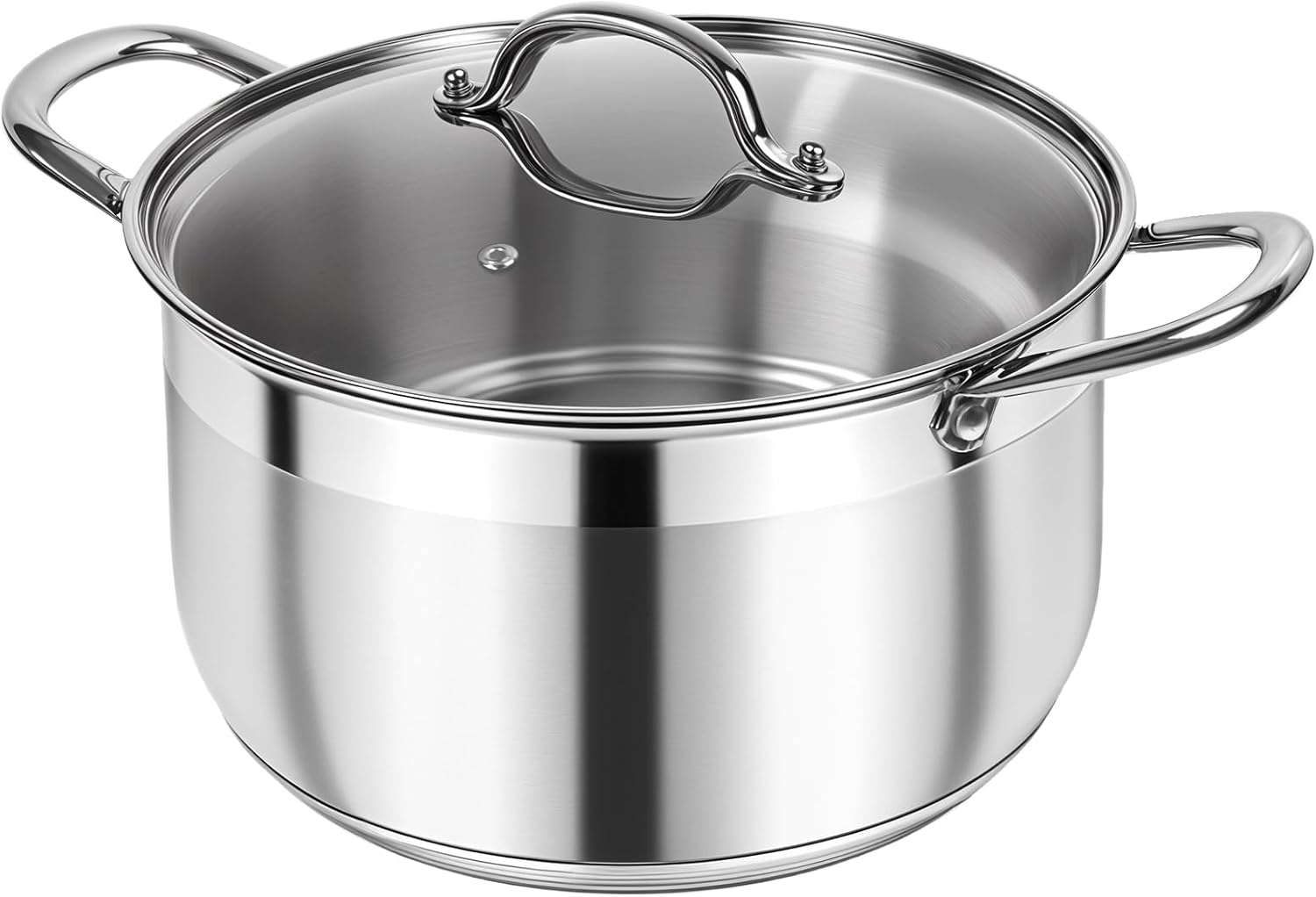
This pot suits home cooks who make modest bone broth batches and want an affordable, reliable stainless steel option. The visible lid helps monitor simmering without lifting, but the lid handle can become hot during long cooking.
Brand: Kirecoo · Price when checked: $26.99 · Rating: 4.5 out of 5 (572 ratings)
Pros
- Visible glass lid for monitoring
- Durable stainless steel construction
- Reasonably priced
Cons
- Lid handle lacks heat insulation
- Limited to 5-quart capacity
Best for easy cleanup: MICHELANGELO 5 Quart Nonstick Granite Pot

If you prioritise cleaning ease after hours of simmering, this nonstick pot reduces sticking residue. However, nonstick coatings can deteriorate with long, high-heat simmering essential for bone broth, so it’s best for occasional or shorter batches.
Brand: MICHELANGELO · Price when checked: $34.98 · Rating: 4.5 out of 5 (1673 ratings)
Pros
- Nonstick surface reduces scrubbing
- Stay-cool handles improve safety
- Induction compatible
Cons
- Nonstick wears faster with extended simmering
- Smaller capacity restricts large batch cooking
Best for large batch simmering: NutriChef 19-Quart Stainless Steel
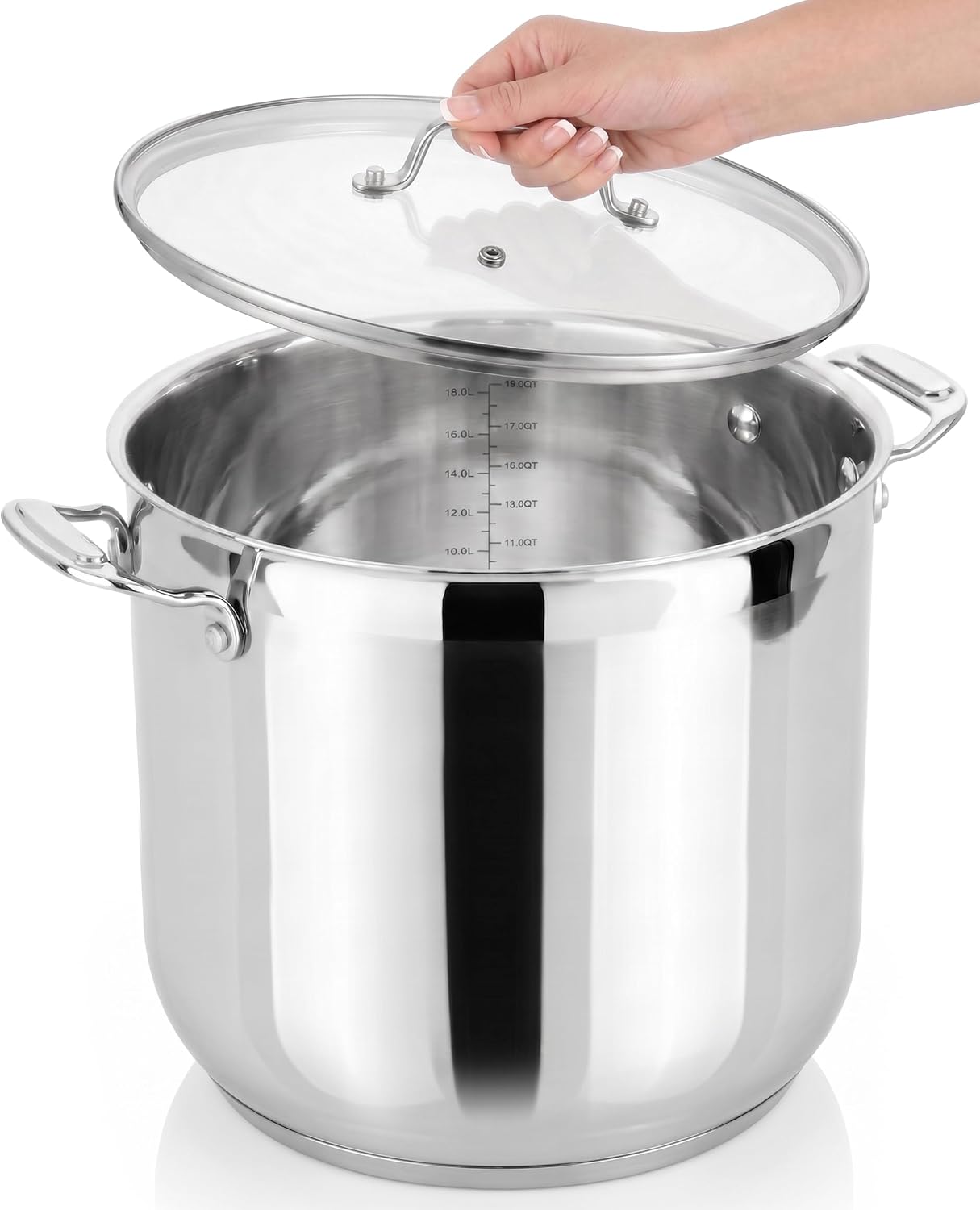
This heavy-duty 19-quart pot is ideal for cooks who make large volumes of bone broth at once. Its thick 18/8 stainless steel and encapsulated base ensure steady heat without hotspots, but it is heavy and requires a sufficiently large burner to heat evenly.
Brand: NutriChef · Price when checked: $71.99 · Rating: 4.7 out of 5 (572 ratings)
Pros
- Large capacity for batch cooking
- 18/8 stainless steel with encapsulated base
- Dishwasher safe for easier cleaning
Cons
- Bulky and heavy to handle
- Not ideal for small kitchens or burners
Best for even heat in small pots: P&P CHEF 5 Quart Tri-Ply Stainless Steel

This tri-ply stainless steel pot prioritises even heat distribution, reducing the risk of scorching during simmering. Its smaller size limits batch volume, making it a niche choice for cooks with limited storage or those who simmer smaller amounts.
Brand: P&P CHEF · Price when checked: $26.99 · Rating: 4.5 out of 5 (253 ratings)
Pros
- Tri-ply base for even heating
- Sturdy riveted handles
- Fits induction cooktops
Cons
- Limited to small batch size
- No nonstick surface for easy cleanup
Best durable mid-size pot: NutriChef 5-Quart Stainless Steel

This 5-quart stainless steel pot balances durability and size for bone broth simmering. It handles the slow cooking process well but is heavier than some small pots, which might affect manoeuvrability for some users.
Brand: NutriChef · Price when checked: $48.99 · Rating: 4.7 out of 5 (669 ratings)
Pros
- Heavy-duty 18/8 stainless steel
- Compatible with induction cooktops
- Includes a fitted lid
Cons
- Heavier than average 5-quart pots
- Not suitable for large batch broth
How to choose the right stock pot for bone broth
Your choice depends largely on batch size and stove type. If you simmer broth infrequently or in small amounts, a 5-quart stainless steel pot with good heat conduction suffices. For daily or large-batch cooking, a 19-quart heavy-duty pot with a thick encapsulated base is preferable.
Induction stove users must confirm compatibility, typically ensured by stainless steel construction and magnetic bases. Nonstick pots offer easier cleaning but can degrade under extended simmering and may not be the best choice for pure bone broth cooking.
Avoid pots with narrow bases relative to height, as they concentrate heat and risk burning the broth. Prioritise pots with well-fitted lids to minimise evaporation and maintain simmering temperatures between about 180°F and 205°F (82°C to 96°C).
Related reading
- Best Portable Induction Cooktops with Precise Temperature Control
- How to choose the best 2 burner gas cooktop for your kitchen
- Portable induction cooktop vs electric hot plate: how they differ and which to choose
Frequently Asked Questions
What size stock pot is ideal for making bone broth?
A pot of at least 5 quarts (4.7 litres) is generally recommended to hold enough water and bones without crowding. For larger batches, pots of 10 to 20 quarts (9.5 to 19 litres) are better but require compatible stove burners and more storage space.
Why is an encapsulated base important for stock pots used in bone broth?
An encapsulated base sandwiches a conductive metal like aluminium or copper between stainless steel layers. This design improves heat distribution, reducing hotspots that cause burning during the long, slow simmering needed for gelatin extraction from bones.
Can I use nonstick stock pots for bone broth simmering?
While nonstick pots make cleaning easier, their coatings often degrade with prolonged simmering at moderate to high temperatures. This can lead to flaking or loss of nonstick properties, making stainless steel pots a more durable and flavour-neutral choice for bone broth.
Related: Top 7 saucepans for small sauces: precise control in compact pots
Related: Top 8 bundt pans for show cakes with detailed shape and heat control

Rimi Sultana is a home cook from Bangladesh who has cooked for her family every day for the past five years and writes about it at Smart Cooks. Perpetually testing whether internet-famous recipes actually work in a regular home kitchen. Say hello on Facebook or through the contact page.