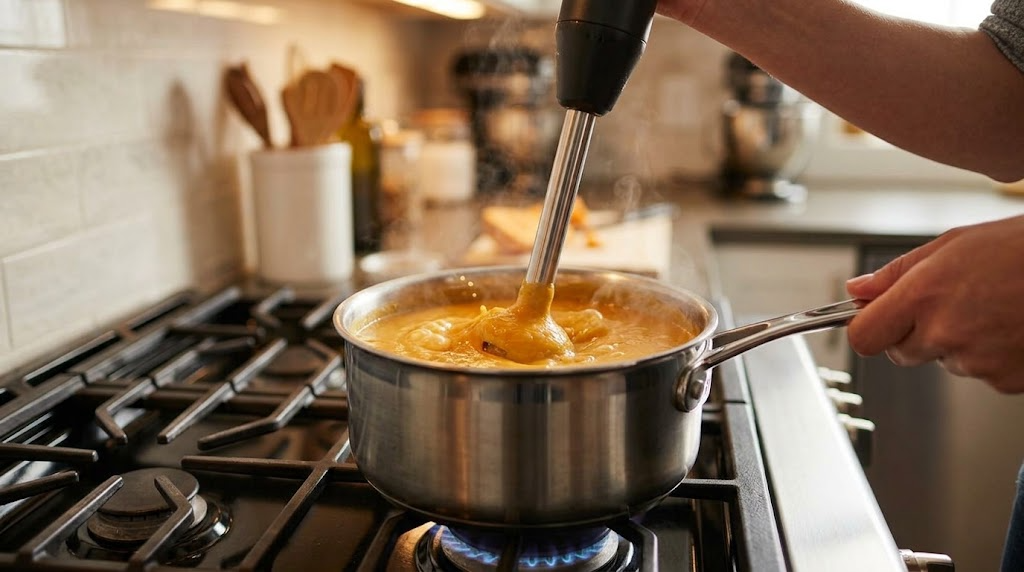
An immersion blender’s main advantage over a countertop blender is blending directly in the pot — no transferring hot liquid, no multiple dishes to wash. But not all immersion blenders handle thick sauces equally well, and the differences show up fast once you’re working with something denser than soup.
Some links in this post are affiliate links. If you buy through them we may earn a small commission at no extra cost to you — it never changes which products we recommend.
What Actually Matters
Wattage and Motor Strength
Thin soups blend easily with almost any immersion blender, but thicker sauces — a reduced tomato sauce, a béchamel, a puréed vegetable sauce — need real motor power to blend smoothly without straining or stalling. Look for something in the 200-watt-plus range if thick sauces are a regular part of your cooking.
Blade Guard Design
A well-designed blade guard prevents splashing while still allowing the blade to properly pull thick liquid through it. Poorly designed guards can actually trap thick sauce around the blade instead of circulating it, leaving unblended pockets.
Variable Speed Control
Sauces often benefit from starting slow to avoid splattering hot liquid, then increasing speed to fully smooth out the texture. A single-speed blender forces a compromise between control and thoroughness.
From My Kitchen: The Splatter I Didn’t See Coming
The first time I used an immersion blender in a hot tomato sauce, I ran it at full speed from the start, and hot sauce splattered up the side of the pot and onto the stovetop before I could react. I’ve since learned to start at the lowest speed setting, keep the blade fully submerged before turning it on at all, and only increase speed once the initial splash risk has passed. It’s a small habit, but it made a real difference — thick, hot sauces are exactly the situation where an immersion blender’s convenience can backfire if you’re not deliberate about how you use it.
Worth Considering
Braun’s MultiQuick 7 immersion blender has enough motor power for thick sauces without straining.
Waring’s 2-speed immersion blender is a solid, more budget-friendly option that still offers useful speed control.
Blade Geometry Beats Wattage
Wattage is the number on the box, and it is a poor guide to how well an immersion blender purees. What actually matters is the shape of the bell around the blade. A well-designed bell has vents or a shaped skirt that lets liquid circulate through and out, which keeps a vortex going and pulls unblended sauce down into the blade. A flat, unvented bell suctions itself to the bottom of the pan, the sauce stops moving, and you end up lifting and dropping the blender repeatedly to get anything done.
The second thing worth having is genuine speed control rather than two fixed speeds. Starting slow keeps hot sauce in the pan instead of on the wall, and finishing fast is what actually emulsifies. A blender with a single speed forces you to choose between splattering and under-blending.
Quick Comparison
| Immersion blender | Countertop blender | |
|---|---|---|
| Blending hot sauce in the pan | Yes, directly | No — must be transferred and vented |
| Ultimate smoothness | Very good | Better, especially with fibrous ingredients |
| Small quantities | Excellent | Poor, blades do not reach |
| Cleaning | Rinse the shaft | Full jug to wash |
| Emulsifying mayonnaise | Excellent in a narrow jar | Needs a larger batch |
Technique That Prevents the Usual Problems
Keep the head fully submerged before you switch on, and keep it submerged while it runs — lifting the blade to the surface is what sprays sauce across the kitchen and also whips air into a sauce that should be dense. Tilt the blender slightly every few seconds to release trapped air from under the bell, then move it slowly around the pan rather than stirring vigorously, which does not help. And respect the duty cycle: most home immersion blenders are not designed to run for more than about a minute continuously, and overheating the motor is the most common way they die.
For a genuinely silky sauce, accept that the blender is only the first stage. Fibrous ingredients — tomato skins, pepper skins, celery threads, fibrous herbs — will not break down completely no matter how long you blend. Passing the blended sauce through a fine mesh strainer takes a minute and does more for the final texture than any equipment upgrade.
Two Blenders Worth Considering
Best overall: Braun MultiQuick 7 Immersion Blender
A well-designed bell and genuinely variable speed, which is the combination that avoids both suction-lock and splatter. Powerful enough to handle a pan of soup without straining the motor, and it comes apart easily for cleaning.
Pros
- Bell design keeps the sauce circulating
- Variable speed from very slow to fast
- Comfortable to hold for longer blending
Cons
- More expensive than basic models
- Attachments add storage bulk
Best simple option: Waring 2-Speed Immersion Blender
A straightforward, solidly built blender for someone who wants to puree soups and sauces without extra attachments. Two speeds is fewer than ideal, but the low speed is slow enough to start safely in a hot pan.
Pros
- Solid build for regular use
- Low speed is genuinely slow, so less splatter
- Simple, few parts to clean or lose
Cons
- Only two speeds
- Fewer attachments than premium sets
Frequently Asked Questions
Can an immersion blender fully replace a countertop blender for sauces?
For most sauces, yes, especially anything you’re already cooking in a pot. Countertop blenders still have an edge for extremely silky, restaurant-smooth purées, since their fixed blade housing creates more consistent circulation.
Is it safe to use an immersion blender in a hot pot on the stove?
Yes, as long as you keep the blade fully submerged before starting and use a low speed initially to avoid splattering — most are designed specifically for use directly in a hot pot.
Why does my immersion blender leave lumps in thick sauce?
This is usually a sign the motor is underpowered for the thickness, or that you’re not moving the blender enough through the pot to reach every pocket of the sauce. Moving it slowly in a figure-eight pattern usually helps.
Why is my sauce still not silky after blending?
Because blending cannot break down fibre and skins past a certain point — it chops them finer, but they stay as particles you feel on the tongue. The fix is mechanical: push the sauce through a fine mesh strainer with the back of a ladle. For tomato and pepper sauces specifically, removing the skins before cooking makes far more difference than any amount of extra blending, since that is where almost all of the texture problem comes from.
Can I use an immersion blender directly in a hot pan?
Yes, provided the shaft is stainless steel rather than plastic, and provided you take the pan off the heat first. Blending over a live flame risks scorching the sauce where it stops circulating, and a plastic shaft sitting against a hot pan base can soften. Also check the pan itself: metal blades in a nonstick pan will scratch the coating, so transfer the sauce to a jug or a stainless pan before blending.

Rimi Sultana is a home cook from Bangladesh who has cooked for her family every day for the past five years and writes about it at Smart Cooks. Perpetually testing whether internet-famous recipes actually work in a regular home kitchen. Say hello on Facebook or through the contact page.