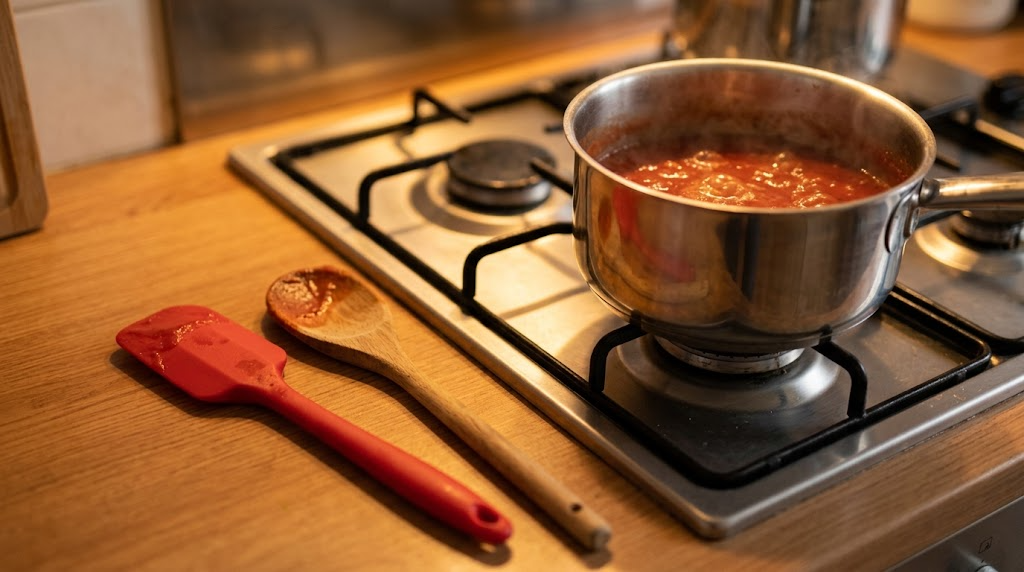
Recipes often just say ‘stir’ without specifying a tool, but for sauces specifically, the choice between a silicone spatula and a wooden spoon actually changes how well you can manage the pan, not just personal preference.
Some links in this post are affiliate links. If you buy through them we may earn a small commission at no extra cost to you — it never changes which products we recommend.
What Actually Matters
Scraping the Pan Bottom
A flexible silicone spatula’s flat edge hugs the curve of a pan bottom and corners far better than a rounded wooden spoon, which matters for sauces that reduce and can scorch on the bottom if not scraped continuously and thoroughly.
Heat Resistance Ceiling
Quality silicone spatulas are rated up to around 600°F, well above any stovetop sauce temperature, so heat isn’t actually a limiting factor for either tool at normal sauce-making temperatures — this is a smaller differentiator than marketing suggests.
Absorption and Odor Retention
Wooden spoons are porous and can absorb odors and pigments from strongly flavored or colored sauces (curry, tomato) over repeated use, while silicone doesn’t absorb liquid the same way and cleans up without retaining stains or smells.
From My Kitchen
I used a wooden spoon for a long-simmered tomato sauce for years and eventually noticed it had taken on a permanent faint orange tint and a slight tomato smell even after washing. Switching to silicone for sauce work specifically solved that, and the flat edge genuinely does a better job scraping the very bottom of a curved saucepan where a rounded spoon just glides over instead of scraping.
Worth Considering
For everyday sauce work, a set like the HOTEC Silicone Rubber Spatula Set covers different sizes for different pan depths. The U-Taste Silicone Spatula Set is another solid, heat-resistant option if you want a few extra pieces on hand.
Heat, Reactivity and What Each One Does to a Sauce
Most food-grade silicone spatulas are rated to somewhere between 400 and 500°F, which is well above anything a sauce will reach in a home pan. Silicone is also non-porous, so a spatula that stirred a garlic-heavy tomato sauce on Monday will not carry that flavour into a béchamel on Tuesday. Wood is the opposite on both counts: it is porous enough to absorb oils and aromatics over time, and while it will not melt, it will scorch and eventually crack if you leave it resting against a hot pan edge.
Where wood genuinely wins is stiffness. A wooden spoon has an unyielding edge that scrapes fond — the browned residue stuck to the bottom of the pan — in a way a flexible silicone head simply cannot. If your sauce starts with searing meat or deeply browning onions, that fond is most of the flavour, and prying it up takes rigidity. Silicone flexes away from the pan bottom instead of biting into it.
Quick Comparison
| Silicone spatula | Wooden spoon | |
|---|---|---|
| Heat tolerance | Typically 400–500°F | Will not melt, but scorches and cracks |
| Safe on nonstick | Yes, will not scratch | Yes, though a chipped edge can gouge |
| Scraping fond | Poor — too flexible | Excellent — rigid edge |
| Scraping the bowl clean | Excellent — conforms to curves | Poor — leaves sauce behind |
| Flavour carryover | None, non-porous | Absorbs garlic, chilli and onion over time |
| Dishwasher | Yes | No — warps and splits |
Which to Reach For, by Sauce
- Pan sauces and gravies — wooden spoon, because the fond is the point.
- Custards, curds and anything with egg — silicone, because it clears the bottom and corners of the pan where curdling starts.
- Tomato and chilli-heavy sauces — silicone, unless you want that garlic living in your spoon for the next year.
- Reductions you are scraping into a jar — silicone, which gets every last spoonful out.
The Two Sets Worth Owning
Best all-rounder: HOTEC Silicone Rubber Spatula Set
A one-piece design matters more than people realise — two-piece spatulas trap sauce and water in the seam between head and handle, and that seam is where the smell eventually comes from. This set is seamless, stiff enough in the core to stir a thick sauce, and flexible at the edges for scraping a bowl.
Pros
- One-piece build, nothing to trap residue
- Stiff core with a flexible scraping edge
- Dishwasher safe and stain-resistant
Cons
- Too flexible for lifting fond off a pan
- Head can stain slightly with turmeric or heavy tomato
Best for varied pan work: U-Taste Silicone Spatula Set
The value here is the shape range rather than the material — a spoon-shaped head for stirring, a flat one for folding, a narrow jar spatula. If you cook a mix of sauces, custards and batters, having the right head shape does more for you than a marginally better single spatula.
Pros
- Several head shapes for different jobs
- High heat rating, safe on nonstick
- Comfortable handles that stay cool
Cons
- More pieces to store than most drawers want
- Some handles are hollow, so drying matters
Frequently Asked Questions
Is it fine to still use a wooden spoon for sauces occasionally?
Yes — for a quick pan sauce that isn’t strongly pigmented or simmered for a long time, a wooden spoon works fine; the drawbacks show up more with repeated use on strongly colored, long-cooked sauces specifically.
Can silicone spatulas go in the dishwasher?
Most quality silicone spatulas are dishwasher-safe, but check the specific product, since spatulas with a wooden handle attached to a silicone head often need hand-washing to protect the wood.
Is it safe to leave a silicone spatula in a simmering sauce?
For short periods, yes — simmering tops out around 212°F, far below silicone’s rating. The problem is not the sauce but the pan rim: resting a spatula so the head touches the dry, direct-heat side of a pan can push it past its limit and leave a sticky, degraded surface. Rest it in the sauce or on a spoon rest, not against the metal.
How do you get garlic and onion smell out of a wooden spoon?
Scrub with coarse salt and half a lemon, rinse in hot water, then stand it upright to dry completely rather than leaving it flat in a drawer. Once a month, rubbing a little food-grade mineral oil into a bone-dry spoon fills the pores that absorb odour in the first place. What does not work is soaking — that swells the wood and speeds up the cracking that eventually makes a spoon unsafe to use.

Rimi Sultana is a home cook from Bangladesh who has cooked for her family every day for the past five years and writes about it at Smart Cooks. Perpetually testing whether internet-famous recipes actually work in a regular home kitchen. Say hello on Facebook or through the contact page.