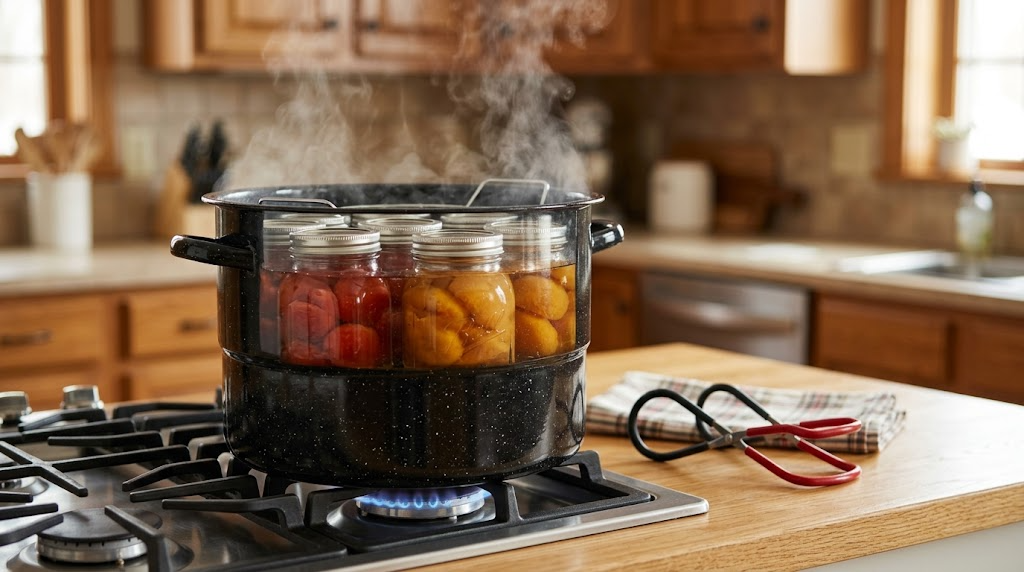
Every autumn a lot of people buy a canning pot, use it once, and never touch it again. Usually it is not the pot’s fault. It is that nobody explained the one rule that governs everything: a boiling-water canner is only safe for acid foods. Jam, pickles, chutney, tomatoes with added acid, fruit in syrup — yes. Green beans, carrots, soup, meat — absolutely not, ever, under any circumstances.
Some links in this post are affiliate links. If you buy through them we may earn a small commission at no extra cost to you — it never changes which products we recommend.
That is not a cautious blogger’s hedge. The National Center for Home Food Preservation is explicit: low-acid foods must be processed in a pressure canner to be free of botulism risk, and boiling-water canners are recommended only for acid foods. Water simply cannot get hot enough to destroy botulism spores, no matter how long you boil it.
Get that straight and a water bath canner becomes one of the most satisfying things in your kitchen. It is also one of the simplest — a big pot, a rack, and a lid. Below are seven worth buying, sorted by the differences that actually matter: what your cooktop can take, how tall the pot is, and whether you need the tools thrown in.
Our Top 7 Picks for the Best Water Bath Canner
Best Overall for Beginners: Granite Ware Canning Pot with Rack, 8-Piece Set

This is the speckled black enamel canner your grandmother probably owned, and it is still the sensible first buy. Granite Ware has been making these for decades, the porcelain-on-steel body is light enough to lift full of water without hurting yourself, and the 8-piece set means you are not discovering on jam day that you have no jar lifter.
The rack matters more than people expect. Jars must not sit directly on the pot base — direct contact with the hot metal causes uneven heating and cracked jars — and the included rack also lets you lower seven jars in at once rather than fishing them in one at a time.
One important limitation, covered properly in the buying guide below: enamel canners are generally not recommended on glass or ceramic smooth-top ranges. If that is your cooktop, skip to the McSunley.
Key Specifications
- Porcelain-enamel on steel, classic canner design
- 8-piece set including rack and canning tools
- Holds seven quart jars
- Lightweight for its size
Pros
- Complete starter kit — nothing else to buy
- Light enough to handle when full
- Long-established, proven design
- The most affordable honest entry point
Cons
- Not recommended for glass or ceramic smooth-top ranges
- Enamel chips if knocked, and chipped areas rust
- Thin base means it needs watching on high heat
Best for Glass and Induction Cooktops: McSunley Prep•N•Cook 21.5-Quart Stainless Water Bath Canner

If you have a glass-top or induction range, this is the pick and it is not a close call. Most stove manufacturers advise against large enamel canners on smooth tops — the wide, slightly warped base traps heat against the glass and can crack it, and enamel canners are not magnetic so they will not work on induction at all.
The McSunley is flat-bottomed stainless with an encapsulated base, rated for induction, and heavy enough not to warp. It is a genuine canner rather than a stockpot with a rack thrown in, so the height is right for covering quart jars with the required inch or two of water.
It costs more than an enamel canner. On a glass top, that is not really optional spending.
Key Specifications
- 21.5-quart stainless steel with rack
- Flat encapsulated base, induction compatible
- Holds seven quart jars
- Safe for glass and ceramic smooth tops
Pros
- The right answer for glass-top and induction ranges
- Stainless will not chip or rust like enamel
- Heavy flat base resists warping
- Doubles as a large stockpot
Cons
- Noticeably heavier than enamel when full
- Costs meaningfully more
- Tools are not included
Best Electric: Ball EasyCanner Electric Water Bath Canner

Ball is the name on most of the jars and lids in America, so it is worth paying attention when they build an appliance. The EasyCanner is a countertop electric water bath canner — it holds temperature itself, frees up a burner, and removes the single most common beginner mistake, which is not keeping a real rolling boil for the full processing time.
It is genuinely useful if your stove is small, your kitchen gets unbearably hot in August, or you are canning while also cooking dinner.
Read this carefully: this is a water bath canner, so the acid-foods-only rule applies to it exactly as it does to a pot on the stove. It is not a pressure canner and cannot be used for vegetables, meat or soup. Electric appliances marketed for low-acid canning are a separate and much more fraught question, and we cover it in our best pressure canners guide.
Key Specifications
- Countertop electric water bath canner
- Maintains processing temperature automatically
- From Ball, the established canning brand
- For acid foods only — jam, pickles, acidified tomatoes
Pros
- Holds a steady boil without babysitting
- Frees up a stove burner entirely
- Much less kitchen heat than a big pot
- Removes the most common beginner error
Cons
- Acid foods only — never vegetables or meat
- Smaller batch capacity than a full canner
- Another appliance to find storage for
- Most expensive option here
Best Complete Starter Kit: 24-Quart Water Bath Canning Pot with Rack, Lid and Tools

At 24 quarts this is the roomiest pot on this list that still fits a normal burner, and the extra depth is genuinely useful: covering quart jars with the required inch or two of water above the lids is exactly where undersized pots fail people.
It ships as a starter kit with the rack, lid and the usual canning tools, so it is a single purchase rather than four. Sensible if you are starting from nothing and know you want to do quart jars of tomatoes rather than half-pints of jam.
Key Specifications
- 24-quart stainless canning pot
- Includes rack, lid and canning tool set
- Deep enough for quart jars with full water cover
- Starter kit for beginners
Pros
- Extra depth handles quart jars properly
- Everything needed in one purchase
- Stainless, so no chipping
- Works as a big stockpot the rest of the year
Cons
- 24 quarts of water takes a long time to boil
- Heavy when full — think before lifting
- Generic brand with less track record
Best Mid-Size Stainless: 21.5-Quart Canning Pot with Rack and Lid

Twenty-one and a half quarts is the standard canner size for a reason: it holds a full seven-jar batch, it fits on an ordinary burner, and it boils in a sensible amount of time. This is that size in plain stainless with a rack and lid, without a bundle of tools you may already own.
A good choice as a second canner if you already have tools, or if you want stainless without paying for the McSunley’s heavier induction-rated base. Check your cooktop requirements first if you have a smooth top.
Key Specifications
- 21.5-quart stainless steel
- Rack and lid included
- Standard seven-jar canner capacity
- Doubles as a stock pot
Pros
- The standard, proven canner size
- Stainless will not chip
- Boils faster than a 24 or 27-quart pot
- Good value without a tool bundle
Cons
- No canning tools included
- Base is lighter than dedicated induction canners
- Generic brand
Best for Big Batches: 27.5-Quart Water Bath Canning Pot with Rack

If you are putting up a serious quantity — a whole tree of peaches, a bushel of tomatoes — the time cost of canning is mostly waiting for water to boil, so bigger batches per boil genuinely saves an afternoon. At 27.5 quarts this handles tall quart jars with plenty of headroom.
Be honest with yourself about your stove and your back before buying it. Twenty-seven quarts of water is heavy, it takes a long time to come up to a boil, and on a weak burner it may never hold a proper rolling boil at all.
Key Specifications
- 27.5-quart capacity
- Rack and lid included
- Listed as suitable for induction cooktops
- Extra headroom for tall quart jars
Pros
- Largest batches, fewest boils
- Plenty of water cover over quart jars
- Handles a bushel day without endless rounds
- Induction compatible
Cons
- Very slow to reach a boil
- Heavy and awkward to drain
- May overwhelm a small or weak burner
- Hard to store
Best Tool Bundle: LEONICE Canning Supplies Starter Kit, Full Set

Sometimes the pot is the part you already have. If you own a tall stainless stockpot, you are most of the way to a water bath canner — you need a rack to keep jars off the base, and the handful of tools that make the job tolerable: jar lifter, wide-mouth funnel, magnetic lid lifter, headspace gauge and bubble remover.
This is that set, in stainless. The jar lifter is the one you will actually feel the difference on — the cheap ones flex and drop hot jars.
The jar lifter is the one that matters, and it is the one people try to skip. I did my first batch with kitchen tongs, dropped a hot jar back into the water from about four inches up, and spent the rest of that afternoon fishing glass out of a boiling pot. The lifter grips under the ring, where a jar is strongest; tongs squeeze the middle, which is exactly where it does not want to be squeezed.
The magnetic lid wand I use every single batch, because retrieving flat lids from hot water with your fingers is genuinely not possible. The wide-mouth funnel earns its place too. The plastic bubble-remover stick I have never once used — a chopstick does the same job and is already in the drawer.
Key Specifications
- Full canning tool starter set
- Food-grade stainless steel
- Includes rack, jar lifter, funnel and headspace tool
- Turns a stockpot into a working canner
Pros
- Cheapest way in if you own a big pot
- Stainless tools rather than plastic
- Everything needed besides the pot
- Easy to store
Cons
- No pot included
- Your stockpot must be tall enough for full water cover
- Rack must fit your specific pot diameter
The Ultimate Buying Guide for Water Bath Canners
The One Rule: Acid Foods Only
Everything else in this guide is detail. This is the rule. A boiling-water canner reaches 212°F at sea level and no higher, and that temperature does not destroy Clostridium botulinum spores. In an acidic environment those spores cannot grow, which is why high-acid foods are safe. In a low-acid environment they can, and the toxin they produce is often fatal.
Safe in a water bath canner: jams and jellies, fruit and fruit juice, pickles and relishes, chutneys, salsa made to a tested recipe, and tomatoes with added bottled lemon juice or citric acid. If you are putting up a lot of tomatoes, a food mill or tomato press saves the peeling and seeding entirely.
Never in a water bath canner: green beans, corn, carrots, potatoes, beets, pumpkin, mushrooms, meat, poultry, fish, stock, soup, or any mixed dish. These need a pressure canner — see our guide to the best pressure canners.
And a specific warning about a common shortcut: modern tomato varieties are less acidic than older ones, so tomatoes are treated as borderline and must be acidified with bottled lemon juice or citric acid to a tested recipe. Bottled, not fresh — fresh lemon acidity varies too much to rely on.
Size and Depth
Depth matters more than volume. Jars must be covered by one to two inches of water throughout processing, and the water must be able to boil freely without slopping over. A pot that is wide but shallow will not do this for quart jars.
- 21 to 22 quarts is the standard canner size and handles seven quart jars — the right default
- 24 to 27 quarts gives more headroom and bigger batches, at the cost of much slower boils
- Small pots and pressure saucepans are not recommended by NCHFP for canning at all
Your Cooktop Decides More Than You Think
This is the part that catches people out after the pot has arrived.
- Gas or coil electric: anything here works. Enamel is the value choice.
- Glass or ceramic smooth top: most manufacturers advise against large enamel canners — the wide base traps heat against the glass. Use a flat-bottomed stainless canner no wider than about an inch beyond the element, and check your stove’s manual.
- Induction: the canner must be magnetic and flat-bottomed. Enamel-on-steel sometimes works and often does not; stainless canners sold as induction-rated are the safe buy.
- Any electric stove: consider a countertop electric canner instead — it will hold a steadier boil than a struggling element.
Enamel vs Stainless
Enamel (porcelain on steel) is light, cheap and traditional. It heats fast because the walls are thin. It also chips, and a chipped canner rusts from the exposed steel outward. Not for smooth tops.
Stainless is heavier, more expensive, will not chip, and usually has a thicker encapsulated base that resists warping — which is what makes it safe on glass and induction. If you can only own one large pot, stainless earns its keep the other eleven months of the year.
The Rack Is Not Optional
Jars must not touch the bottom of the pot. Direct contact with the hot base heats the glass unevenly and cracks jars, and it stops water circulating underneath. If your canner did not come with a rack, buy one that fits, or in a pinch use a round cake rack — but a proper canning rack with handles that let you lower and lift all seven jars at once is worth having.
Altitude Changes Your Processing Time
Water boils cooler as you go up, so processing times must be extended at altitude. Tested recipes give the adjustments; do not skip them. If you live above roughly 1,000 feet, check the altitude table for every recipe you use rather than assuming the base time is fine.
What Else You Actually Need
- A jar lifter — the one tool with no good improvised substitute
- A wide-mouth funnel — keeps rims clean, which is what makes lids seal
- A headspace gauge and bubble remover — usually one plastic tool
- A magnetic lid lifter — convenient rather than essential
- New lids every single time. Rings and jars are reusable; flat lids are not.
Frequently Asked Questions About Water Bath Canning
Can I use a regular stockpot as a water bath canner?
Yes, provided it is deep enough to cover your jars with one to two inches of water plus room for a rolling boil, and provided you put a rack in the bottom so jars are not sitting on the metal. A tall 20-quart-plus stockpot works fine. A shallow pasta pot does not, especially for quart jars.
Can I can vegetables or meat in a water bath canner?
No. This is the one thing in home canning with no flexibility. Low-acid foods — vegetables, meat, poultry, fish, stock, soup and mixed dishes — must be processed in a pressure canner, because boiling water cannot reach the temperature needed to destroy botulism spores. NCHFP is unambiguous on this. Recipes on social media that water-bath green beans are dangerous regardless of how confident the person sounds or how long their family has done it.
Why do my jars crack in the canner?
Almost always thermal shock or direct contact with the pot base. Do not put cold jars into boiling water or hot jars into cold water, always use a rack so jars sit off the metal, and do not let jars touch each other. Using jars not designed for canning — old commercial jars from pasta sauce, for instance — is the other common cause.
Do I need to sterilise the jars first?
For anything processed 10 minutes or longer, no — the processing itself sterilises them. You do need them clean and hot so they do not crack when they meet the boiling water. For processing times under 10 minutes, sterilise the jars first.
How do I know the jars sealed?
After they cool completely, the lid should be concave and should not flex when pressed in the centre. Remove the ring and lift the jar gently by the lid edge — a sealed lid holds. Anything that did not seal goes in the fridge and gets eaten, or gets reprocessed with a new lid within 24 hours.
Is an electric water bath canner worth it?
If your stove struggles to hold a rolling boil under a full canner, or your kitchen becomes unbearable in canning season, yes. It holds temperature more reliably than a weak element and frees a burner. Just remember it is still a water bath canner — the acid-foods-only rule applies exactly the same.
Final Thoughts
For most people starting out, the Granite Ware 8-piece set is the right first buy — complete, light and inexpensive. If you cook on glass or induction, ignore price and buy the McSunley stainless canner instead, because an enamel canner on a smooth top risks the stove, not just the jam. And if you already own a tall stockpot, a tool set and a rack gets you canning this weekend for very little.
Whatever you buy, stay on the right side of the acid rule, use tested recipes with their altitude adjustments, and buy new lids every time. Reference the National Center for Home Food Preservation when a recipe you found online contradicts something here — they are the authority, not us.
This article is general information about food preservation equipment. Follow tested recipes from NCHFP, your state extension service, or a current USDA-based canning guide. Improperly canned low-acid food can cause botulism, which can be fatal.
As an Amazon Associate we earn from qualifying purchases. Availability is accurate as of the date of publishing. We do not list prices because they change too often to quote honestly.

Rimi Sultana is a home cook from Bangladesh who has cooked for her family every day for the past five years and writes about it at Smart Cooks. Perpetually testing whether internet-famous recipes actually work in a regular home kitchen. Say hello on Facebook or through the contact page.