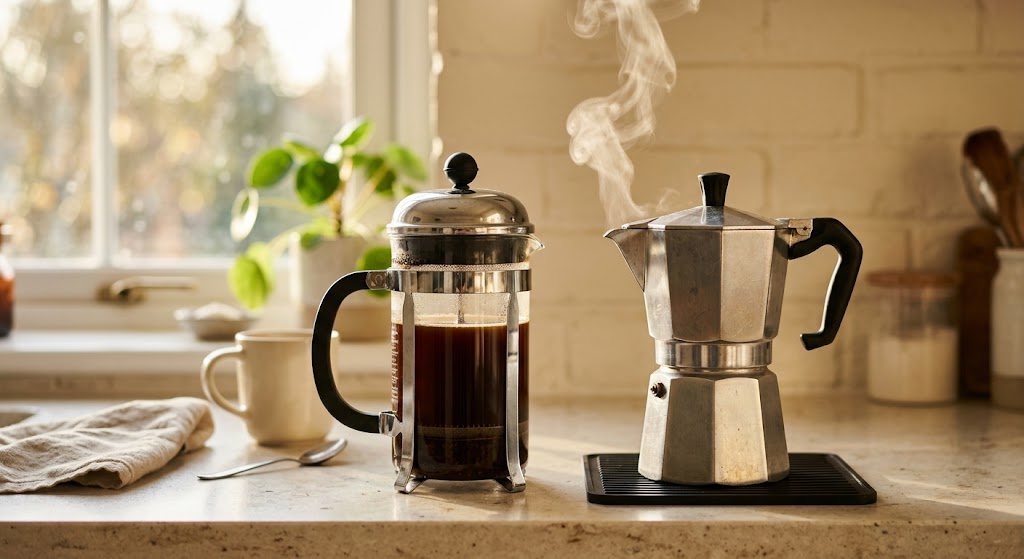
Both a moka pot and a French press promise rich, full-bodied coffee without an espresso machine, and both have loyal fans who insist theirs is better. They actually produce genuinely different drinks, though, so the right pick depends on what you’re after.
Some links in this post are affiliate links. If you buy through them we may earn a small commission at no extra cost to you — it never changes which products we recommend.
What Actually Matters
Brewing Method and Strength
A moka pot forces steam-pressurized water up through finely ground coffee, producing a concentrated, espresso-like shot with some crema. A French press steeps coarser grounds in hot water for several minutes, producing a fuller-bodied but less intense cup with more of the coffee’s natural oils.
Grind Size and Consistency
Moka pots need a fine, even grind close to espresso grind — too coarse and the coffee under-extracts and tastes weak. French press needs a coarse grind, since anything finer slips past the mesh filter and leaves gritty sediment in your cup.
Speed and Cleanup
A moka pot takes 5-7 minutes on the stove and has more parts to disassemble and clean, including a small gasket that wears out over time. A French press brews in about 4 minutes and cleanup is just rinsing the carafe and plunger.
From My Kitchen
I owned a French press for years before trying a moka pot, and the first cup genuinely surprised me — it tasted closer to café espresso than any drip coffee I’d made at home. I still reach for the French press on lazy mornings, but the moka pot comes out whenever I want something strong enough to cut with milk.
Worth Considering
The Bialetti Moka Express is the iconic stovetop design that’s barely changed in decades because it simply works. If you want a slightly larger option with a wider handle for easier pouring, the GROSCHE Milano stovetop espresso maker is a solid alternative.
Pressure, Grind and What Actually Ends Up in the Cup
A moka pot works by steam pressure pushing water up through a bed of coffee — usually somewhere between 1 and 2 bar. That is real pressure, which is why the result is concentrated and syrupy, but it is nowhere near the roughly 9 bar an espresso machine produces. The honest description is strong, concentrated stovetop coffee: more intense than drip, less refined than espresso, and with a body all of its own.
A French press does something completely different. There is no pressure at all — the coffee simply steeps in water for around four minutes, and a metal mesh holds the grounds back at the end. Because that mesh passes oils and very fine particles that a paper filter would trap, the cup has a heavier, rounder mouthfeel and a small amount of sediment. Neither method is better; they produce genuinely different drinks from the same beans.
Quick Comparison
| Moka pot | French press | |
|---|---|---|
| Method | Steam pressure through the bed | Full immersion steeping |
| Grind | Fine, just coarser than espresso | Coarse, like sea salt |
| Brew time | 3–5 minutes on the hob | 4 minutes steeping |
| Result | Concentrated, intense, small volume | Full-bodied, larger volume |
| Sediment | Very little | Some, by design |
| Milk drinks | Works well as a base | Too dilute to cut through milk |
The Mistakes That Ruin Each One
For the moka pot: heat too high, and tamping the grounds. Medium-low heat lets the water rise steadily rather than violently, which is the difference between a rich cup and a scorched one. The basket should be filled level and never compressed — a moka pot has nothing like the pressure needed to push through a tamped puck. Fill the base with already-hot water too, which shortens the time the coffee spends sitting over heat, and take it off the hob the moment it starts to gurgle.
For the French press: grinding too fine and plunging hard. Fine grounds slip through the mesh and keep extracting in the carafe, which is where bitterness and muddiness come from. Plunge slowly and stop when you reach the surface of the grounds rather than compressing them. And decant the coffee into a jug or cups immediately — coffee left sitting on the grounds keeps extracting and turns harsh within minutes.
Two Worth Considering
The classic: Bialetti Moka Express
The reference point for the category, and the design most other moka pots copy. Parts and gaskets are easy to find years later, which matters more than it sounds — a moka pot is a decades-long purchase whose only consumable is a rubber seal.
Pros
- Replacement gaskets and filters widely available
- Proven design, straightforward to use
- Makes genuinely concentrated coffee for very little money
Cons
- Aluminium body is not induction compatible
- Needs hand washing; dishwashers dull and pit it
Best for induction hobs: GROSCHE Milano Stovetop Espresso Maker
A well-built moka pot in the same tradition, worth looking at if your hob is induction or you want something a little more solid in the hand. The brewing behaviour is the same — the differences are materials, finish and hob compatibility.
Pros
- Solid build and finish
- Available in sizes for one cup up to several
- Straightforward to clean and maintain
Cons
- Check the specific model for induction compatibility
- Same care rules apply — hand wash only
Frequently Asked Questions
Is moka pot coffee the same as espresso?
Not quite — a moka pot uses lower pressure than a true espresso machine, so the result is strong and concentrated but without the same thick crema or micro-foam that espresso machines produce.
Which one lasts longer, a moka pot or a French press?
Both can last many years with care, though a moka pot’s rubber gasket typically needs replacing every year or two with regular use, while a French press’s main wear point is the metal mesh filter, which can bend or clog over time.
Is moka pot coffee actually espresso?
No, and the packaging that calls it a stovetop espresso maker is stretching the term. Espresso is defined by roughly 9 bar of pressure and a 25 to 30 second extraction, which produces the emulsified crema on top. A moka pot manages 1 to 2 bar over several minutes. What you get is a concentrated coffee that works beautifully as the base of a milk drink and tastes stronger than drip — just not espresso by any technical definition.
Why is my French press coffee bitter and muddy?
Nearly always grind size. Too fine, and the fines slip past the mesh and keep extracting in the carafe, producing both the muddiness and the bitterness. Move to a coarse grind that looks like sea salt. The other common cause is leaving the coffee sitting on the grounds after plunging — pour it all out into a separate vessel within a minute, even if you are not drinking it straight away.
Related: Top 5 French presses for full bodied coffee with real brewing insight

Rimi Sultana is a home cook from Bangladesh who has cooked for her family every day for the past five years and writes about it at Smart Cooks. Perpetually testing whether internet-famous recipes actually work in a regular home kitchen. Say hello on Facebook or through the contact page.