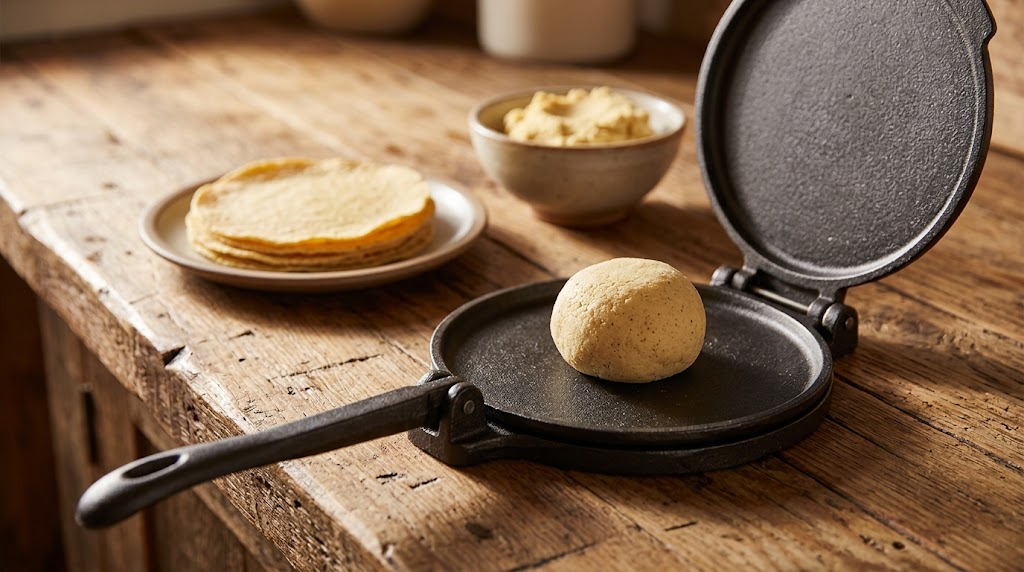
A rolling pin can flatten tortilla dough, but getting an even circle by hand takes practice most people don’t have time for on a weeknight. A tortilla press solves that in one motion, and it turns out to be useful for more than just tortillas.
Some links in this post are affiliate links. If you buy through them we may earn a small commission at no extra cost to you — it never changes which products we recommend.
What Actually Matters
Cast Iron vs. Aluminum
Cast iron presses are heavier and apply more even pressure across the whole disc, which matters for getting a uniformly thin tortilla without thick, doughy edges. Aluminum presses are lighter and easier to store, but need a bit more care to press evenly by hand.
Size Matches Your Tortilla Style
An 8-inch press makes standard taco-sized tortillas, while smaller 6-inch presses are better suited to street-taco style or for pressing empanada and dumpling wrappers. Bigger presses handle burrito-sized tortillas but take up more storage space.
Parchment Paper Prevents Sticking
Pressing dough directly against bare cast iron almost always results in sticking. A layer of parchment paper on both sides of the dough ball, cut to size, makes the difference between a clean release and a frustrating mess.
From My Kitchen
My first attempt at pressing tortillas without parchment paper turned into scraping dough off cast iron with a butter knife, which taught me quickly why every recipe insists on the parchment step. Once I started cutting rounds of parchment paper ahead of time, tortilla night went from a hassle to genuinely one of my favorite weeknight dinners.
Worth Considering
The IMUSA USA tortilla press is a classic aluminum design that’s affordable and easy to store, with a lever that gives decent leverage for even pressure. For something heavier that presses more evenly on the first try, the SIRCLES cast iron tortilla press is worth the extra weight on the counter.
Weight Is the Specification That Matters
A tortilla press is a lever and a mass. The mass is what flattens the masa evenly; the lever just applies it. This is why a heavy cast iron press produces an even tortilla with a gentle push while a light aluminium one needs you to lean on it — and leaning unevenly is exactly how you get a tortilla that is thin on one side and thick on the other. If you press regularly, weight is the single feature worth paying for.
The second thing to check is whether the plates actually sit parallel. Cheap presses often have a hinge with enough play that the plates close at a slight angle, which produces a wedge-shaped tortilla no matter how carefully you press. You can feel this before you ever use it: close the press empty and look at the gap along the far edge. If the plates meet at the hinge first and stay open at the front, that press will always give you uneven results.
Quick Comparison
| Cast iron | Aluminium | Wood | |
|---|---|---|---|
| Pressing force needed | Light — the weight does it | Heavy — you supply the force | Moderate, depends on the lever |
| Evenness | Very good | Variable | Good when well made |
| Weight to store | Heavy, 4–7 kg | Light, easy to move | Moderate |
| Care | Season and keep dry | Wipe clean, no rust worry | Keep dry, oil occasionally |
| Price | Higher | Lowest | Usually highest |
Size, and What a Press Can Actually Do
A 6.5-inch press is the standard and makes a taco-size tortilla, which is what most recipes assume. An 8-inch press gets you closer to burrito size but is substantially heavier and more expensive, and the larger plate makes evenness harder to achieve unless the press is genuinely well made. For most households the 6.5-inch is the right call.
It is also worth being clear about what a press cannot do: flour tortillas. Flour dough develops gluten, and gluten springs back — press a flour ball flat and it will contract within seconds, leaving you with a thick disc. Flour tortillas are rolled, not pressed. A tortilla press is a masa tool, and it is excellent at that one job, along with pressing plantains for tostones and flattening dough for empanadas or gorditas.
Two Presses Worth Considering
Best value: IMUSA USA Tortilla Press
The aluminium standard that most home kitchens start with. It asks for more downward force than cast iron and rewards a deliberate, even push, but it makes perfectly good tortillas and stores without needing a dedicated shelf.
Pros
- Inexpensive entry into fresh tortillas
- Light enough to store anywhere
- No rust or seasoning to maintain
Cons
- Needs real force, and uneven force shows
- Hinge play varies between units
Best for regular use: SIRCLES Cast Iron Tortilla Press
Once you are making tortillas weekly, the weight stops being a downside and becomes the point — press down gently and the tortilla comes out even without you thinking about technique. This is the version you buy after the aluminium one has convinced you that you will keep doing this.
Pros
- Even pressure with minimal effort
- Solid hinge, plates meet parallel
- Heavy enough to stay put on the counter
Cons
- Heavy to move and store
- Needs to be kept dry to avoid surface rust
Frequently Asked Questions
Can I use a tortilla press for other foods?
Yes — it works well for flattening empanada dough, dumpling wrappers, and even thin cracker-style flatbreads, since it’s really just a fast, even way to flatten any small ball of dough into a uniform disc.
Do I need to season a cast iron tortilla press?
Since parchment paper sits between the dough and the press, seasoning isn’t strictly necessary the way it is for a cast iron skillet, but a light coat of oil after cleaning helps prevent rust on the exposed metal over time.
Why does my masa stick to the press?
Because there is nothing between the masa and the metal, or the wrong thing is. Cut open a zip-top freezer bag and use the two halves as liners — it releases cleanly and lasts for months. Do not use wax paper, which sticks and tears, and do not use cling film, which wrinkles. If it still sticks with a proper liner, the masa is too wet: it should feel like soft play dough and not leave residue on your palm.
How thin should a pressed tortilla be?
About 2 mm for a standard corn tortilla — thin enough to be pliable, thick enough not to tear when you fold it around a filling. If yours are cracking at the edges as they press, the masa is too dry and needs another tablespoon of warm water worked through. If they are tearing when you peel the liner off, they are too thin or too wet, and a slightly lighter press will fix it.
Related: Drip coffee maker vs French press: Brewing methods and flavour differences explained

Rimi Sultana is a home cook from Bangladesh who has cooked for her family every day for the past five years and writes about it at Smart Cooks. Perpetually testing whether internet-famous recipes actually work in a regular home kitchen. Say hello on Facebook or through the contact page.