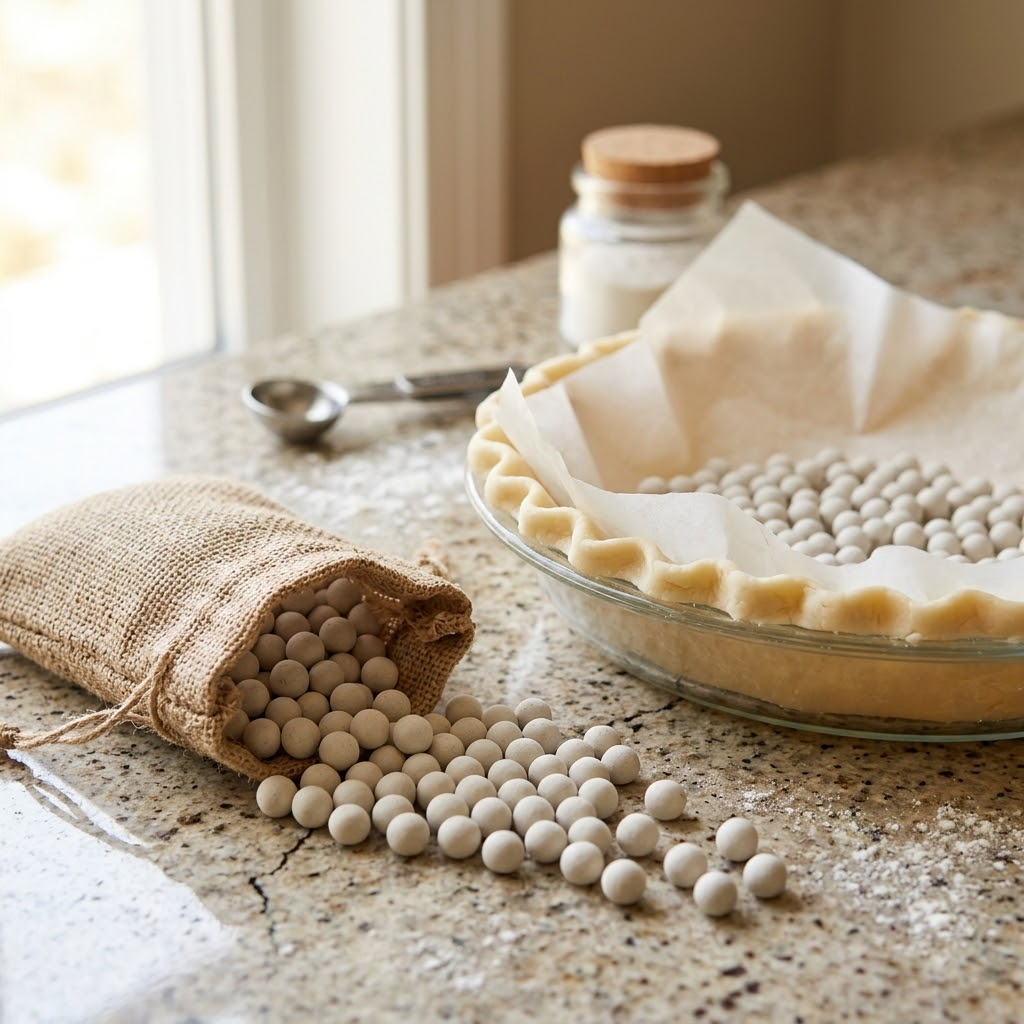
If you’ve ever blind-baked a pie crust and pulled it out of the oven to find the bottom puffed up like a balloon and the sides slumped down, pie weights are the fix — but plenty of home bakers get by with substitutes, so it’s a fair question whether you actually need to buy dedicated ones.
Some links in this post are affiliate links. If you buy through them we may earn a small commission at no extra cost to you — it never changes which products we recommend.
What Actually Matters
What Pie Weights Actually Do
Weights press down on the crust while it bakes without filling, keeping steam from puffing up the base and stopping the sides from sliding down the pan as the fat melts. Without them, an empty crust rarely holds its shape.
Ceramic vs. Metal vs. DIY Substitutes
Ceramic weights hold heat well and distribute evenly, metal chain-style weights get into corners better, and dried beans or rice work in a pinch but conduct heat unevenly and can scorch over repeated use. Dedicated weights simply give more consistent results batch after batch.
Weight and Coverage
Enough weight matters more than people expect — too few weights, spread too thin, still lets the crust puff in the gaps between them. A generous layer that reaches all the way to the edges of the pan is what actually prevents slumping.
From My Kitchen
I used dried rice for years, kept in a jar labeled ‘pie rice only,’ and it worked fine until one batch scorched slightly and left a faint smell in my crust that I couldn’t figure out for weeks. Switching to ceramic weights solved that instantly, and the crust edges hold their shape far more reliably now.
Worth Considering
Mrs. Anderson’s ceramic pie weights are a classic for a reason — natural stoneware that heats evenly and comes in a generous quantity that actually covers a standard 9-inch crust edge to edge. If you want something with a bit more heft per weight, the MOBYKE pie weights are a good alternative.
What Blind Baking Is Actually Preventing
Two things go wrong in an empty pastry shell, and they have different causes. The base puffs because moisture in the dough turns to steam and has nowhere to go but up. The sides slump because the butter melts and the pastry becomes briefly fluid before the flour and egg set into a structure that can hold itself — there is a window of a few minutes where the crust is essentially a soft paste sliding down the tin wall.
Weights address both, but only for that window. Once the pastry has set — usually fifteen to twenty minutes, when the edges look dry and matte rather than shiny — the weights have done their job and need to come out so the base can actually colour. Leaving them in for the whole bake is the most common mistake, and it produces a pale, slightly raw base under a nicely browned rim.
Quick Comparison
| Ceramic weights | Dried beans or rice | Chain-style weights | No weights | |
|---|---|---|---|---|
| Heat conduction | Good, retain heat well | Adequate | Excellent, metal conducts | N/A |
| Filling corners properly | Good if you use enough | Very good, small pieces settle | Good, follows the shape | |
| Reusable | Indefinitely | Many times as weights | Indefinitely | — |
| Cost | Low | Almost nothing | Higher | Free |
| Result | Reliable | Reliable | Reliable, quickest to remove | Puffed base, slumped sides |
The Technique Matters More Than What You Fill It With
Three details do more for a blind-baked shell than any particular product. First, chill the lined tin until the pastry is properly cold — thirty minutes in the fridge or fifteen in the freezer — because cold butter buys you time before the slumping window opens. Second, fill the shell all the way up to the rim, not just across the base. The sides are what slump, and weights sitting only on the bottom do nothing to hold them. Third, use enough weight that it presses outward into the corner where base meets wall, which is exactly where shrinkage starts.
Line the shell with parchment or foil before filling — parchment releases more cleanly, foil moulds into the corners better. Then bake until the edges are set and matte, lift the parchment and weights out in one go, and return the shell to the oven for another eight to twelve minutes until the base is properly golden. That second stage is what stops a soggy bottom, and it is the stage people skip.
Two Sets Worth Considering
Best classic option: Mrs. Anderson’s Ceramic Pie Weights
Ceramic beads hold heat well, which helps set the base rather than just holding it down. Buy enough to genuinely fill the shell to the rim — one small tub is usually not enough for a 9-inch tart, and under-filling is the most common reason weights disappoint.
Pros
- Retain heat and help the base set
- Last indefinitely with no upkeep
- Easy to pour in and out via parchment
Cons
- One package is often not enough for a large tart
- Beads scatter if the parchment tears
Best convenient set: MOBYKE Pie Weights
A practical set for someone who blind bakes often enough to want the job to be quick. The value over dried beans is not better results, it is less fuss in loading, removing and storing them.
Pros
- Quick to load and lift out
- Stores neatly between uses
- Enough weight for a standard tart tin
Cons
- Results are not better than dried beans, just tidier
- Still needs parchment underneath
Frequently Asked Questions
Can I skip pie weights entirely?
For a filled pie that bakes with its filling, yes. For a blind-baked crust — like for a custard or cream pie — skipping weights usually means dealing with a puffed, uneven base that won’t hold filling properly.
How do I store pie weights between uses?
A resealable bag or small jar works fine. Just make sure they’re completely dry before storing, since any trapped moisture can affect how evenly they heat the next time you use them.
Can I reuse the beans I used as pie weights?
As weights, yes — indefinitely, for years. Keep them in a labelled jar and they will outlast several tins. What you should not do is cook and eat them afterwards. Repeated dry baking dries them out past the point where they will ever soften properly in water, and they pick up fat and pastry smells along the way. Sacrifice one bag of the cheapest dried beans and treat it as a permanent tool.
Do I need to blind bake at all for a no-bake filling?
Yes, and more thoroughly than usual — that is the one case where the shell is never going back in the oven, so it has to be fully baked and properly coloured before anything goes in. Bake with weights until the sides set, remove them, and then continue until the base is a genuine golden brown rather than pale. A shell for a chilled filling should be baked to the point where you would be happy eating it on its own.
Related: Step stool vs ladder: understanding which fits your home needs
Related: Top 7 juicers for leafy greens: what you really need to know

Rimi Sultana is a home cook from Bangladesh who has cooked for her family every day for the past five years and writes about it at Smart Cooks. Perpetually testing whether internet-famous recipes actually work in a regular home kitchen. Say hello on Facebook or through the contact page.