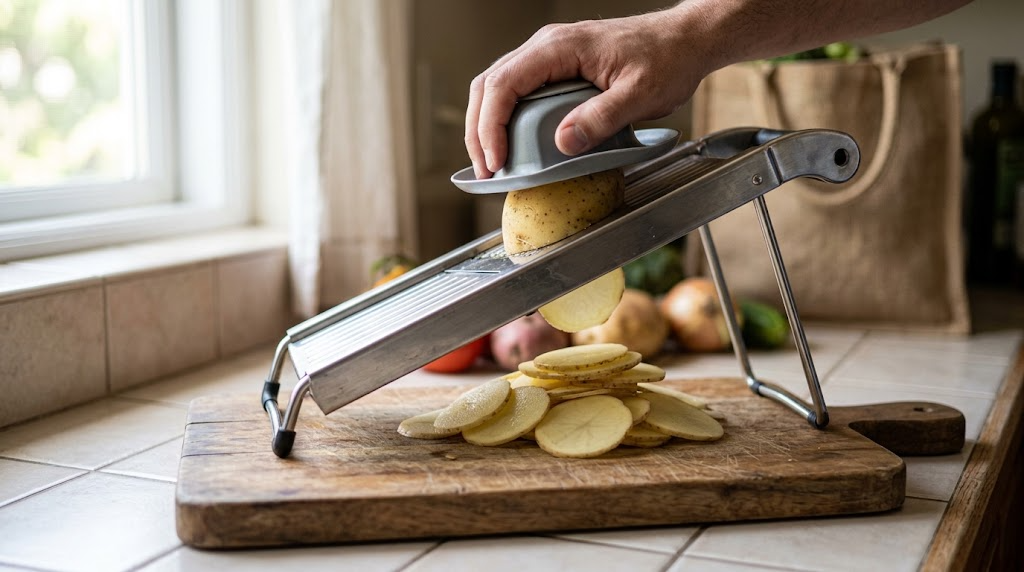
A mandoline slicer promises perfectly uniform, paper-thin slices in a fraction of the time a knife takes, but it also has a reputation as the most feared tool in a home kitchen after one too many nicked-finger stories.
Some links in this post are affiliate links. If you buy through them we may earn a small commission at no extra cost to you — it never changes which products we recommend.
What Actually Matters
The Hand Guard Isn’t Optional
Nearly every serious mandoline injury happens when someone skips the hand guard to get that last inch of a vegetable sliced. A mandoline with a secure, well-designed guard that actually holds the food firmly changes the entire safety equation.
Adjustable Thickness Range
A wide thickness range, from paper-thin to a chunkier chip-cut, makes a mandoline useful for far more than one task — from delicate cucumber slices to thicker potato rounds for gratin. A narrow range limits what the tool is actually good for.
Stability While Slicing
A mandoline that wobbles or slides on the counter mid-slice is both frustrating and genuinely more dangerous. Non-slip feet or a stable base that locks against the counter edge matters as much as the blade itself.
From My Kitchen
I avoided using a mandoline for years after hearing enough horror stories from other home cooks, until a friend showed me how the hand guard was actually meant to be used — I’d been trying to slice without it out of impatience. Used correctly, it turned potato gratin from a fifteen-minute knife job into about ninety seconds, and I’ve genuinely never looked back.
Worth Considering
The OXO Good Grips handheld mandoline slicer includes a hand guard and a non-slip handle, and its compact size makes it easy to store in a drawer rather than needing dedicated counter space. For a full-size version with more thickness settings, the Gramercy mandoline food slicer offers 12 adjustable settings.
What a Mandoline Does That a Knife Cannot
The value is not speed, it is uniformity. When potato slices vary between two and four millimetres, a gratin cooks unevenly — the thin slices turn to mush while the thick ones stay firm, and no amount of extra oven time fixes it, because by then the thin ones have disintegrated. The same applies to anything cooked in a stack or a single layer: chips, root vegetable crisps, pickles, fennel for a salad where the texture is the whole point.
A very good knife hand can get close, but not consistently at one or two millimetres, and not across a kilo of potatoes without slowing down. This is the honest case for a mandoline: it solves one narrow problem extremely well. If you never make gratins, crisps, quick pickles or finely shaved salads, the learning curve genuinely is not worth it and a knife will serve you fine.
Quick Comparison
| Handheld mandoline | Full-size mandoline | |
|---|---|---|
| Setup | Grab and slice over a bowl | Unfold, set angle, position |
| Thickness range | A few fixed settings | Fine adjustment, often to 0.5 mm |
| Julienne and waffle cuts | Limited or none | Usually included |
| Storage | Drawer | Needs real cupboard space |
| Stability while cutting | Held, so less stable | Sits braced on the counter |
| Best for | Occasional slicing, small kitchens | Regular batch work, gratins, pickling |
The Safety Conversation, Honestly
Mandoline injuries are common, and they almost always happen the same way: on the last 20% of the vegetable, when the piece gets too small to hold safely and the guard feels like it is getting in the way. The discipline that prevents it is simple — decide in advance that the final stub goes on the chopping board, not through the blade. A few grams of potato is not worth a trip to A&E, and every experienced cook who has been cut will tell you it happened on that last piece.
A cut-resistant glove is the other thing worth buying, and it costs a fraction of the mandoline. It does not slow you down, it means the guard is a backup rather than your only protection, and it removes the temptation to freehand. Use both: glove on the holding hand, guard for as long as the piece is big enough to hold it.
Two Mandolines Worth Considering
Best for most kitchens: OXO Good Grips Handheld Mandoline Slicer
Fast to pick up, easy to store, and the thickness settings cover the cuts most home cooking actually needs. A handheld slices straight over a bowl, which removes the counter-space problem that keeps full-size mandolines in the cupboard unused.
Pros
- Fits in a drawer, so it actually gets used
- Simple thickness settings, quick to change
- Non-slip base for stability against a bowl rim
Cons
- Fewer thickness options than a full-size unit
- No julienne or waffle cutting
Best for volume work: Gramercy Mandoline Food Slicer
A braced, counter-standing design with a wider adjustment range and extra cut styles. Worth it if you make gratins, pickles or crisps in real quantity — the stability and fine thickness control are what you are paying for, not the extra blades.
Pros
- Fine thickness control for gratins and crisps
- Stable on the counter, both hands free to work
- Includes julienne and other cut options
Cons
- Takes real cupboard space
- More parts to wash and dry carefully
Frequently Asked Questions
Is a mandoline actually dangerous if used properly?
Used with the hand guard every single time, a mandoline is no more dangerous than a sharp knife. Nearly all injuries happen when someone tries to slice the last small piece of food by hand instead of discarding it or using a fork to hold it.
Can a mandoline replace a food processor’s slicing disc?
For most vegetables, yes, and often with better control over exact thickness. A food processor is faster for very large volumes, but a mandoline gives more precise, consistent results for smaller batches.
What thickness should I actually use?
For a potato gratin, 2 to 3 mm — thin enough to soften into layers, thick enough to keep a little structure. For crisps, 1 to 1.5 mm, which is thin enough to dry out and go properly crisp rather than leathery. For quick pickles like cucumber or radish, 2 mm holds a pleasant bite. For shaved salads — fennel, celeriac, raw courgette — go as thin as your mandoline allows and dress them immediately so they soften slightly.
Why does my mandoline drag and tear instead of slicing cleanly?
Three usual causes. The blade is dull, which happens sooner than people expect and cannot be fixed on most home models. The produce is wet, so it sticks to the ramp instead of gliding — pat it dry first. Or you are pushing straight down rather than forward: a mandoline wants a smooth, steady forward stroke with light downward pressure, and pressing hard makes tearing worse rather than better.

Rimi Sultana is a home cook from Bangladesh who has cooked for her family every day for the past five years and writes about it at Smart Cooks. Perpetually testing whether internet-famous recipes actually work in a regular home kitchen. Say hello on Facebook or through the contact page.