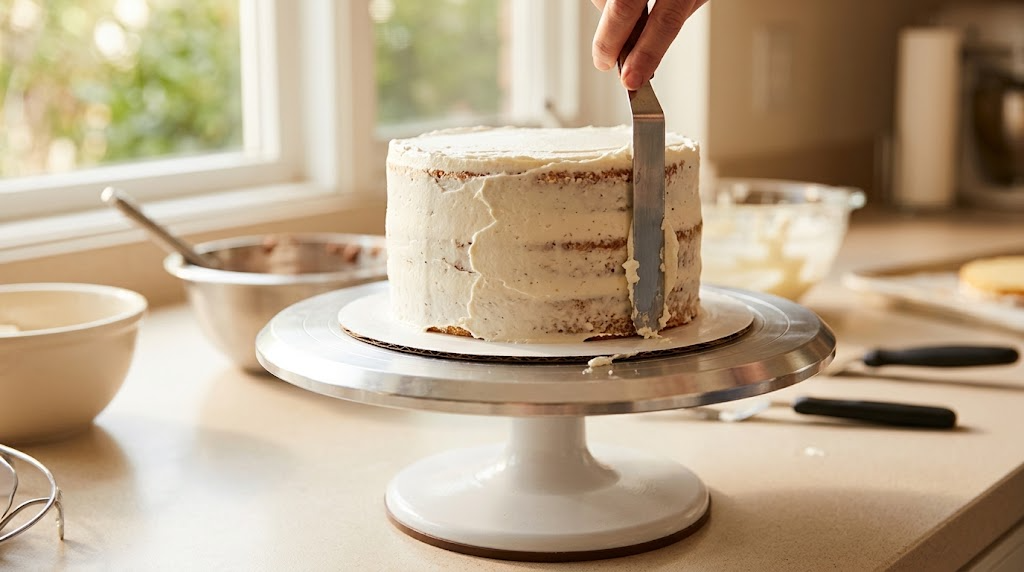
A cake turntable looks like a simple spinning platform, but the difference between a smooth, stable turntable and a wobbly one shows up directly in how even your frosting comes out. If you’ve tried decorating a cake on a stationary plate and fought the angle the whole time, a turntable is one of the more genuinely worthwhile upgrades in a home baking kit.
Some links in this post are affiliate links. If you buy through them we may earn a small commission at no extra cost to you — it never changes which products we recommend.
What Actually Matters
Rotation Smoothness
The whole value of a turntable is in how smoothly and evenly it spins — a cheap bearing will catch or wobble slightly as it turns, which shows up as uneven lines in your frosting. Look specifically for reviews that mention smooth, consistent rotation rather than just size or price.
Base Weight and Non-Slip Grip
A turntable that slides around on the counter while you’re trying to frost defeats the purpose. Heavier bases with rubberized, non-slip feet stay planted far better than lightweight ones, especially once there’s a full cake and stand-mounted weight on top.
Surface Size vs Storage
A larger platform (12-14 inches) accommodates bigger tiered cakes, but takes up more storage space. If you mostly make single-layer cakes, a smaller turntable is easier to store and still gives you the rotation benefit.
From My Kitchen
I frosted cakes on a stationary cake stand for years, constantly walking around the counter to reach different sides, and my frosting lines were never quite even because I was reaching at different angles each time. The first cake I frosted on an actual turntable came out visibly smoother, purely because I could keep my spatula angle consistent while the cake rotated instead of me.
Worth Considering
The Kootek 12″ Aluminum Alloy Cake Turntable has a heavy, stable base and smooth rotation that holds up well for regular decorating. If you’d rather have a display-quality piece that doubles as a serving stand, the 12″ Acacia Wood Revolving Cake Stand looks good enough to bring straight to the table.
Height and Bearing Quality Decide Everything
Two specifications separate a turntable you enjoy using from one that fights you. The first is the bearing: a good turntable spins for several seconds from a light push and keeps a constant speed, which is what lets you hold a scraper still and let the cake do the work. A poor bearing stutters, and every stutter puts a ridge in the frosting you were just smoothing. You can test this in a shop — spin it empty and count how long it keeps turning.
The second is height. A turntable that raises the cake 10 to 12 cm off the counter puts the side of the cake near your elbow height, where you can hold a spatula steady without hunching. A very low turntable means working with your wrist bent downward, which is the main reason home decorators end up with wobbly sides. Height feels like a minor detail until you frost a tall cake on a flat one.
Quick Comparison
| Aluminium turntable | Wooden revolving stand | |
|---|---|---|
| Spin quality | Smooth, long coast | Varies, generally shorter |
| Stability under a heavy cake | Very good | Good, heavier base |
| Working height | Usually raised | Often lower |
| Doubles as a serving stand | No, workmanlike | Yes, it looks the part |
| Cleaning | Wipe clean, tolerates frosting | Needs care, no soaking |
Size the Plate to Your Cakes, Not Bigger
A 12-inch plate is the standard and handles anything up to a 10-inch cake comfortably, leaving a margin around the edge so your hand and the scraper have somewhere to be. Going larger sounds safer but is usually worse — a wide plate makes it awkward to bring the scraper in at a true vertical, and the extra overhang gets in the way when you are turning the stand with one hand while the other holds a spatula.
One accessory worth more than a better turntable: a non-slip mat or a dab of frosting between the plate and the cake board. A cake that shifts on the plate mid-turn ruins the pass you were making, and no amount of bearing quality prevents that. Anchor the board first, then worry about technique.
Two Turntables Worth Considering
Best for decorating: Kootek 12-inch Aluminium Alloy Cake Turntable
Metal build, smooth bearing and enough height to work comfortably on the sides of a layer cake. This is the practical choice if the turntable’s job is frosting rather than serving, and it tolerates being wiped down repeatedly.
Pros
- Smooth, consistent spin
- Raised height suits working on cake sides
- Wipes clean easily after buttercream
Cons
- Not attractive enough to serve on
- Metal can feel cold and utilitarian
Best dual-purpose: 12-inch Acacia Wood Revolving Cake Stand
Worth choosing if you want one object that both frosts the cake and presents it. The spin is not as long or as fluid as a dedicated metal turntable, but it is good enough for home decorating and it looks right on a table afterwards.
Pros
- Doubles as a serving stand
- Heavy base feels stable
- Attractive enough to leave out
Cons
- Bearing is less smooth than metal models
- Wood needs careful cleaning, no soaking
Frequently Asked Questions
Do I need a cake turntable if I only make simple cakes?
Even simple single-layer cakes frost more evenly on a turntable, since you’re not repositioning your arm and spatula angle every few inches — it’s not just for elaborate tiered designs.
What size cake turntable should I buy?
A 10-12 inch turntable comfortably fits most standard 8-9 inch cake layers with room for the cake board underneath, which covers the majority of home baking needs.
Can I decorate a cake without a turntable?
You can, and people did for a long time — put the cake on a board and move around it, or set the board on an upturned bowl to gain height and turn the board by hand. The results are perfectly acceptable for a home cake. What the turntable actually buys you is the smooth continuous side: holding the scraper still while the cake rotates is what produces that unbroken finish, and turning a board in steps always leaves faint junctions.
How do I stop the cake sliding on the turntable?
Put a small blob of frosting on the plate before setting the cake board down — it acts as glue and comes off with a wipe afterwards. A thin non-slip mat works too, and is easier to clean. Either is worth doing every time, because a cake that shifts halfway through a pass leaves a gouge that you then have to fill and re-smooth.
Related: Cake pan vs springform pan: differences that matter in baking
Related: Piping bag set vs icing spatula: which tool suits your cake decorating needs
Related: Top 5 hand mixers for cake batter: precise control and power explained
Related: Top 6 cake pans for layer cakes: what makes one better than another

Rimi Sultana is a home cook from Bangladesh who has cooked for her family every day for the past five years and writes about it at Smart Cooks. Perpetually testing whether internet-famous recipes actually work in a regular home kitchen. Say hello on Facebook or through the contact page.