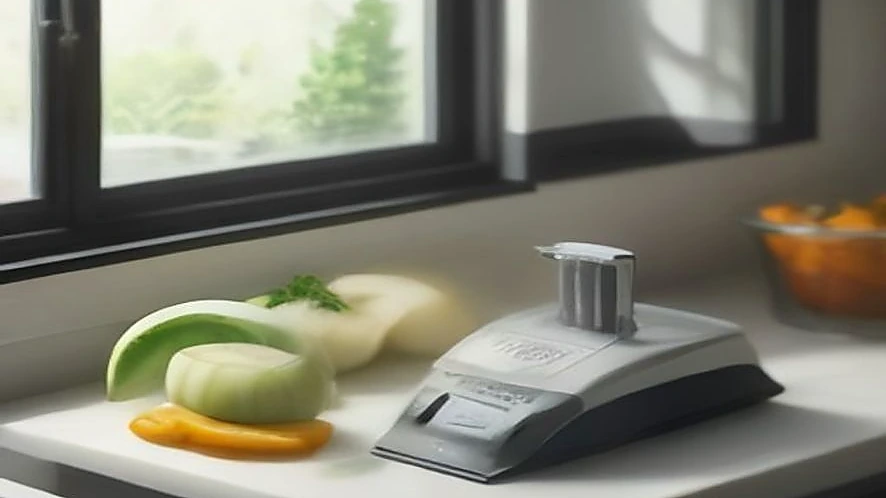
Mandoline slicers and food processors often get lumped together as interchangeable kitchen tools for cutting vegetables. While they both can slice, the methods they use and the results they produce are quite different. Understanding these differences helps avoid frustration when a recipe calls for thin, uniform slices or quick chopping.
Some links in this post are affiliate links. If you buy through them we may earn a small commission at no extra cost to you — it never changes which products we recommend.
Mandolines rely on manual operation with an adjustable blade set on a sloped surface, while food processors use motor-driven blades and multiple attachments. This fundamental distinction affects precision, speed, volume capacity, and the types of cuts possible, making each better suited to different kitchen tasks.
Where each one wins
Mandoline slicers excel when precise, thin, and uniform slices are essential. Tasks like making potato chips, slicing cucumbers for salads, or preparing vegetables that cook evenly benefit from the control a mandoline offers. The mechanical simplicity means no electricity, less noise, and straightforward cleanup.
Food processors shine when speed and versatility are priorities. Preparing large quantities of vegetables for stews, chopping nuts, shredding cheese, or making dough is easier with a food processor. The motor-driven blades reduce manual effort, but the trade-off is less control over slice thickness and shape, often producing less delicate results.
Diving deeper into the mechanics, a mandoline slicer operates on a simple principle: the vegetable is slid manually across a fixed, sharp blade set at a precise angle. The blade’s height can be adjusted, typically from about 0.5 mm to 3 mm, allowing for thin slices that are uniform and consistent. This precision is crucial for recipes where cooking times depend on even thickness, such as gratins or chips. The slicing speed depends entirely on the user’s hand speed and dexterity, which means it can be slower for large volumes but offers unparalleled control.
In contrast, a food processor uses a powerful electric motor to spin blades or discs rapidly, typically at speeds ranging from 800 to 1200 RPM. The rotating blades can chop, slice, shred, or puree depending on the attachment used. While this motorized action allows processing large batches—up to 14 cups in popular models like the Cuisinart 14-Cup Food Processor—in under two minutes, the slicing precision is less exact. Thickness depends on the disc selected and processing time; over-processing can lead to uneven or mashed results. The versatility extends beyond slicing to kneading dough, chopping nuts, and even emulsifying sauces, making it a multifunctional kitchen assistant.
The consequences of these differences impact kitchen workflow significantly. For example, when preparing a delicate salad requiring paper-thin radish slices, a mandoline ensures uniformity and presentation quality, albeit at a slower pace and with higher safety precautions due to exposed blades. On the other hand, when making a vegetable stew for a large family, a food processor can chop ingredients quickly and efficiently, saving time but sacrificing slice uniformity. Moreover, the cleanup time for food processors is longer due to multiple parts, including blades and bowls, whereas mandolines have fewer components but require careful handling to avoid injuries.
Speed and capacity are also critical factors. A mandoline’s manual operation means fatigue can set in when slicing large quantities, limiting its practicality for big batches. In contrast, food processors can handle large volumes effortlessly, processing up to several kilograms of vegetables in minutes. However, this speed comes with increased noise levels and electricity use, which may be considerations in certain kitchen environments.
From a safety perspective, mandolines require careful attention. The sharp, exposed blades pose a risk of cuts, especially when slicing small or irregularly shaped items. Most models include hand guards or holders, which should always be used. Food processors, while safer in blade exposure due to enclosed design, require caution during assembly and cleaning to avoid blade injuries.
In summary, the mandoline slicer’s strength lies in precision slicing with manual control, ideal for tasks demanding uniform thin slices, while the food processor excels in speed and versatility, suitable for bulk processing and multiple kitchen functions. Understanding these mechanisms and their practical consequences helps cooks choose the right tool for each culinary task.
User experience and practical considerations
Once, I needed thin, even slices of radish for a Korean-style salad. I started with the food processor using the slicing disc, but the slices came out uneven, some too thick and others shredded. Switching to the Benriner mandoline, I adjusted the blade to 1 mm thickness and carefully slid each radish over the blade. The slices were nearly identical, which made the salad look and cook exactly as intended. It took longer, but the precision was worth it for this dish.
This experience highlights the trade-off between speed and precision. While the food processor is a time-saving powerhouse for many tasks, it can struggle with delicate slicing that demands uniformity. The mandoline, though slower and requiring more manual effort, delivers consistent results that can elevate the quality of dishes where appearance and texture matter.
Cleaning and maintenance also affect user experience. The mandoline’s simple design means fewer parts to wash, but the sharp blades require careful handling to avoid injury. Food processors come with multiple detachable parts — bowls, lids, blades, discs — which can be dishwasher safe but take longer to clean and dry. Storage space is another consideration; mandolines are slim and easy to store, whereas food processors are bulkier and require more kitchen real estate.
Another practical aspect is noise. Mandolines operate silently, a benefit when working in quiet environments or early mornings. Food processors generate significant noise during operation, which might be disruptive in some settings.
In terms of durability, mandolines, especially high-quality models like the Benriner, can last for many years with minimal maintenance due to their simple mechanical construction. Food processors have more complex motors and electronic components that may require servicing or replacement over time.
Overall, the choice between a mandoline and a food processor depends on the cook’s priorities: precision and uniformity versus speed and multifunctionality. For professional chefs or enthusiasts focusing on presentation and texture, the mandoline’s precise slicing is invaluable. For busy home cooks or those preparing large meals, the food processor’s versatility and speed often outweigh the drawbacks.
To maximize kitchen efficiency, some cooks keep both tools on hand, using the mandoline for tasks requiring delicate slicing and the food processor for bulk chopping, shredding, and dough preparation. Understanding the strengths and limitations of each tool allows better planning and execution of recipes, reducing frustration and improving culinary results.
| Attribute | Benriner Japanese Mandoline Slicer | Cuisinart 14-Cup Food Processor |
|---|---|---|
| Cutting method | Manual slicing over a fixed angled blade | Motor-driven rotating blades with interchangeable discs |
| Thickness control | Adjustable between approximately 0.5 mm to 3 mm manually | Disc options control thickness; less precise, varies by processing time |
| Speed | Depends on user speed; slower for large volumes | Processes large batches quickly, typically under 1-2 minutes |
| Uniformity of slices | High uniformity due to fixed blade and manual control | Variable uniformity; longer processing can over-shred or unevenly slice |
| Versatility | Limited to slicing and julienne with included blades | Can chop, dice, shred, puree, knead dough with multiple attachments |
| Cleaning and storage | Simple parts; easy to clean but blades are exposed and require careful handling | Multiple parts; more time to clean and larger storage footprint |
From my kitchen
Once, I needed thin, even slices of radish for a Korean-style salad. I started with the food processor using the slicing disc, but the slices came out uneven, some too thick and others shredded. Switching to the Benriner mandoline, I adjusted the blade to 1 mm thickness and carefully slid each radish over the blade. The slices were nearly identical, which made the salad look and cook exactly as intended. It took longer, but the precision was worth it for this dish.
Worth Considering
Best for precision slicing: Benriner Japanese Mandoline Slicer

The Benriner mandoline offers fine control over slice thickness with four stainless steel blades, suitable for vegetables that benefit from uniform slices. It is not ideal for large quantities or complex chopping tasks due to manual effort and limited blade options.
Brand: Benriner
Pros
- Adjustable blade with increments from about 0.5 mm to 3 mm
- Four stainless steel blades including julienne options
- BPA-free components and simple design for easy cleaning
Cons
- Manual slicing requires physical effort and attention to safety
- Limited to slicing and julienne cuts; no chopping or pureeing
Best for versatility and volume: Cuisinart 14-Cup Food Processor

The Cuisinart food processor handles multiple kitchen tasks beyond slicing, including chopping, shredding, kneading, and pureeing. It suits cooks who need to process large amounts quickly but yields less uniform slices and requires more cleanup.
Brand: Cuisinart
Pros
- Large 14-cup capacity for batch processing
- Multiple functions including mincing, shredding, and dough kneading
- Powerful motor reduces manual labour
Cons
- Less precise slicing; thickness can vary
- More parts to clean and store
When neither a mandoline nor a food processor is the right choice
For some tasks, such as finely chopping herbs or dicing small amounts of vegetables for fresh salsa, a sharp chef’s knife or specialised tools like herb scissors may be preferable. Mandolines are too bulky and risky for small items, while food processors can over-process and bruise delicate ingredients. Also, for ultra-thin slices like paper-thin prosciutto or shaving truffles, a flexible slicing knife is more suitable. Neither a mandoline nor a food processor handles these with the subtlety and control required.
Frequently Asked Questions
Can a food processor replace a mandoline slicer for all slicing tasks?
No, a food processor cannot fully replace a mandoline for slicing. While it can slice vegetables using specific discs, the manual control and fixed blade angle of a mandoline provide more consistent, uniform slices, especially thin ones. Food processors tend to produce less even slices and can crush or shred delicate vegetables if processed too long.
Is it safe to use a mandoline slicer without a hand guard?
Using a mandoline without a hand guard is risky because the blade is exposed and extremely sharp. The risk of cutting your fingers is significant, especially when slicing small or irregularly shaped items. Most mandolines, including the Benriner, come with a hand guard or holder to protect your fingers and improve grip. Always use it for safety.
How do I clean a food processor properly after slicing vegetables?
To clean a food processor, first unplug it and disassemble the bowl, lid, and blade or discs carefully. Rinse off large food particles under running water. Wash all removable parts with warm soapy water or in a dishwasher if manufacturer instructions allow. Be cautious handling blades as they remain sharp. Wipe the motor base with a damp cloth; never immerse it in water.

Rimi Sultana is a home cook from Bangladesh who has cooked for her family every day for the past five years and writes about it at Smart Cooks. Perpetually testing whether internet-famous recipes actually work in a regular home kitchen. Say hello on Facebook or through the contact page.