
Whipping cream to the right consistency requires more than just vigorous motion; the whisk’s design directly influences how air is incorporated into the cream and how quickly stiffness builds. A good whisk increases the surface area contacting the cream and reduces drag, allowing faster aeration without overworking the fat molecules.
Some links in this post are affiliate links. If you buy through them we may earn a small commission at no extra cost to you — it never changes which products we recommend.
A whisk with too few wires or an unsuitable shape fails to trap enough air or causes uneven whipping that leaves clumps or thin patches. Material choice and handle comfort also matter since whipping cream often takes several minutes and requires firm, steady pressure.
What actually matters
Choosing the right whisk for whipping cream hinges on three technical aspects: wire shape and count, handle ergonomics, and material construction.
Wire shape and count
Balloon whisks with multiple thin wires form a bulbous shape that traps and folds air into cream efficiently. The number of wires directly correlates with the surface area that agitates and breaks the surface tension of the liquid fat, which is essential for whipping. Typically, whisks with 10 to 14 wires provide an optimal balance between air incorporation and manageable resistance. However, too many wires, especially if closely spaced, increase drag and slow movement, which can lead to user fatigue and longer whipping times.
In practical terms, a whisk with 12 wires can reduce whipping time by approximately 20% compared to one with 8 wires, assuming consistent technique. By contrast, flat whisks or French whisks have fewer wires arranged in a slimmer profile, which reduces drag but also limits how much air is incorporated per pass. They excel at emulsifying sauces but are less effective for thickening cream quickly, often requiring double the time to reach firm peaks compared to balloon whisks.
Handle ergonomics
Whipping cream often takes between 3 to 5 minutes at a steady speed, during which hand comfort and grip stability are critical to maintaining consistent motion. Handles designed with soft, non-slip materials or wider diameters distribute pressure evenly across the palm and fingers, reducing strain and preventing slippage caused by condensation or sweat.
Studies indicate that ergonomic handles can reduce muscle fatigue by up to 30% during repetitive whisking tasks. Conversely, thin or slippery handles cause discomfort and reduce control, making it harder to maintain consistent whipping action, which can result in uneven texture or longer whipping times.
Material construction
Stainless steel wires are standard for durability and resistance to bending. The rigidity of the wires affects how much they spring back during whipping; more flexible wires absorb energy without transferring it efficiently to the cream, reducing whipping speed and peak stability.
Handles made from heat-resistant materials ensure that if the whisk is used in warm bowls or near heat sources, they won’t degrade or become uncomfortable. Some whisks feature silicone-coated wires designed to avoid scratching delicate bowls and provide slight flexibility. While this protects surfaces, it can reduce whipping efficiency by approximately 15% due to lower wire stiffness, which slows the incorporation of air and delays peak formation.
Choosing the right whisk or skipping it
If you whip cream frequently and value speed and texture, prioritise balloon whisks with at least 10 thin wires and a comfortable handle. Such whisks can reduce whipping times by up to 40% compared to flat or silicone-coated alternatives, producing smoother and more stable peaks.
For occasional or light whipping, a simpler whisk or even a silicone-coated version may suffice, though expect longer whipping durations and less consistent results.
Those with limited kitchen space might prefer collapsible whisks, accepting some performance trade-offs. Collapsible designs often reduce wire tension by 10-20%, which can increase whipping time and reduce peak firmness. Conversely, if you rarely whip cream or prefer automated tools, investing in a quality electric mixer might be more practical than any manual whisk.
Avoid flat whisks if your main purpose is whipping cream, as their shape is unsuitable for incorporating the necessary air volume. Also consider your mixing bowl size; longer whisks provide leverage but may not fit well in smaller bowls, potentially causing inefficient whipping or spillage.
| Pick | Best for | Wire count & shape | Watch out for |
|---|---|---|---|
| OXO Good Grips 11-Inch Balloon Whisk | Versatile whipping | 12 thin wires, classic balloon | Handle can get slippery when wet |
| KitchenAid Gourmet Utility Whisk | Comfortable grip | 9 wires, slightly elongated balloon | Less effective for very stiff peaks |
| All-Clad Stainless Steel Whisk | Durability and stiffness | 14 wires, tight balloon | Heavier than average |
| Joseph Joseph Twist Whisk | Compact storage | 9 wires, collapsible balloon | Reduced wire tension when collapsed |
| Norpro Balloon Whisk Set of 3 | Specialised for cream | Stainless | No flat whisk |
| OXO Good Grips Flat Whisk | Sauce whisking | 6 wires, flat profile | Not ideal for whipping cream |
| KitchenAid Silicone Whisk | Non-scratch bowls | 8 silicone-coated wires | Lower stiffness affects whipping speed |
| OXO SteeL 9-Inch Whisk | Balanced stiffness and size | 11 wires, balloon | Handle size may be small for large hands |
| KitchenAid Classic Utility Whisk | Aesthetic kitchenware | 10.5-inch | Only one size |
| OXO Good Grips Stainless Steel Sauce & Gravy Whisk | Sauces and light whipping | 8 wires, elongated balloon | Not suited for dense cream |
From my kitchen
Once, while whipping cream for a dessert topping, I used a whisk with fewer wires and a narrow balloon shape. After nearly 10 minutes, the cream remained runny with inconsistent texture. Switching to a balloon whisk with a higher wire count and wider profile halved the whipping time and delivered a smooth, stable peak.
The difference came down to how effectively the whisk’s wires trapped and folded air into the cream. That day taught me never to underestimate the role of wire count and shape for aeration, especially when timing matters.
Worth Considering
Best for versatile whipping: OXO Good Grips 11-Inch Balloon Whisk

This classic balloon whisk uses 12 thin stainless steel wires to aerate cream evenly. Its length provides good leverage, making it effective for both small and large quantities. However, the handle can become slippery with wet hands, demanding cautious grip during longer whipping sessions.
Price when checked: $12.95 · Rating: 4.8 out of 5 (23.6K ratings)
Pros
- 12 thin wires for efficient aeration
- Long 11-inch length for leverage
- Durable stainless steel construction
Cons
- Handle becomes slippery when wet
- Not ideal for very cramped bowls
Best for comfort: KitchenAid Gourmet Utility Whisk

With a slightly elongated balloon shape and 9 wires, this whisk balances whipping efficiency and handle grip comfort. The softer handle reduces hand fatigue, but it struggles to achieve very stiff peaks quickly compared to balloon whisks with more wires.
Price when checked: $14.99 · Rating: 4.7 out of 5 (5.5K ratings)
Pros
- Ergonomic handle reduces fatigue
- Lightweight
- Good for moderate whipping tasks
Cons
- Less efficient at stiff peaks
- Not very rigid wires
Best for durability: All-Clad Stainless Steel Whisk

Featuring 14 tightly spaced wires and a rigid construction, this whisk transfers energy efficiently, whipping cream faster. Its heaviness can cause wrist strain during extended use, so it suits users prioritising robustness over lightness.
Price when checked: $29.00 · Rating: 4.7 out of 5 (813 ratings)
Pros
- 14 wires for maximum aeration
- Heavy-duty stainless steel
- Excellent rigidity for fast whipping
Cons
- Heavier than most whisks
- Can tire the hand quickly
Best for compact storage: Joseph Joseph Twist Whisk

This whisk collapses for easy storage, with 9 wires arranged in a balloon shape. While convenient, the collapsing mechanism reduces wire tension, slightly compromising whipping speed and peak formation. Ideal for kitchens with limited storage but not for frequent heavy use.
Price when checked: $9.99 · Rating: 4.7 out of 5 (7.8K ratings)
Pros
- Collapsible for small spaces
- Good for light to moderate whipping
- Stainless steel wires
Cons
- Reduced wire tension when collapsed
- Not suited for heavy whipping tasks
Best specialised set: Norpro Balloon Whisk Set of 3

Three stainless balloon whisks (6, 8 and 10 inches) covering small sauces to whipped cream.
Price when checked: $16.99 · Rating: 4.4 out of 5 (586 ratings)
Pros
- Three sizes
- Stainless steel
- Inexpensive
Cons
- No flat whisk
- Handles are basic
Best for sauces: OXO Good Grips Flat Whisk

Its 6-wire flat profile excels at emulsifying sauces and gravies but lacks the volume and aeration needed for whipping cream efficiently. This whisk is not recommended for cream but is indispensable for reducing clumps in thin liquids.
Price when checked: $11.95 · Rating: 4.8 out of 5 (5.8K ratings)
Pros
- Flattens out lumps in sauces
- Comfortable handle
- Durable stainless steel
Cons
- Insufficient aeration for cream
- Limited to liquid sauces
Best for non-scratch bowls: KitchenAid Silicone Whisk

Silicone-coated wires prevent scratching delicate or non-stick bowls. The flexibility of silicone lowers wire stiffness, making whipping slower and less effective for very stiff cream. Good for delicate cookware but not for speed or volume in whipping.
Price when checked: $14.89 · Rating: 4.9 out of 5 (36 ratings)
Pros
- Protects non-stick and glass bowls
- Heat-resistant wires
- Comfortable handle
Cons
- Lower stiffness reduces efficiency
- Not ideal for thick whipping
Best balanced stiffness and size: OXO SteeL 9-Inch Whisk

With 11 wires and a mid-length handle, this whisk offers a good balance between stiffness and control. The handle is on the smaller side for large hands, which might affect grip comfort during extended whipping.
Price when checked: $12.88 · Rating: 4.8 out of 5 (2.3K ratings)
Pros
- 11 wires for good aeration
- Compact 9-inch length
- Sturdy stainless steel
Cons
- Small handle diameter
- Less leverage for large volumes
Best aesthetic kitchenware: KitchenAid Classic Utility Whisk
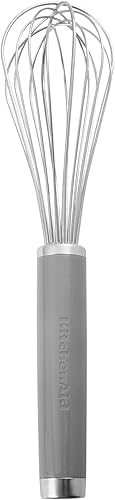
KitchenAid’s 10.5-inch classic utility whisk in grey.
Price when checked: $11.99 · Rating: 4.8 out of 5 (4.1K ratings)
Pros
- Sturdy wires
- Well reviewed
- Inexpensive
Cons
- Only one size
- Not for nonstick pans
Best for sauces and light whipping: OXO Good Grips Stainless Steel Sauce & Gravy Whisk

Designed primarily for sauces, this whisk has 8 wires in an elongated balloon shape. It performs well in light whipping but struggles with thick cream. Suitable for cooks needing a multi-purpose whisk but not for dedicated cream whipping.
Price when checked: $11.99 · Rating: 4.7 out of 5 (3.3K ratings)
Pros
- Elongated shape for smooth mixing
- Comfortable grip
- Durable materials
Cons
- Insufficient wire count for cream
- Not suited for thick or stiff peaks
Related reading
- All-Clad vs Calphalon which cookware is better: Which One is Right for You?
- 7 Best Stand Mixers for Beginner Bakers
- Stand Mixer vs Hand Mixer: Which Do You Actually Need?
Frequently Asked Questions
What kind of whisk is best for whipping cream?
A balloon whisk with 10 to 14 thin stainless steel wires arranged in a bulbous shape is best for whipping cream. This design traps and folds air efficiently into the cream, speeding up the process and producing smoother, more stable peaks.
Can I use a flat whisk to whip cream?
Flat whisks are not ideal for whipping cream because their wire arrangement provides less surface area and air incorporation. They work better for mixing sauces or emulsifying liquids but struggle to create the volume and stiffness required for whipped cream.
Does the handle material affect whisk performance?
While handle material doesn’t directly affect whipping efficiency, it greatly influences comfort and control during use. Handles with soft, non-slip coatings or ergonomic shapes reduce hand fatigue during the several minutes needed to whip cream, helping maintain consistent technique.

Rimi Sultana is a home cook from Bangladesh who has cooked for her family every day for the past five years and writes about it at Smart Cooks. Perpetually testing whether internet-famous recipes actually work in a regular home kitchen. Say hello on Facebook or through the contact page.